Setting intentions can be a beautiful practice, but it can also become another way to pressure yourself. Many people are taught to treat intention-setting like a performance: choose the perfect words, stay positive at all times, and expect immediate transformation. When it does not feel good, they assume they are doing it wrong.
A more supportive approach begins somewhere gentler. An intention is not a demand you place on your life. It is not a test of your spiritual worth, and it is not a contract that says you must become someone else before you are allowed to feel steady, connected, or whole. A true intention is a relationship. It helps you listen more closely to your own energy, recognize what you actually need, and move in a direction that feels aligned instead of forced.
When intentions really support you, they do not come from self-criticism. They come from honesty. They sound less like “I need to fix myself” and more like “I want to meet this season of my life with care.” They are spacious enough to evolve. They leave room for your humanity. And rather than dragging you toward a version of success that looks good from the outside, they bring you back into connection with what feels nourishing, steady, and real on the inside.
Spiritual Context
At its heart, intention-setting is an energetic practice of conscious orientation. It asks: where am I placing my attention, my care, and my life force right now? This is what makes intention different from a goal. A goal is often external and measurable. An intention is internal and relational. It shapes the way you move through your day, the meaning you give your choices, and the energy you return to when life feels noisy.
Intentions become unsupportive when they are rooted in fear, perfectionism, or urgency. You can often feel this in the body right away. A harsh intention creates contraction. It makes you feel monitored. It may sound polished on paper, but your nervous system does not trust it. Supportive intentions feel different. Even when they invite growth, they also create space. They help your body soften instead of brace.
This is why it is so important to ask not only what you want, but how you want to feel while moving toward it. Do you want more clarity, more courage, more rest, more discernment, more trust? A grounded intention brings you into a relationship with the quality of energy you want to cultivate, rather than trapping you in a rigid outcome.
There is also wisdom in remembering that your intentions do not have to be impressive. They do not have to sound spiritual enough, ambitious enough, or poetic enough. A deeply supportive intention can be simple: I want to respond to myself with patience. I want to trust my pace. I want to make room for peace in my home. I want to stop abandoning what I know is true.
The more honest the intention, the more powerful it becomes.
Crystal Support
Crystals can support intention-setting by helping you create a clear energetic atmosphere around the practice. They do not replace discernment, action, or inner listening, but they can serve as anchors. A crystal placed on your altar, held in meditation, or kept near your journal becomes a tactile reminder of what you are choosing to embody. It gives your intention a physical point of return.
When working with crystals for intentions, it helps to choose stones that support different layers of the process. Some assist with clarity. Some encourage compassion. Some ground scattered energy. Some protect your space so your intention can develop without being constantly interrupted by outside noise.
| Crystal | Why it supports this topic | Best for |
|---|---|---|
| Clear Quartz | Amplifies awareness and helps clarify what you are truly asking for | Clear intentions and focused journaling |
| Amethyst | Encourages spiritual perspective, calm, and inner honesty | Releasing pressure and listening inward |
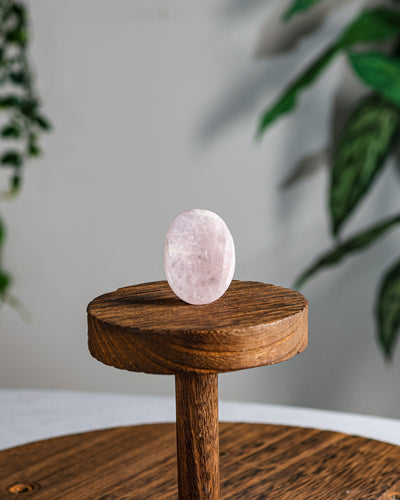
| Rose Quartz | Softens self-judgment and supports intentions rooted in care | Self-worth, gentleness, and emotional healing |
| Smoky Quartz | Grounds lofty ideas into practical energy and steadies overwhelm | Staying rooted while making changes |
| Moonstone | Supports intuition, inner cycles, and trust in unfolding timing | Intentions connected to emotional growth and new phases |
| Carnelian | Brings life force, courage, and momentum without forcing | Acting on supportive intentions with confidence |
| Lepidolite | Helps regulate emotional intensity and encourages soothing habits | Intentions around peace, rest, and nervous system support |
You do not need all of these at once. In many cases, one or two stones are enough. The point is not to build a perfect collection. The point is to create a relationship with support that feels meaningful and sustainable.
Practical Guidance for Supportive Intention-Setting
A supportive intention usually begins with listening, not declaring. Before writing anything down, pause and notice your current state. What feels tender right now? What feels overextended? What have you been craving more of? What are you tired of pretending is fine? These questions help you move past surface-level answers and toward something real.
It can also help to notice the difference between an intention that comes from your center and one that comes from your conditioning. Conditioned intentions often sound like they were inherited from pressure: be more productive, be more pleasing, be more impressive, do more, prove more. Centered intentions tend to carry a different texture. They may be quieter, but they land more deeply: protect my peace, trust my own timing, speak with honesty, create from fullness, tend my energy before giving it away.
Another way to make intentions more supportive is to choose language that invites relationship instead of control. Rather than saying, “I will never be anxious again,” you might say, “I intend to meet anxious moments with more steadiness and compassion.” Rather than saying, “I will fix everything this month,” you might say, “I intend to give my energy to what truly matters.” The second kind of language is not weaker. It is more realistic, more embodied, and far more sustainable.
Intentions also benefit from specificity. Not rigid specificity, but lived specificity. Ask yourself how your intention wants to exist in daily life. If your intention is peace, does that look like five minutes of silence in the morning? A cleaner bedside table? Fewer commitments? More boundaries around your phone? A supportive intention should have roots you can actually water.
Simple Rituals for Working with Intentions
Morning Centering Practice
Begin the day with one hand over the heart and one over the lower belly. Take a few slow breaths and let your body arrive before your mind starts organizing the day. Hold a piece of Clear Quartz or Amethyst if you like, and ask: what energy would truly support me today?
Let the answer be simple. Perhaps it is patience, courage, clarity, softness, or trust. Write one sentence in your journal beginning with “Today I intend to…” Keep it honest and reachable. Then choose one small action that reflects it. This practice teaches your energy that intention is not an abstract concept. It is something you are willing to live.
Intention Bowl for the Home
Create a small space in your home where your current intention can rest. This could be a bowl, tray, or altar with a candle, a folded note, and one or two crystals such as Rose Quartz, Moonstone, or Smoky Quartz. Keep it somewhere visible but calm.
Each time you pass by, pause for a breath and mentally return to your chosen energy. This kind of repetition matters. It gently retrains attention. Instead of setting an intention once and forgetting it, you create a home-based rhythm that helps the intention remain active in your field.
Full-Body Check-In Before Committing
Before saying yes to a request, opportunity, or plan, pause and check your body. Hold Lepidolite or Smoky Quartz if that helps you ground. Ask yourself: does this support the intention I am living right now?
This practice is especially powerful because it moves intention-setting out of the journal and into discernment. An intention becomes real when it helps you choose differently. It may guide you toward rest instead of overextension, truth instead of politeness, or consistency instead of intensity.
Release and Rewrite Ritual
Sometimes the most supportive intention begins with admitting that your old one no longer fits. On a small piece of paper, write the energy pattern you are ready to release: rushing, proving, pleasing, overcommitting, numbing, doubting. Sit with Amethyst or Rose Quartz and thank that pattern for what it once tried to protect.
Then write a new intention that reflects where you are now. For example: I release the need to earn rest. I intend to honor my natural rhythm. Keep the new statement on your altar, in your planner, or under a crystal overnight as a symbol of energetic commitment.
Mythic and Inner History of Intention
Across many spiritual traditions, focused attention has long been understood as a shaping force. Prayer, blessing, ritual language, vow-making, and devotional practice all reflect a shared understanding: what we repeatedly offer our awareness to begins to influence how we live. Intention-setting is one contemporary expression of that ancient truth.
But many older traditions also carried an important balance that is worth remembering now. Intention was rarely treated as pure personal control. It was relationship with spirit, with mystery, with nature, with the soul, with community, with the unseen order of life. In other words, intention was not only about deciding what should happen. It was also about listening for right relationship.
This perspective can soften the pressure modern people often put on themselves. You do not have to force reality into shape through perfect thoughts. You are allowed to co-create. You are allowed to set an intention and also remain teachable. You are allowed to say, “This is what I am moving toward,” while also trusting that deeper wisdom may refine the path.
Related Crystals
As your intention-setting practice deepens, you may also feel drawn to complementary stones that support clarity, protection, and emotional balance in different ways. These crystals can round out the energetic container without replacing the simpler tools that already work for you.
Final Reflection
The most supportive intentions are not the most dramatic ones. They are the ones that help you come back to yourself.
They help you notice where your energy has been scattered, where your choices have drifted away from your values, and where you are ready to live with more care and honesty. They do not ask you to become perfect. They ask you to become present. They remind you that your energy deserves collaboration, not criticism.
If you are rebuilding your relationship with intention-setting, begin simply. Choose one true sentence. Choose one crystal that helps you remember it. Choose one small action that brings the energy into form. Let the practice be warm, steady, and humane.
Over time, that is what creates change you can actually live with. Not pressure. Not performance. Just a sincere return to what supports your spirit.