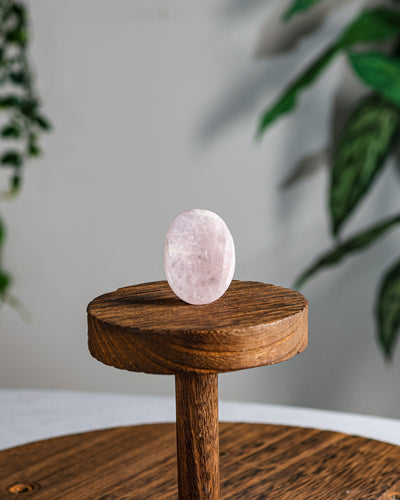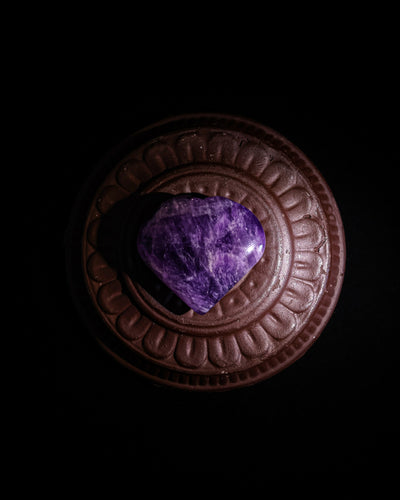
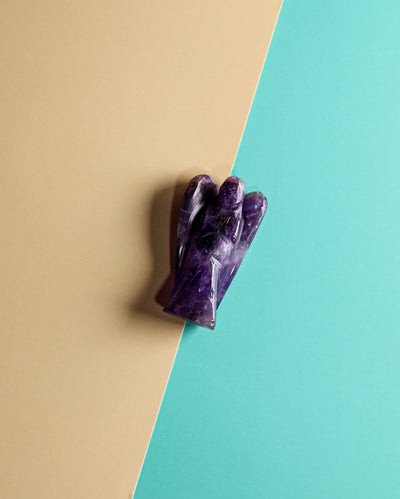
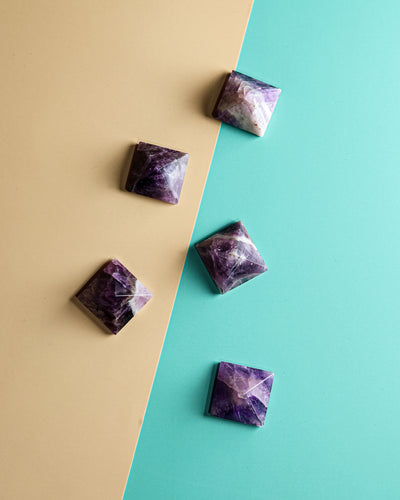
When your mind keeps running long after the day is done, amethyst offers a different kind of help: not more effort, but more quiet. This violet quartz has been kept close for centuries as a stone of calm and stress relief, easing the mental noise so intuition and clarity have room to come through. Set one on your nightstand or hold it through a few slow breaths, and the pace inside your head begins to match the stillness of the stone.
Key Traits
- Quiets a racing, looping, or overactive mind
- Opens intuition so decisions feel clearer
- Holds a calm, protective boundary around your space
- Deepens meditation and supports restful, dream-rich sleep
- Long carried to loosen old habits and attachments
Intentions
Brief Overview
Amethyst is the purple variety of quartz and one of the most widely loved crystals in the world. The ancient Greeks named it for sobriety, medieval soldiers carried it for a steady head, and meditators today keep it close to settle mental chatter. Its lasting appeal comes from one quality: it lowers the noise without dulling awareness, leaving room for clear thought and deeper rest.
Properties
Amethyst calms what is agitated and clears what is clouded. It is said to relax or stimulate the mind as needed, gathering scattered thoughts into focus and helping you connect cause with effect. It tempers compulsive impulses, eases the tension worry leaves behind, and brings common sense and intuition together so your choices feel both sound and true.
Metaphysical Properties
- Transmutes tense or heavy energy into calm
- Stimulates the Throat, Third Eye, and Crown for insight and honest expression
- Shields against psychic and environmental overwhelm
- Traditionally carried for sobriety and for releasing old patterns
- Encourages intuitive dreams and easier dream recall
Physical Properties
- Type: Purple variety of macrocrystalline quartz
- Color: Pale lavender to deep violet-purple
- Luster: Vitreous (glassy)
- Structure: Trigonal crystal system
Meaning & Energy
Amethyst's energy is steady serenity. Instead of pushing you forward, it turns the volume down, transmuting restless or heavy feeling into something centered and still. In that stillness the quieter, wiser part of the mind can finally be heard, which is why amethyst has long been the meditator's stone and is often placed on the third eye during practice.
Emotions
When your thoughts spin and rest won't come, amethyst helps you find solid ground again. It is traditionally used to ease worry, cool anger and fear, and soften grief so loss can be accepted rather than resisted. As it calms you, it also helps you feel more collected and more in charge of your own mind, so you can meet your feelings with steadiness instead of being carried off by them.
Crystal Pairings
- Clear Quartz – amplifies amethyst's clarity and intuitive focus
- Selenite – cleanses and recharges amethyst while deepening crown connection
- Rose Quartz – softens amethyst's calm with tender, heart-centered comfort
- Citrine – balances serenity with warmth, optimism, and opportunity
Science & Origin
Amethyst is silicon dioxide, the purple variety of quartz, colored by trace iron altered by natural irradiation within the earth. It grows slowly in gas cavities of volcanic rock, often lining geodes with dense clusters of pointed crystals. Heat turns most amethyst yellow to orange, and because natural citrine is comparatively rare, much of the citrine on the market began as heat-treated amethyst.
- Also Known As: Purple Quartz
- Formation: Crystallizes slowly from silica-rich fluids in volcanic cavities and geodes
- First Discovery: Known since antiquity; ancient Egyptians mined it at Wadi el-Hudi during the Middle Kingdom, around 2000 BCE
- Safety Note: Prolonged direct sunlight can fade the color and strong heat can permanently change it; cleanse briefly with cool water and avoid harsh chemicals
Ancient Myths
- In 1576 the French poet Rémy Belleau wrote the legend most people know today: the maiden Amethyste is turned to clear stone to escape Bacchus, and the god, in remorse, pours wine over the crystal and stains it violet.
- The Greek name amethystos means "not intoxicated," and drinking vessels were carved from the stone in the belief that it kept the drinker clear-headed.
- Medieval European soldiers carried amethyst amulets into battle for protection and a cool head, and bishops wore amethyst rings as a sign of piety and sober judgment.
Chakras Table
| Chakra | Connection | Healing Focus | Energy Type |
|---|---|---|---|
| Throat | Tertiary: steadies honest, calm communication | Truthful expression, steady speech | Purifying |
| Third Eye | Secondary: opens inner sight and intuition | Clarity, insight, focus | Perceptive |
| Crown | Primary: links everyday awareness to higher calm | Peace, spiritual connection | Elevating |
Planets Table
| Planet | Influence | Energy |
|---|---|---|
| Jupiter | Wisdom, expansion, higher understanding | Expansive |
| Neptune | Intuition, dreams, spiritual sensitivity | Receptive |
Zodiacs Table
| Zodiac | Attribute | Benefit |
|---|---|---|
| Aries | Bold and quick to act | Tempers impulsiveness with calm, clear-headed restraint |
| Sagittarius | Adventurous and freedom-seeking | Grounds restless enthusiasm in calm, sound judgment |
| Aquarius | Visionary and independent | Deepens insight and inner steadiness |
| Pisces | Sensitive and intuitive | Protects and clears the empathic mind |
Elements Table
| Element | Power | Aspect |
|---|---|---|
| Water | Emotional flow and intuition | Soothing and reflective |
| Air | Mental clarity and perspective | Clear and lifting |
Sacred Numbers Table
| Number | Vibration | Meaning |
|---|---|---|
| 3 | Harmony and expression | Balance of mind, body, and spirit |
Color Variations
- Pale lavender: soft, gentle purple favored for everyday calm and bedside use
- Deep violet: rich, saturated purple prized for meditation and intuitive work
- Deep Siberian: the top trade grade, deep purple with red and blue flashes
- Chevron amethyst: banded with white quartz and long favored for third eye work
Mohs Scale Hardness
Amethyst rates 7 on the Mohs scale, the same as all quartz. It is durable enough for everyday jewelry and handling, but harder stones such as topaz, sapphire, and diamond can scratch it, so store it separately to keep its polish bright.
Chemical Formula
Amethyst is silicon dioxide, with the chemical formula SiO2.
- Silicon (Si): the structural backbone of the crystal lattice
- Oxygen (O): bonds with silicon to form the quartz framework
- Iron (Fe): trace impurity that, with natural irradiation, produces the purple color
Summary of Composition
- Mineral Class: Silicate (quartz group)
- Crystal System: Trigonal
- Transparency: Transparent to translucent
- Luster: Vitreous
Care Instructions
- Keep amethyst out of prolonged direct sunlight and away from strong heat to protect its color
- Cleanse briefly under cool running water, then pat dry
- Recharge on a selenite plate or under moonlight
- Store apart from harder stones to prevent scratches
Final Summary
Amethyst asks only that you slow down. It meets a restless mind with calm, opens a clearer line to your own intuition, and keeps a quiet, protective field around the space it shares with you. Keep one within reach, and stillness stops feeling so far away.