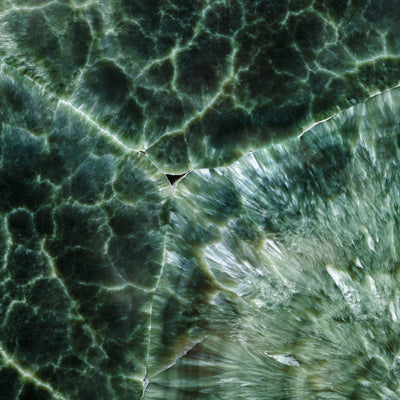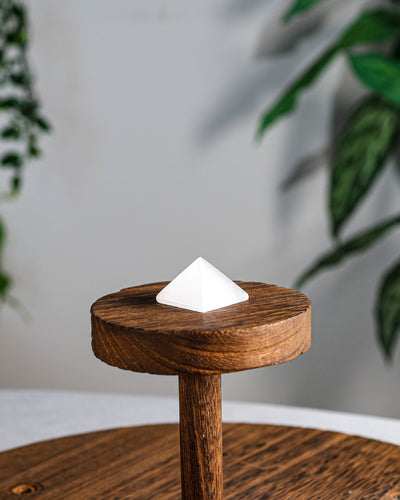

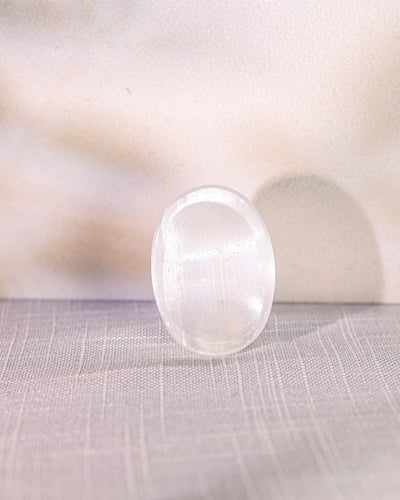
Some days the mind will not go quiet, the to-do list loops, and the room itself seems to hold the residue of everything that happened in it. Selenite is the stone that meets that noise. Pale and translucent, it works like a shaft of moonlight moving through the clutter, and it has long been reached for when someone needs intuition and clarity or simply a return to calm and stress relief. Hold a piece and the first thing you notice is how still it asks you to become.
Key Traits
- Translucent, moon-pale gypsum with a soft satin or pearly sheen
- Prized for clearing mental confusion and settling scattered thoughts
- A quiet meditation stone that invites deep, unhurried calm
- Traditionally used to cleanse a space and other crystals
- Very soft and water-soluble, so it asks to be handled with care
Intentions
Brief Overview
Selenite is a crystalline form of gypsum named for Selene, the Greek goddess of the Moon, a fitting namesake for a stone that glows with such cool, quiet light. It grows as clear, glassy blades and twinned fishtails, and its gypsum relatives, silky satin spar and sand-grown desert rose, are sold under the same name. Across cultures it has been treated as a stone that sits between light and matter, used for meditation, for reading a situation clearly, and for keeping a home feeling peaceful and undisturbed.
Properties
Selenite works on the mind and the atmosphere around you. It is reached for to lift confusion, to help you see the larger shape of a problem rather than its tangled details, and to steady emotions that have been running erratic. It is equally valued as a cleanser, both of a physical space and of the energy carried in an aura, which is why so many people keep a wand nearby as a quiet reset button.
Metaphysical Properties
- Clears mental confusion and supports honest, level-headed judgment
- Encourages a deep, meditative calm that quiets an overactive mind
- Cleanses stagnant energy from a room, an object, or the body's field
- Forms a gentle protective boundary that keeps a space feeling settled
- Opens the higher chakras to intuition and a sense of inner guidance
Physical Properties
- Type: Crystalline gypsum (hydrated calcium sulfate)
- Color: Pure white, orange, blue, brown, green
- Luster: Vitreous to pearly, silky in satin spar
- Structure: Monoclinic
Meaning & Energy
The energy of selenite is less like a jolt and more like a hush. Where some stones push and activate, this one clears and settles, drawing the mental static down until what remains is a single, quiet signal. That is the source of its reputation for clarity: it does not hand you an answer so much as remove the noise that was hiding it. Sitting with a piece often feels like stepping into a still, well-lit room after a crowded day.
Emotions
When your thoughts are spinning and every feeling seems louder than it should be, selenite offers you a place to set them down. It is steadying company for the moments you feel scattered, overstimulated, or unable to tell what you actually think beneath the noise. Rather than numbing what you feel, it helps you meet your emotions with a calmer, clearer eye, so you can respond from a settled place instead of a reactive one.
Crystal Pairings
- Clear Quartz – Amplifies selenite's clearing effect and sharpens overall focus
- Amethyst – Deepens calm and supports quiet, restful meditation
- Black Tourmaline – Grounds and anchors selenite's high, airy energy
- Seraphinite – Enhances the connection to intuition and inner guidance
Science & Origin
Selenite is the transparent, crystalline variety of gypsum. It forms as calcium sulfate crystallizes from mineral-rich water, most often as that water evaporates; in the Naica caves of Mexico, slowly cooling groundwater grew selenite beams more than ten meters long. In the crystal trade the name is used broadly: most wands and towers sold as selenite are satin spar, the fibrous, silky variety of gypsum, and desert rose is a rosette of gypsum blades grown in sand. All share the same chemistry, softness, and care. Major sources include the United States, Mexico, Morocco, Russia, Poland, Germany, and France.
- Also Known As: Satin Spar, Desert Rose, Gypsum
- Formation: Grows in evaporite deposits as mineral-rich water dries and deposits gypsum
- First Discovery: Named by the ancient Greeks (selenites lithos, meaning moonstone); gypsum has been worked since antiquity
- Safety Note: Very soft and water-soluble, so keep it dry and handle it gently
Ancient Myths
- Named for Selene, the Greek goddess of the Moon, the stone was called the moonstone because its pale sheen seemed to move with the lunar cycle.
- The Romans cut translucent gypsum, known as lapis specularis, into thin panels and set it into windows to let in a soft, filtered light.
- Folk tradition held that selenite placed in the corners of a home wove a quiet shield of light around it, keeping unwanted influences outside.
Chakras Table
| Chakra | Connection | Healing Focus | Energy Type |
|---|---|---|---|
| Third Eye | Quiets the intellect and sharpens inner sight | Intuition and clear perception | Still, perceptive |
| Crown | Opens the crown to higher awareness and guidance | Mental clarity and spiritual connection | Expansive, illuminating |
Planets Table
| Planet | Influence | Energy |
|---|---|---|
| Moon | Governs intuition, emotion, and cycles of reflection | Cool, reflective, calming |
Zodiacs Table
| Zodiac | Attribute | Benefit |
|---|---|---|
| Taurus | Steadiness seeking a calmer mind | Softens stubborn tension and clears mental clutter |
| Cancer | Deep feeling and lunar sensitivity | Stabilizes shifting emotions and restores inner quiet |
Elements Table
| Element | Power | Aspect |
|---|---|---|
| Air | Clarity of thought and mental spaciousness | Lifts confusion and lightens a heavy mind |
| Water | Emotional flow and reflection | Calms and stabilizes erratic feeling |
Sacred Numbers Table
| Number | Vibration | Meaning |
|---|---|---|
| 8 | Balance and steady flow | A calm, ordered energy that brings scattered thoughts back into alignment |
Color Variations
- White: The classic pure, translucent form with a soft satin or pearly glow, most associated with clarity and calm.
- Orange-brown: A warmer, grounding tone that settles the energy and anchors it closer to the earth.
- Blue: A cool, quieting variety linked with the third eye, stilling the intellect during meditation; vivid blue wands are often dyed, so ask about treatment.
- Green: A gentle, restorative shade associated with well-being and a sense of ease with oneself.
Mohs Scale Hardness
Selenite sits at just 2 on the Mohs scale, which makes it one of the softer crystals you can own. In practical terms it can be scratched by a fingernail, so it is best kept away from harder stones, tumbling, and rough handling. Treat it as a display and meditation piece rather than something to carry loose in a pocket, and it will hold its luminous finish for years.
Chemical Formula
Selenite is a hydrated calcium sulfate with the chemical formula CaSO₄·2H₂O.
- Ca – Calcium, one atom
- S – Sulfur, one atom
- O₄ – Oxygen, four atoms forming the sulfate group
- 2H₂O – Two water molecules bound into the crystal structure
Summary of Composition
- Mineral Class: Sulfate (gypsum group)
- Crystal System: Monoclinic
- Transparency: Transparent to translucent
- Luster: Vitreous to pearly, silky in satin spar
Care Instructions
- Keep it completely dry, as selenite dissolves and flakes when exposed to water.
- Cleanse it with sound, smoke, or moonlight rather than rinsing it.
- Store it apart from harder crystals so its soft surface does not get scratched.
- Handle it gently and lift it by the body of the wand to avoid snapping delicate ends.
Final Summary
Selenite is the quiet in the room, the stone you reach for when the noise inside and around you needs to settle. It clears confusion, softens the edges of a hard day, and leaves your mind and your space feeling washed clean. Keep it close, keep it dry, and let it hold a little stillness for you.