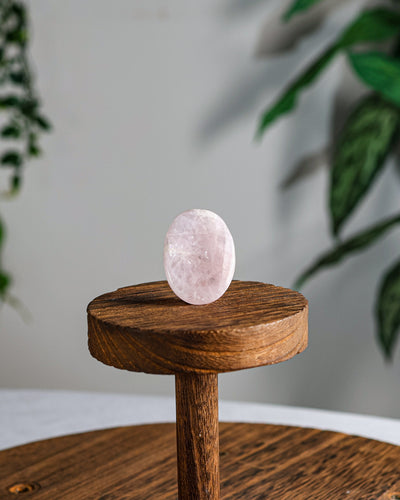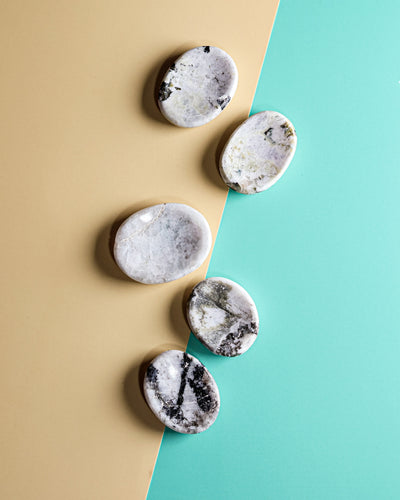
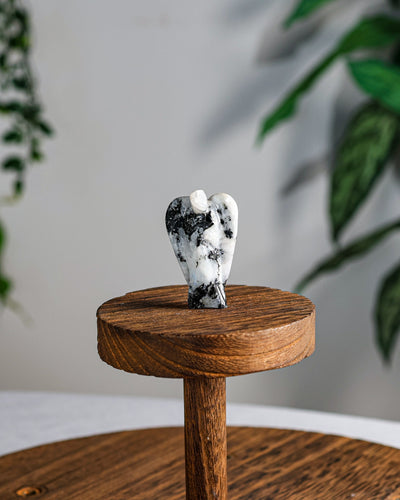

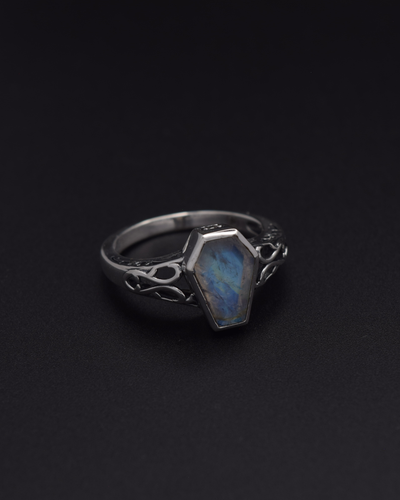
When your feelings rise faster than you can name them, Moonstone gives them somewhere to settle. This milky feldspar carries a soft blue light that drifts across its surface like moonlight on water, and it has long been kept as a stone of new beginnings, reached for when you need calm and stress relief and a clearer line to your own intuition. Judy Hall names calming the emotions as its most powerful effect. Hold it through a season of change and it reminds you that every phase, even this one, belongs to a cycle.
Key Traits
- Milky feldspar with a floating blue-to-white sheen called adularescence
- Known in crystal tradition as the stone of new beginnings
- Most valued for calming heightened emotions
- Closely linked with the moon, intuition and dreamwork
- Carries a receptive, reflective energy that balances drive
Intentions
Brief Overview
Moonstone is a feldspar gem, orthoclase laced with fine layers of albite, prized for the glow that seems to float just beneath its surface. In crystal tradition it is the stone of new beginnings and one of the most trusted companions for emotional steadiness, intuition and dreamwork. Judy Hall describes it as a mirror, like the moon itself, reminding us that everything moves through cycles of waxing and waning.
Properties
Moonstone is used to soften emotional overreaction and ease the stress of inner ups and downs, so you can feel deeply without being carried away. In crystal healing tradition it is worked with to bring what sits in the unconscious into awareness, strengthen intuition and empathy, and encourage lucid dreaming, especially around the full moon. Its receptive energy balances masculine and feminine qualities, and it supports emotional intelligence: the ability to understand a feeling, then let it go.
Metaphysical Properties
- Calms overreaction to emotional triggers
- Brings unconscious patterns into awareness
- Heightens intuition, empathy and inner knowing
- Encourages lucid dreaming near the full moon
- Balances receptive and active energies
Physical Properties
- Type: Feldspar (orthoclase with albite layers; adularia variety)
- Color: White, cream, peach, gray and near-clear, often with a blue or silvery sheen
- Luster: Vitreous to pearly, with adularescence
- Structure: Monoclinic; finely layered feldspar with perfect cleavage
Meaning & Energy
Moonstone's meaning is written in its light. The glow never sits still; it slides across the stone as you turn it, the way the moon changes shape across a month without ever leaving the sky. Its energy is receptive rather than forceful, drawing feeling to the surface so it can be understood instead of acted out. Hall also notes that it opens the mind to sudden impulses, happy accidents and synchronicity, with a caution not to be carried off by wishful illusions, which makes it a stone for trusting your instincts while keeping your feet on the ground.
Emotions
When your emotions feel oversized and unpredictable, Moonstone helps you find the steadier ground beneath them. It eases the stress of emotional ups and downs, softens the reactions that catch you off guard and gives you a moment between feeling something and responding to it. Hall suggests placing it on the solar plexus to understand old emotional patterns and then release them. Keep it close through a move, a new role or the end of something, and let it remind you that you can feel everything and still stay whole.
Crystal Pairings
- Labradorite – deepens intuition and adds a protective shimmer to Moonstone's sensitivity
- Rose Quartz – wraps emotional release in gentle, loving warmth
- Selenite – cleanses and recharges it, sharing Moonstone's lunar light
- Sunstone – balances Moonstone's receptive glow with warm, outward confidence
Science & Origin
Moonstone is a feldspar in which two minerals, potassium-rich orthoclase and sodium-rich albite, separate into microscopically thin alternating layers as the rock slowly cools. Light scattering between those layers produces adularescence, the billowing sheen behind the stone's name; thinner layers read blue, thicker ones white. Sri Lanka leads today's commercial production, and Florida named moonstone its state gemstone in 1970 to honor the moon landings launched from its coast.
- Also Known As: Adularia, Hecatolite
- Formation: Forms as orthoclase and albite unmix into thin alternating layers while feldspar-rich igneous and metamorphic rocks slowly cool
- First Discovery: Known since antiquity; the variety name adularia was coined in 1780 by Ermenegildo Pini for the Adula Massif, Switzerland
- Safety Note: Non-toxic and safe to handle; perfect cleavage means it can chip, so avoid ultrasonic and steam cleaners, salt, harsh chemicals and long soaks
Ancient Myths
- Ancient Romans believed moonstone was formed from solidified rays of moonlight and linked it with their moon goddess Diana.
- In India, moonstone has long been regarded as sacred and was believed to be made of frozen moonlight, a stone of sweet dreams and good fortune.
- Its old name, hecatolite, honors Hecate, the Greek goddess of the moon, the night and the crossroads, and the Greeks likewise tied the stone to their lunar deities.
Chakras Table
| Chakra | Connection | Healing Focus | Energy Type |
|---|---|---|---|
| Sacral | Secondary: emotional flow | Restoring the natural ebb and flow of feeling | Flowing |
| Third Eye | Primary: intuition and inner sight | Trusting instinct and dream insight | Receptive |
| Crown | Secondary: spiritual awareness | Opening to quiet guidance and synchronicity | Expansive |
Planets Table
| Planet | Influence | Energy |
|---|---|---|
| Moon | Emotion, intuition and natural cycles | Receptive and reflective |
| Neptune | Dreams, empathy and imagination | Fluid and intuitive |
Zodiacs Table
| Zodiac | Attribute | Benefit |
|---|---|---|
| Cancer | Emotional depth | Steadies moods and strengthens intuition |
| Libra | Balance | Softens reactions and restores inner equilibrium |
| Scorpio | Transformation | Supports emotional renewal and new beginnings |
| Pisces | Deep sensitivity | Gives tender sensitivity a calm, clear center |
Elements Table
| Element | Power | Aspect |
|---|---|---|
| Water | Emotion and intuition | Flow, reflection and the tides of feeling |
| Air | Insight and perception | Clear thought and openness to synchronicity |
Sacred Numbers Table
| Number | Vibration | Meaning |
|---|---|---|
| 4 | Stability within change | A steady structure that lets intuition and emotion move safely |
Color Variations
- White to near-clear with a blue sheen: the classic, most prized moonstone, with the strongest floating light
- Cream, peach and champagne: warmer, milkier stones with a soft silvery glow
- Gray to near-black: darker stones with a silvery sheen, often sold as black moonstone
- Rainbow: a trade name for white labradorite with a multicolored glow, a close feldspar cousin rather than true orthoclase moonstone
Mohs Scale Hardness
Moonstone rates 6 to 6.5 on the Mohs scale, a little softer than quartz. Its perfect cleavage matters more than the number: a sharp knock along those planes can chip or split it, so it is lovely for pendants, earrings and pocket stones but asks for a protective setting and some care in rings and bracelets worn every day.
Chemical Formula
Moonstone's general formula is (Na,K)AlSi₃O₈, a sodium-potassium aluminum silicate in which potassium feldspar (orthoclase) and sodium feldspar (albite) are intergrown in fine alternating layers.
- Potassium (K): defines the orthoclase layers
- Sodium (Na): defines the albite layers
- Aluminum and silicon (Al, Si): build the three-dimensional silicate framework
- Oxygen (O): binds the framework together
Summary of Composition
- Mineral Class: Silicate (tectosilicate), feldspar group
- Crystal System: Monoclinic
- Transparency: Transparent to translucent
- Luster: Vitreous to pearly, with adularescence
Care Instructions
- Wipe your moonstone with a soft cloth and lukewarm, mildly soapy water, then dry it; skip salt and long soaks
- Never use ultrasonic or steam cleaners, which can crack it along its cleavage
- Store it in its own pouch, away from harder stones and hard knocks
- Recharge it on a selenite plate or under moonlight, the tradition that suits it best
Final Summary
Moonstone is a stone for the in-between: the pause before a decision, the turn of a season, the moment your feelings outpace your words. Keep it close and it steadies the tide, sharpens your intuition and reminds you that every ending is also the first night of a new moon.