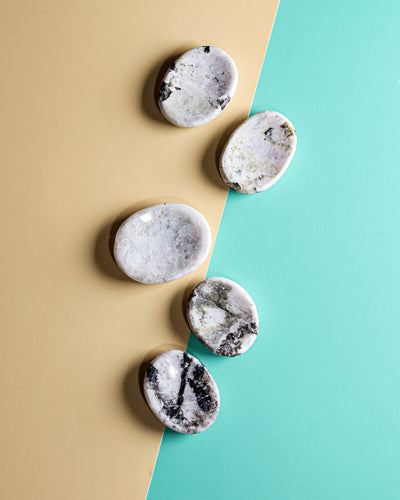
Some days your own instincts are the hardest voice to hear, drowned out by other people's moods, old disappointments, and a mind that will not slow down. Labradorite is the stone for that noise. In dim light it looks like plain gray rock; tilt it, and a sheet of blue-gold fire wakes across its face, the way a true answer surfaces once you stop straining for it. Carried for intuition and clarity, and for protection while you listen, it keeps your inner signal clear.
Key Traits
- Flashes blue, green, and gold as it turns in the light
- Sharpens intuition and your sense of right timing
- Draws a protective boundary around your energy
- Steadies you through periods of change
- Quiets an overactive, racing mind
Intentions
Brief Overview
Labradorite is a calcium-rich plagioclase feldspar named for Labrador, Canada, where it was first described in 1770. Its signature is labradorescence, a shifting flash of color that appears only at certain angles and vanishes at others. Crystal healers regard it as a deeply mystical, protective stone that brings light, and it is traditionally kept by anyone learning to read beneath the surface of a situation and trust what they find there.
Properties
Labradorite works on the inner life. In crystal tradition it heightens intuition and the sense of right timing, bringing half-formed insights up to where you can use them. It is said to deflect other people's projections and unwanted energy from the aura, so your own read on a situation has room to come through. It calms a mind that runs too fast while waking the imagination, balancing analysis with inner vision, and it lends strength and perseverance when circumstances shift faster than feels comfortable.
Metaphysical Properties
- Awakens intuition and the art of right timing
- Deflects unwanted energy and the projections of others
- Calms an overactive mind while sparking new ideas
- Dispels illusion to reveal the true intention behind words and actions
- Strengthens self-trust through periods of transformation
Physical Properties
- Type: Plagioclase feldspar (silicate mineral)
- Color: Smoky gray to near black, flashing blue, green, gold, and occasionally orange or violet
- Luster: Vitreous, pearly on cleavage surfaces
- Structure: Triclinic crystal system, usually massive with fine internal layering
Meaning & Energy
The meaning of labradorite lives in its flash: light hidden inside a dark stone, visible only when the angle is right. Its energy is quietly electric rather than loud. It is a stone of the threshold, aligning everyday awareness with the intuitive mind so that messages from beneath the surface become something you can act on. Reach for it when you are between one chapter and the next and want to keep your footing while you cross.
Emotions
When your thoughts scatter or your feelings run high, labradorite helps you settle. It eases the fear and insecurity left behind by past letdowns, so you stop bracing for disappointments that have already passed. As you work with it, you may find it easier to trust your own judgment and hold a steady boundary, keeping other people's moods and expectations from becoming yours.
Crystal Pairings
- Moonstone – deepens intuition and softens labradorite's psychic work with a calm, lunar quality
- Black Tourmaline – grounds and shields, anchoring the protection labradorite offers
- Sunstone – balances labradorite's receptive, moonlit energy with warm solar vitality
- Amethyst – quiets the mind and supports clear spiritual insight
Science & Origin
Labradorite forms in slowly cooling igneous rock such as anorthosite. Its flash is structural: microscopic alternating layers inside the crystal reflect and interfere with light, which is why the color appears and vanishes as the stone turns. The stone takes its name from Labrador, where it was first described.
- Also Known As: Spectrolite (Finnish variety), Labrador Feldspar, Labrador Stone
- Formation: Crystallizes within cooling magma in igneous rocks such as anorthosite, where very slow cooling produces the fine internal layers behind its flash
- First Discovery: 1770, on the Isle of Paul near Nain, Labrador, Canada
- Safety Note: Non-toxic and safe to handle; rinse briefly, dry promptly, and protect from hard knocks and sudden heat
Ancient Myths
- Inuit legend tells that the Northern Lights were once trapped in the coastal rocks of Labrador until a warrior struck them with his spear; most of the lights escaped into the sky, and the fire left behind is the flash seen in the stone today.
- Esoteric tradition holds labradorite as a stone of initiation into the mysteries, carried by those seeking hidden knowledge and said to open a doorway to other worlds and other lives.
- In modern crystal lore it is called a stone of magic, kept by seers and healers to uncover hidden truth and sense what is coming before it arrives.
Chakras Table
| Chakra | Connection | Healing Focus | Energy Type |
|---|---|---|---|
| Throat | Tertiary: supports honest self-expression | Speaking your truth | Expressive |
| Third Eye | Primary: opens inner sight and intuition | Intuition and vision | Receptive |
| Crown | Secondary: connects to higher awareness | Spiritual insight | Elevating |
Planets Table
| Planet | Influence | Energy |
|---|---|---|
| Moon | Governs intuition and the inner tides | Receptive, reflective |
| Uranus | Sparks sudden insight and awakening | Electric, revelatory |
Zodiacs Table
| Zodiac | Attribute | Benefit |
|---|---|---|
| Capricorn | Discipline and endurance | Strength and perseverance through long transitions |
| Aquarius | Vision and originality | Fresh ideas grounded in inner knowing |
| Pisces | Sensitivity and intuition | A protective boundary for an open, empathic nature |
Elements Table
| Element | Power | Aspect |
|---|---|---|
| Water | Flow and feeling | Emotional depth and intuition |
| Air | Thought and perception | Mental clarity and new ideas |
Sacred Numbers Table
| Number | Vibration | Meaning |
|---|---|---|
| 6 | Harmony | Balance between the inner and outer self |
| 7 | Insight | Inner wisdom and spiritual seeking |
Color Variations
- Blue-flash labradorite — the classic smoky gray body with sweeping blue, green, and gold labradorescence
- Spectrolite — the Finnish variety from Ylämaa, prized for a full spectrum that includes orange, pink, and violet
- Yellow labradorite — a transparent golden form associated in crystal tradition with the solar plexus
- White labradorite — a pale, translucent form with a blue flash, sold in the trade as rainbow moonstone
Mohs Scale Hardness
Labradorite rates 6 to 6.5 on the Mohs scale, hard enough for tumbled stones, pendants, and beads but softer than quartz, which will scratch it. It also has two directions of cleavage, so a sharp knock can chip or split it. It wears well day to day when stored apart from harder crystals and set in protective mountings for rings.
Chemical Formula
Labradorite has the general formula (Ca,Na)(Al,Si)4O8, a calcium-rich member of the plagioclase feldspar series containing roughly 50 to 70 percent anorthite.
- Calcium (Ca) and Sodium (Na): their ratio places the stone within the labradorite range of the series
- Aluminum (Al) and Silicon (Si): form the aluminosilicate framework
- Oxygen (O): links the framework into a three-dimensional structure
Summary of Composition
- Mineral Class: Silicate (plagioclase feldspar)
- Crystal System: Triclinic
- Transparency: Translucent to opaque; yellow and white forms can be transparent
- Luster: Vitreous, pearly on cleavage surfaces
Care Instructions
- Rinse your labradorite under cool running water for a few seconds, then dry it right away
- Recharge it on a selenite plate or in moonlight; its flash is structural and will not fade in sunlight
- Store it apart from harder stones such as quartz to prevent scratches
- Avoid salt soaks, harsh chemicals, ultrasonic cleaners, and sudden heat
Final Summary
Labradorite keeps its fire hidden until the moment it meets the light, and it asks the same of you: to trust what you already know before anyone else can see it. Keep it close when your intuition feels quiet, when change asks more than feels comfortable, or when you need a guardian for the inner work. Turn it in your hand, and watch the answer surface.