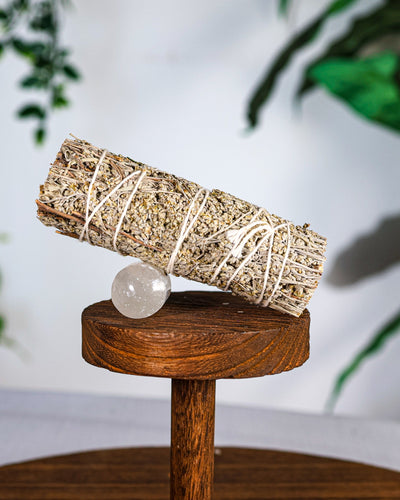
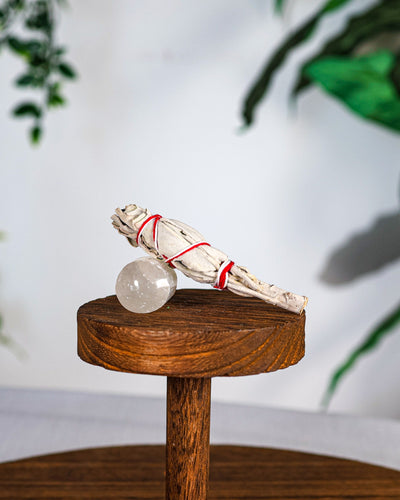
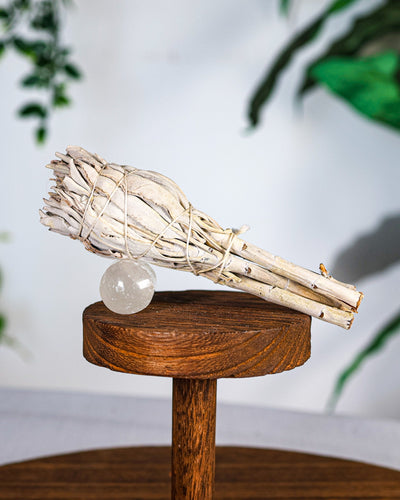
Some rooms hold onto things. An argument, a long stretch of illness, a week where nothing landed right — it settles into the air and stays there after everyone has gone home. White sage is what people have reached for, for thousands of years, when a space needs to be emptied before it can be lived in again: a resinous shrub of the California chaparral whose smoke moves through a room the way rain moves through August heat. Burned with attention, it supports protection and the particular kind of clarity that only arrives once the noise has been cleared out.
Key Traits
- The strongest and most direct of the common cleansing herbs
- Sharp, camphorous, cooling smoke with a resinous undertone
- Traditionally burned to clear a space rather than to scent one
- Sacred to the Indigenous peoples of Southern California and northern Baja
- Should be sourced from cultivated farms, never from stripped wild stands
Intentions
Brief Overview
White sage is Salvia apiana, an evergreen perennial of the mint family that grows wild in exactly one place on earth: the dry coastal ranges and chaparral running from Santa Barbara down into northern Baja California. Its leaves are pale, almost white with fine hair, and stiff with aromatic oil. Dried and bound into bundles, it is lit, allowed to catch, then blown out so it smoulders. What follows is the most recognizable smoke in modern spiritual practice — and one of the most misunderstood, both in how it is used and in where it comes from.
Properties
Sage is a clearing herb before it is anything else. Where softer botanicals soothe or sweeten, white sage empties. It is traditionally burned at thresholds — moving into a new home, closing out a difficult season, resetting a room after conflict or long illness, preparing a space before meditation or ritual. Practitioners also use it to cleanse crystals, tools, and jewelry between workings. The character is decisive rather than gentle, which is precisely why it works on the heavy, stuck-feeling atmospheres that milder smokes only perfume.
Metaphysical Properties
- Clears stagnant or heavy energy from rooms, objects, and the body's immediate field
- Supports a sense of protection at doorways, windows, and thresholds
- Sharpens mental clarity by clearing the atmosphere around a decision
- Marks ordinary space as intentional space before meditation, prayer, or ritual
- Traditionally used to cleanse crystals and ritual tools between uses
Physical Properties
- Type – Aromatic evergreen shrub, mint family (Lamiaceae)
- Color – Pale silver-green to whitish grey, deepening as it dries
- Surface – Matte and finely hairy, faintly tacky with resin when fresh
- Structure – Opposite lance-shaped leaves on woody stems, with tall flowering spikes to five feet
Meaning & Energy
The meaning of white sage is subtraction. Most spiritual materials are asked to add something — luck, love, courage — but sage is asked to take away, and it does that job with an almost startling directness. There is a reason the smell registers instantly as ceremony even to people who have never used it: the oil is dominated by cineole, the same compound behind eucalyptus, and the nose reads it as cold, clean, and slightly medicinal. Energetically, it functions as a hard reset. Whatever was in the room before is now on its way out the window with the smoke.
Emotions
Reach for white sage on the days when you cannot name what is wrong, only that the space around you feels used up. It is the herb for the hour after a hard conversation, the morning after guests who drained you, the moment when the house still smells faintly of a bad week. You are not being asked to process anything while you burn it. You walk the perimeter, you let the smoke find the corners, and you give yourself permission to treat the atmosphere as something you are allowed to change. What tends to shift first is not your mood but your sense of ownership — this is your room again, and you decided that.
Crystal Pairings
- Palo Santo – Burned after the sage, its sweeter smoke invites warmth back into a space that has just been emptied
- Selenite – A smokeless companion for clearing crystals and tools when burning is not an option
- Black Tourmaline – Set at doorways after cleansing to hold the boundary the smoke established
- Blue Sage – The gentler cousin, for shared homes and anyone sensitive to strong sage smoke
Science & Origin
White sage is endemic to a narrow strip of the American Southwest, thriving in poor, fast-draining soil under long dry summers. Its resin is a survival strategy: the oils deter grazing deer, slow water loss, and make the plant fiercely aromatic when crushed or burned. The species name apiana means "of bees," a nod to the clouds of pollinators its long white-and-lavender flower spikes attract each spring, and to the pale, prized honey they produce.
- Also Known As – Sacred Sage, Bee Sage, California White Sage, Salvia apiana
- Formation – Woody perennial shrub of coastal sage scrub and chaparral; leaves harvested, hand-tied, and dried
- First Discovery – Used ceremonially by Indigenous Southern Californian peoples long before contact; formally described in Western botany by Willis Linn Jepson in 1908
- Safety Note – Burn over a fireproof dish in a ventilated room, never unattended. Smoke can irritate airways, so keep it away from infants, pets, and anyone with asthma or respiratory sensitivity. Not for internal use.
Sourcing, Ethics & Respect
White sage grows naturally in one region on earth, and it is sacred to the Cahuilla, Chumash, Kumeyaay, Luiseño, Cupeño, Tongva, and Serrano peoples who have tended it since long before it appeared in any catalog. The global popularity of smudging has put severe pressure on those wild stands. Rangers at preserves such as North Etiwanda in Rancho Cucamonga confiscate poached sage by the hundreds of pounds at a time, and Indigenous communities on both sides of the border report entire hillsides stripped. One common claim deserves correcting: white sage is not listed under the Endangered Species Act. It sits on the United Plant Savers "To Watch" list, and harvesting it from public or private land without permission is simply illegal — a narrower fact, but a more enforceable one.
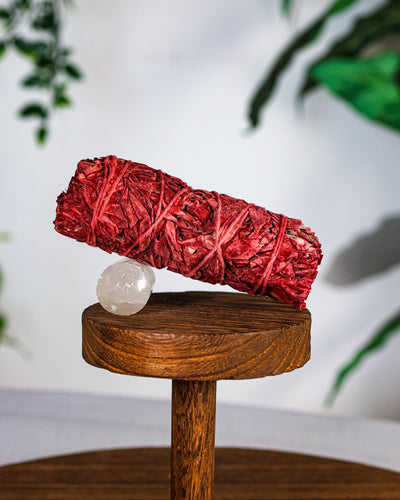
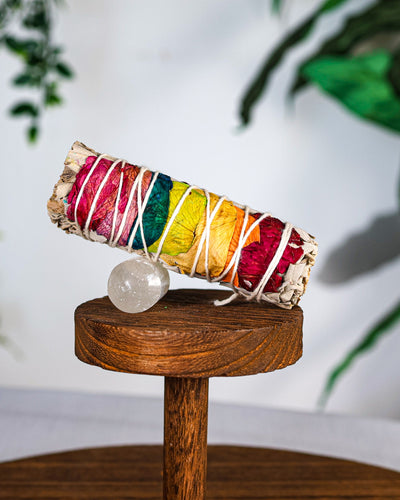
Our sage comes through long-standing private farms and trusted harvesting partners across Southern California — relationships built over years with growers who share our commitment to land stewardship and sustainable practice. Our suppliers take only mature plant material and rotate between areas rather than stripping any single stand, which lets plants regenerate and keeps healthy growing areas healthy. No chemicals or pesticides are used in the growing process, and every harvest season is managed with the next one in mind. Each bundle in our smudge collection — White Sage, Blue Sage, Desert Sage, Black Sage (Mugwort), Yerba Santa, Cedar, and Dragon's Blood Sage — is handmade, hand-tied, and naturally sun-dried in California. Farm-grown and partner-harvested, not anonymously wild-collected.
On appropriation we would rather be direct than comfortable. Smudging as a ceremonial form belongs to specific Indigenous nations, and some Native voices have asked non-Native people to step away from white sage altogether. That request deserves to be sat with rather than argued past. If you do use it, buy only cultivated material, burn a little rather than a lot, and do not call your practice a ceremony that is not yours. If that sits uneasily, there are other good options — Blue Sage, Cedar, and Desert Sage all clear a room, and none carry the same weight.
Ancient Myths
- For the Cahuilla, Chumash, Kumeyaay, Luiseño, Tongva, and Serrano peoples, white sage has been ceremonial and everyday for thousands of years — burned in purification and sweathouse rites, and used as food and medicine. The Chumash name for it is we'wey.
- Judy Hall's Crystal Bible defines smudging as a method of purification used by Native Americans to prepare both themselves and the place for spiritual practice, carried out by spreading the smoke of slowly burning herbs.
- Old European sage lore, recorded by Scott Cunningham, links the whole Salvia family to wisdom and long life, with leaves carried as talismans — the genus name itself rooted in the Latin salvare, to save.
Chakras Table
| Chakra | Connection | Healing Focus | Energy Type |
|---|---|---|---|
| Crown | Primary | Marking ordinary space as sacred and intentional | Purifying |
| Third Eye | Secondary | Clearing mental clutter before decisions or practice | Clarifying |
Planets Table
| Planet | Influence | Energy |
|---|---|---|
| Venus | Governs the sage family in traditional herbal correspondence, tying it to harmony and the restored home | Balancing |
Zodiacs Table
| Zodiac | Attribute | Benefit |
|---|---|---|
| Taurus | Rootedness in place | Supports the instinct to keep a home well-tended and settled |
| Libra | Restoration of balance | Helps reset an atmosphere after conflict or discord |
Elements Table
| Element | Power | Aspect |
|---|---|---|
| Earth | Rootedness | The desert shrub itself, resinous and drought-hardened |
| Air | Movement | The smoke that carries the clearing through a room |
Sacred Numbers Table
| Number | Vibration | Meaning |
|---|---|---|
| 6 | Harmony of the home | The number traditionally assigned to Venus, tying sage to the restored and tended household |
| 7 | Sacred inquiry | Associated with ritual preparation and the turn inward that follows a clearing |
Color Variations
- Silver-white new growth – The youngest leaves, so densely hairy they read almost white in full sun
- Mature sage-green – Older foliage that has darkened toward a soft grey-green with age
- Sun-dried grey-green – The finished bundle, muted and matte, with the resin drawn to the surface
- Flowering spikes – Tall stalks carrying white blossoms faintly washed with lavender
Mohs Scale Hardness
The Mohs scale measures mineral scratch resistance and does not apply to botanical material, so white sage carries a hardness of 0 in our database. Practically, what matters instead is brittleness: a properly sun-dried bundle is fragile and will shed leaf fragments if crushed or dropped. Store it flat, away from humidity, and handle it as you would a dried flower rather than a stone.
Chemical Formula
As a living plant, white sage has no single chemical formula. Its aromatic signature comes chiefly from 1,8-cineole (C10H18O), which can dominate the essential oil, supported by camphor (C10H16O) and a group of monoterpenes. Notably, and unlike common garden sage, it contains no thujone.
- 1,8-Cineole (eucalyptol) – The cool, sharp, lung-opening top note
- Camphor – The dry, medicinal warmth beneath it
- Alpha- and beta-pinene – Resinous, faintly coniferous edges
- Camphene, limonene, myrcene – Trace terpenes rounding out the scent
Summary of Composition
- Botanical Class – Evergreen perennial shrub (Salvia apiana)
- Plant Family – Lamiaceae, the mint family
- Part Used – Leaves and leafy stems, hand-tied and sun-dried
- Aroma Profile – Cool, camphorous, resinous, faintly medicinal
Care Instructions
- Store your bundle flat in a dry, dark place — humidity dulls the oils and encourages mould
- Light the tip, let it catch for several seconds, then blow out the flame so it smoulders
- Always burn over a fireproof dish or abalone shell, with a window cracked and the bundle never left alone
- Press the lit end firmly into sand or the dish to extinguish; do not douse it in water if you want to use it again
Final Summary
White sage does one thing, and it does it without hedging: it takes the room back to zero. That directness is why it has been held sacred in Southern California for millennia, why it has been overharvested nearly everywhere else, and why it is worth buying carefully and burning sparingly. Light it when a space needs emptying, and then notice what you choose to fill it with.