


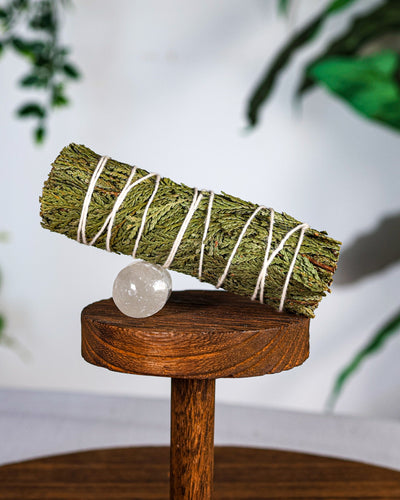
Cedar has stood guard over thresholds for longer than almost any other ritual wood. Its smoke carries protection and grounding & stability in equal measure, purifying a room the old-fashioned way: slowly, thoroughly, and without apology. Cultures on opposite sides of the world have hung cedar over doorways for the same reason, to keep out what does not belong and to let a household settle. Light a little and the room remembers what a guarded, unhurried home feels like.
Key Traits
- Warm, resinous scent from needles or flat sprigs rich in aromatic oils
- Burned to purify a home and turn troubled dreams into peaceful ones
- Long associated with money-drawing when kept in a wallet or purse
- A tree of thresholds, traditionally hung to guard what may enter
- Grows across North America, Lebanon, and the Himalayas under several related names
Intentions
Brief Overview
Scott Cunningham's Encyclopedia of Magical Herbs records cedar as one of the oldest protective woods in continuous ritual use, describing its smoke as purifying and its scent as a cure for the tendency toward bad dreams. What is sold as cedar spans several related conifers, true Old World cedars of the genus Cedrus and the North American Thuja and Juniperus species long used interchangeably in folk practice, but the tradition surrounding all of them stays remarkably consistent: cedar protects the threshold and steadies whoever sleeps behind it.
Properties
Cedar works as a guardian first and a cleanser second. Its smoke is purifying, but the plant's deeper reputation is protective: hung in the home it is said to guard against lightning and harm, carried in a wallet or purse it is said to draw money, and burned before bed it is said to settle the kind of restless dreaming that follows a hard day. It is a slow, steady wood rather than a sharp one, suited to routine use rather than emergency clearing.
Metaphysical Properties
- Purifies a space with a slow, steady smoke rather than a sharp sweep
- Traditionally hung or burned to guard a threshold against harm
- Long carried or kept near money to draw steady prosperity
- Supports calmer, less troubled sleep when burned before bed
- Grounds scattered energy back into the body and the home
Physical Properties
- Type – Dried aromatic conifer, sprigs or shavings, genus Cedrus, Thuja, or Juniperus
- Color – Warm green to brown-green, deepening as it dries
- Luster – Matte with a faint natural sheen on fresh sprigs
- Structure – Flat, scaled sprigs or small chips, bundled or loose for burning
Meaning & Energy
Cedar carries the character of something that has already stood watch for a very long time. It is unhurried the way an old guard is unhurried, certain of the boundary it holds. Where a lighter herb clears a room in a single pass, cedar settles in and stays, a slow presence rather than a quick sweep.
Emotions
Reach for cedar when what you need is less about releasing something sharp and more about feeling steady again. It suits the unease that lingers after a hard month, the restlessness that keeps you from settling into sleep, and the quiet want for a home that feels looked after. You are not being asked to fight anything off. You are being asked to trust the door is guarded so you can finally rest.
Crystal Pairings
- Palo Santo – Adds a sweeter, more meditative note to Cedar's grounded protection
- Black Tourmaline – Doubles down on protection when Cedar's guard needs reinforcing
- Pyrite – Strengthens Cedar's pull toward steady prosperity
- Amethyst – Deepens Cedar's support for peaceful, undisturbed sleep
Science & Origin
True cedars, genus Cedrus, are Old World conifers native to the Mediterranean and Himalayan mountains, while the cedar most often burned in North American ritual practice is usually Thuja or Juniperus, used interchangeably in folk tradition despite the botanical difference. All are rich in aromatic, insect-repelling oils, the same chemistry that has made cedar valued for construction and preservation as much as for ritual.
- Also Known As – Cedarwood, Thuja, Arborvitae, Juniper Cedar
- Formation – Coniferous tree, needles and scale-leaves harvested and dried into sprigs
- First Discovery – Revered since the earliest civilizations, from the Epic of Gilgamesh's cedar forest to the temple beams of the ancient Near East
- Safety Note – Cedar smoke is aromatic and resinous, so burn small amounts over a fireproof surface with ventilation. Keep oils away from pets, especially cats
Ancient Myths
- The cedars of Lebanon were treasured across the ancient world, used to build temples and honored in scripture and epic alike.
- Scott Cunningham records that some American Indian peoples placed cedar twigs on hot stones in sweat baths for purification.
- Folk tradition holds that a three-pronged cedar stick set upright in the earth near the home guards it against all evil.
Chakras Table
| Chakra | Connection | Healing Focus | Energy Type |
|---|---|---|---|
| Root | Primary | Steadying the body and the home | Grounded and protective |
| Crown | Secondary | Quiet spiritual protection during rest | Still and guarding |
Planets Table
| Planet | Influence | Energy |
|---|---|---|
| Sun | Vitality, warmth, and steady strength | Radiant |
Zodiacs Table
| Zodiac | Attribute | Benefit |
|---|---|---|
| Leo | Warm, protective, proud of home and hearth | Strengthens pride in a well-kept space |
| Capricorn | Disciplined, patient, builds for the long term | Supports steady, unhurried prosperity |
Elements Table
| Element | Power | Aspect |
|---|---|---|
| Fire | Warmth, transformation, purification | Burns away what has gathered without urgency |
Sacred Numbers Table
| Number | Vibration | Meaning |
|---|---|---|
| 1 | Leadership and new beginnings | Matches the Sun's steady, radiant influence on cedar |
Color Variations
- Warm green-brown – The common shade of dried sprigs
- Deep forest green – Fresher, more recently harvested cuttings
- Reddish brown – The bark and heartwood of many cedar species
- Silvery green – Some Thuja varieties with a lighter, frosted cast
Mohs Scale Hardness
Cedar has no Mohs value, since the scale measures mineral hardness and this is a dried wood. Practically, cedar sprigs are more durable than a soft leaf like sage, holding their shape well in storage, though the scale-like leaves will still shed if handled roughly.
Chemical Formula
Cedar has no single formula, but its resinous, woody scent comes chiefly from cedrol, C15H26O, a sesquiterpene alcohol concentrated in the wood and foliage.
- Carbon (C) – 15 atoms, forming the larger sesquiterpene skeleton
- Hydrogen (H) – 26 atoms, completing the ring structure
- Oxygen (O) – 1 atom, the alcohol group behind cedar's warm, dry scent
Summary of Composition
- Mineral Class – None; botanical, coniferous wood, genus Cedrus, Thuja, or Juniperus
- Crystal System – Not applicable; woody conifer
- Transparency – Opaque
- Luster – Matte with a faint natural sheen
Care Instructions
- Store sprigs or chips in a dry, airy container away from direct sun
- Light the tip and let it smoulder rather than burn with an open flame
- Rest it on a fireproof dish, since cedar's resin can spark and pop while burning
- Keep smoke away from pets, especially cats, who are sensitive to some conifer oils
Final Summary
Cedar does not clear a room so much as it stands watch over it. Burn a little at the threshold, by the bed, or wherever you want the day to finally stop pressing in, and let its old, steady patience become yours for a while.


