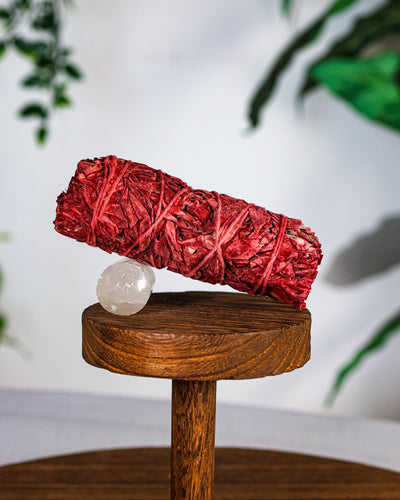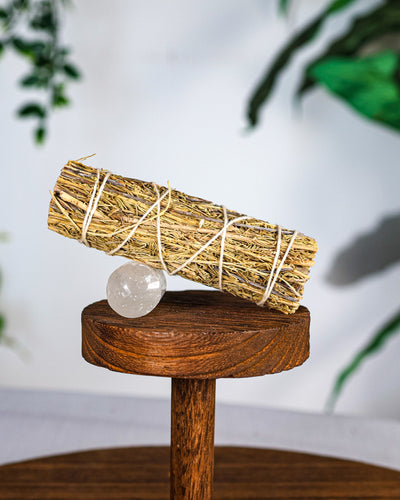
Desert Sage has cleared heavy air across the American West for generations, its silvery leaves carrying a scent that is sharper and more resinous than white sage's softer hush. Burned for grounding & stability and protection, it works like opening a window in a stuffy room, letting stagnant energy out and letting the desert's plain, unhurried clarity back in. This is the bundle for resetting a space fast and getting your feet back under you at the same time.
Key Traits
- Silvery-green leaves with a sharp, camphorous, high-desert scent
- Also sold as sagebrush, the wild Artemisia of the American West
- Burned to sweep out stagnant energy and steady what remains
- Long used in Indigenous ceremony across the Great Basin and Plains
- A quicker, more assertive clearing than gentler botanicals like lavender
Intentions
Brief Overview
Desert Sage, most often Artemisia tridentata or a related Artemisia species, is not a true Salvia sage but an aromatic shrub of the sunflower family that defines the silvery, sharp-scented landscape of the American high desert. Scott Cunningham's Encyclopedia of Magical Herbs records that sagebrush has long been burned in American Indian ceremony to drive away malevolent forces, and that bathing with it was believed to cleanse a person of past misdeeds and negativity.
Properties
Desert Sage works quickly and plainly. Its smoke is reached for when a space feels genuinely heavy, after conflict, illness, or a stretch of hard luck, and folk tradition credits it with clearing negativity, steadying the body, and quietly renewing a person's sense of their own strength. It shares white sage's cleansing intention but carries a sharper, more mineral edge, closer to the high desert itself than to a garden.
Metaphysical Properties
- Sweeps stagnant or heavy energy out of a room quickly
- Traditionally used in purifying baths to clear past negativity
- Grounds the body and steadies scattered attention
- Supports a quieter, clearer form of intuition once the noise clears
- Offers a felt sense of protection during difficult transitions
Physical Properties
- Type – Dried aromatic botanical, genus Artemisia, family Asteraceae
- Color – Silvery-green leaves on woody grey-brown stems
- Luster – Matte with a fine silvery down on the leaf surface
- Structure – Small, deeply lobed leaves on branching woody stems, bundled for burning
Meaning & Energy
Desert Sage carries the character of the high desert itself: plain, unadorned, and clear-eyed. It does not soften what it clears or dress it up afterward. It simply removes what is heavy and leaves you standing in open, honest air.
Emotions
Reach for Desert Sage when you need a real reset, not a gentle one. It suits the aftermath of an argument, a stretch of bad luck, or the specific exhaustion that comes from carrying something you did not choose. You are not asked to process anything slowly here. You are given a clean, quick sweep, and the room to stand up straighter once it settles.
Crystal Pairings
- White Sage – Layers a deeper, more ceremonial clearing onto Desert Sage's grounded sweep
- Black Tourmaline – Reinforces Desert Sage's protective boundary
- Clear Quartz – Sharpens the intuition Desert Sage's smoke helps quiet down
- Smoky Quartz – Doubles the grounding when a heavier reset is needed
Science & Origin
Desert Sage is most often Artemisia tridentata, an aromatic shrub of the sunflower family, Asteraceae, native to the arid high country of the American West, though several related Artemisia species are sold under the same name. Despite the trade name, it is not a true Salvia sage; its silvery, camphorous scent comes from volatile oils, chiefly camphor, concentrated in the leaves.
- Also Known As – Sagebrush, Grey Sage, Wild Sage, Artemisia tridentata
- Formation – Desert shrub, leaf and stem harvested and dried into bundles
- First Discovery – Used ceremonially by Indigenous peoples of western North America for many generations; documented in European botany in the early 19th century
- Safety Note – Burn only in a well-ventilated space over a fireproof dish. Keep away from smoke-sensitive individuals, pets, and unattended flames
Ancient Myths
- Desert Sage belongs to the Artemisia family, plants long linked in European folklore to Artemis, goddess of the wild and protector of women.
- In many Indigenous traditions of the Great Basin and Plains, sagebrush smoke has been used ceremonially to purify people, tools, and gathering spaces.
- Folk tradition holds that bathing with sagebrush cleanses a person of past misdeeds and negativity, a practice recorded by Scott Cunningham.
Chakras Table
| Chakra | Connection | Healing Focus | Energy Type |
|---|---|---|---|
| Root | Primary | Grounding the body after heavy or draining events | Steadying and firm |
| Third Eye | Secondary | Clearing mental noise so intuition can surface | Quiet and clarifying |
Planets Table
| Planet | Influence | Energy |
|---|---|---|
| Venus | Traditional herbal rulership of renewal and inner worth | Restorative |
Zodiacs Table
| Zodiac | Attribute | Benefit |
|---|---|---|
| Taurus | Steady, practical, connected to the earth | Reinforces grounding after upheaval |
| Capricorn | Resilient, disciplined, slow to rattle | Strengthens resolve during hard stretches |
Elements Table
| Element | Power | Aspect |
|---|---|---|
| Earth | Stability, the physical body, the home | Anchors a space right after clearing it |
Sacred Numbers Table
| Number | Vibration | Meaning |
|---|---|---|
| 6 | Harmony and restoration | Reflects Venus's renewing influence on Desert Sage |
Color Variations
- Silvery green – The common shade of most bundles
- Ashy grey-green – Drought-stressed growth, especially arid harvests
- Pale silver – Leaves catching the most direct desert sun
- Warm grey-brown – The woody stems beneath the silvery leaf
Mohs Scale Hardness
Desert Sage has no Mohs value, since the scale measures mineral hardness and this is a dried botanical. In practical terms, its small silvery leaves are delicate and shed easily, so handle bundles by the tied end and store them where they will not be crushed.
Chemical Formula
Desert Sage has no single formula, but its sharp, camphorous scent comes chiefly from camphor, C10H16O, concentrated in the leaf's volatile oils.
- Carbon (C) – 10 atoms, forming the bicyclic terpene skeleton
- Hydrogen (H) – 16 atoms, completing the ring structure
- Oxygen (O) – 1 atom, the ketone group behind its sharp, medicinal edge
Summary of Composition
- Mineral Class – None; botanical, family Asteraceae, genus Artemisia
- Crystal System – Not applicable; herbaceous desert shrub
- Transparency – Opaque
- Luster – Matte with a fine silvery down
Care Instructions
- Store bundles in a dry, dark place with airflow; humidity will dull the scent
- Light the tip, let it catch, then blow out the flame so it smoulders
- Rest the bundle on a fireproof dish, well clear of curtains or paper
- Ventilate the room fully, since the scent is stronger than gentler botanicals
Final Summary
Desert Sage does the plain, necessary work of clearing a room that has genuinely had enough. Light it when you need the air to feel honest again, and let its sharp, silvery smoke carry the heaviness out the door.