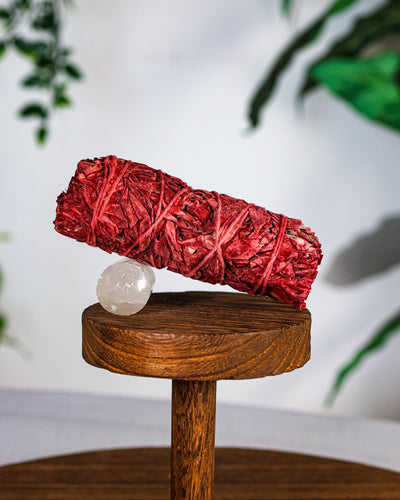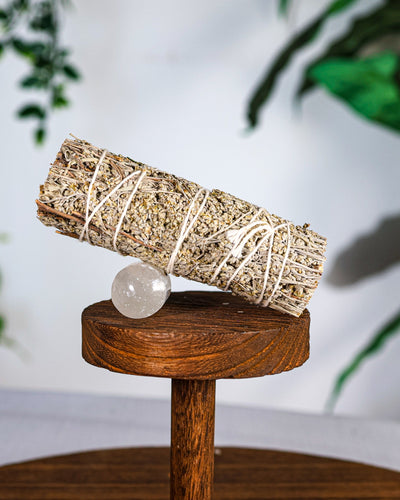
Not every clearing needs to feel like a storm. Blue Sage, sometimes called grandmother sage, is the softer cousin of the sharper white sage bundle, its blue-green leaves carrying a scent closer to lavender than to resin. Where a hard sweep of smoke can feel like too much on a tender day, Blue Sage offers calm and stress relief without demanding anything of you, and its long folk reputation for drawing abundance means it suits a hopeful Tuesday morning as well as a quiet Sunday night. This is the bundle for the days when gentleness is the more honest choice.
Key Traits
- Blue-green leaves with a soft, lavender-like scent, gentler than white sage
- Known in folk tradition as grandmother sage for its nurturing character
- Grown wild across the deserts and grasslands of the American Southwest
- Burned when a soft reset is wanted rather than a hard clearing
- Traditionally favored for calming heavy moods and inviting quiet abundance
Intentions
Brief Overview
Blue Sage is not one of the herbs recorded in our primary source library, so this profile draws on the wider folk tradition surrounding the plant, most often identified as Salvia azurea or Salvia clevelandii, aromatic mint-family shrubs native to the deserts and grasslands of the American Southwest. Sold beside white sage in the smudge trade, it is favored by people who want the ritual of cleansing without the intensity, a bundle reached for on days when calm feels more useful than a hard sweep.
Properties
Blue Sage works less like a broom and more like a held hand. Folk practice turns to it to settle a heavy mood, to soften the edges of a hard week, and to invite a quiet sense of plenty into a home rather than banish scarcity by force. It shares white sage's cleansing intention but trades urgency for warmth, making it the bundle many reach for around children, pets, or anyone sensitive to stronger smoke.
Metaphysical Properties
- Softens heavy or restless moods without forcing a shift
- Supports a gentle reset when a hard clearing feels like too much
- Invites a felt sense of abundance and plenty into the home
- Calms a room after conflict, illness, or ordinary exhaustion
- Offers a nurturing presence during rest and quiet reflection
Physical Properties
- Type – Dried aromatic botanical, genus Salvia, family Lamiaceae
- Color – Silvery blue-green leaves, occasionally touched with pale lavender flowers
- Luster – Matte, softly downy across the leaf surface
- Structure – Slender branching stems with narrow leaves, hand-tied into smudge bundles
Meaning & Energy
Where white sage arrives like a clean, bracing wind, Blue Sage moves more like early evening light. Its folk name, grandmother sage, points at exactly this quality, an elder's patience rather than a young reformer's urgency. It does not insist that a room or a mood change all at once. It simply makes room for softness to happen in its own time.
Emotions
Reach for Blue Sage on the days when you know you need a reset but do not have the energy for a hard clearing. It suits the ordinary tiredness that follows a long week, the tension that lingers after a disagreement, and the quiet worry that shows up when things feel tight. You are not asked to fight your way to calm here. You are only asked to let the smoke do a little of the work while you breathe.
Crystal Pairings
- White Sage – Layers Blue Sage's gentleness with a deeper clearing when the day calls for both
- Amethyst – Settles a racing mind alongside Blue Sage's calm
- Citrine – Adds a brighter note to Blue Sage's quiet draw toward abundance
- Rose Quartz – Softens grief or tension the way Blue Sage softens a heavy room
Science & Origin
Blue Sage typically refers to Salvia azurea or Salvia clevelandii, aromatic shrubs of the mint family native to the deserts, grasslands, and coastal scrub of the American Southwest. Its blue-tinted foliage and lighter, sweeter oils set it apart from the more resinous Salvia apiana sold as white sage, and it has moved into wider smudge practice largely through modern apothecary and metaphysical retail rather than one documented ceremonial lineage.
- Also Known As – Grandmother Sage, Azure Sage
- Formation – Desert and grassland shrub, leaf and stem harvested and hand-tied into bundles
- First Discovery – Part of Southwestern plant lore entering wider smoke-cleansing practice in the modern era
- Safety Note – Burn over a fireproof dish in a ventilated space. A good choice when sharing space with those sensitive to stronger sage smoke, though ventilation still matters
Ancient Myths
- Blue Sage is affectionately called grandmother sage in folk tradition, a name for its gentle, nurturing character.
- The wider sage family carries old associations with wisdom and long life, recorded by Scott Cunningham in his herbal encyclopedia.
- Desert peoples of the American Southwest have long valued the region's aromatic sages in cleansing and blessing practices.
Chakras Table
| Chakra | Connection | Healing Focus | Energy Type |
|---|---|---|---|
| Heart | Primary | Softening grief, tension, and a guarded heart | Nurturing and warm |
| Throat | Secondary | Gentle honesty and calm self-expression | Soft and steady |
Planets Table
| Planet | Influence | Energy |
|---|---|---|
| Venus | Traditional herbal rulership of gentleness and comfort | Softening |
| Jupiter | Carries the plant's folk reputation for drawing abundance | Expansive |
Zodiacs Table
| Zodiac | Attribute | Benefit |
|---|---|---|
| Aquarius | Independent, unconventional, quietly caring | Supports gentleness on your own terms |
| Libra | Harmony-seeking, relationship-oriented | Restores balance after a hard week |
Elements Table
| Element | Power | Aspect |
|---|---|---|
| Air | Communication, thought, a light touch | Carries stress out of a room without force |
| Water | Emotional flow and softness | Lets heavy feelings move rather than sit |
Sacred Numbers Table
| Number | Vibration | Meaning |
|---|---|---|
| 6 | Harmony and nurturing | Matches Blue Sage's gentle, caretaking character |
| 3 | Expansion and growth | Reflects the plant's folk tie to abundance |
Color Variations
- Silvery blue-green – The standard dried leaf color across most bundles
- Pale lavender – The small flowers that sometimes remain on wild-gathered stems
- Soft grey-green – Leaves grown in especially dry, sun-exposed conditions
- Deeper sage green – Stems harvested slightly earlier in the season
Mohs Scale Hardness
Blue Sage has no Mohs value, since the scale measures how minerals resist scratching and this is a dried botanical. In practical terms, treat it as delicate: the leaves are thin and papery once dried and will crumble if pressed or handled roughly, so store bundles loosely rather than stacked under heavier items.
Chemical Formula
Blue Sage has no single formula, but its soft, sweet-herbal scent owes much to linalool, C10H18O, alongside smaller amounts of camphor and cineole typical of the Salvia genus.
- Carbon (C) – 10 atoms, forming the open terpene alcohol chain
- Hydrogen (H) – 18 atoms, completing the chain
- Oxygen (O) – 1 atom, the alcohol group behind its lighter, sweeter fragrance
Summary of Composition
- Mineral Class – None; botanical, family Lamiaceae, genus Salvia
- Crystal System – Not applicable; herbaceous desert shrub
- Transparency – Opaque
- Luster – Matte, softly downy
Care Instructions
- Store your bundle in a dry, dark place with light airflow; sealed plastic invites mold
- Light the tip, let it catch, then blow out the flame so it smoulders rather than burns
- Rest the smouldering bundle on a fireproof dish, never directly on wood or fabric
- Keep smoke away from pets, infants, and anyone sensitive to strong plant smoke
Final Summary
Blue Sage does not ask you to clear a room by force. It asks you to slow down enough to let softness back in, one gentle breath of smoke at a time. Light it when calm feels like the braver choice.