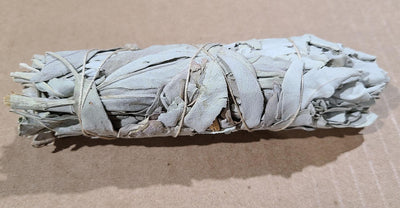
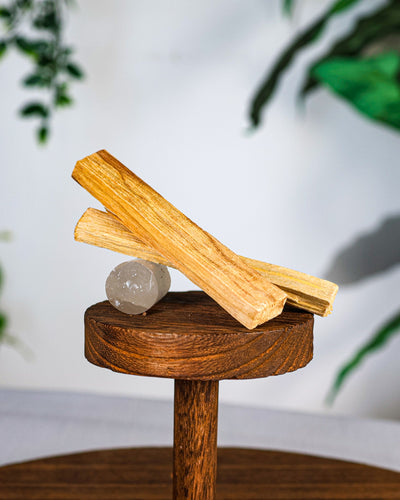
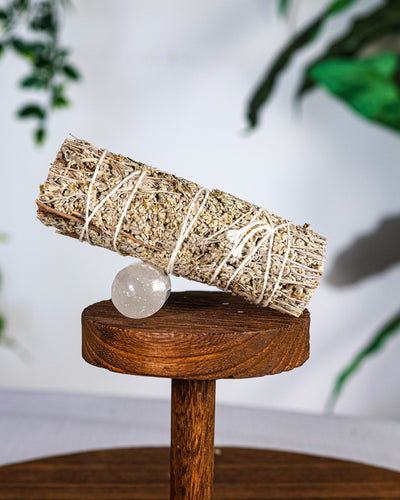
White Sage and Palo Santo both cleanse with smoke, but they do different jobs. White Sage is a clearing herb from the Southern California chaparral, and its sharp, cooling smoke is burned to take a room back to zero. Palo Santo is an aged holy wood from Peru and Ecuador whose sweeter smoke clears more gently, then invites calm and good fortune back in.
Put simply, sage empties a space and palo santo warms it. You can find both, along with bowls to burn them in, in our smudging and cleansing collection.
Sage vs. Palo Santo at a Glance
- What it is: White Sage is Salvia apiana, an evergreen shrub of the mint family. Palo Santo is Bursera graveolens, a tree in the same family as frankincense, myrrh, and copal.
- Scent: Sage smells sharp, cool, and camphorous. Palo Santo smells sweet and resinous, with a faint citrus note.
- Form: Sage comes as hand-tied bundles of dried leaves. Palo Santo comes as sticks, plain or dipped in lavender or white copal.
- Element: Sage carries Earth and Air. Palo Santo carries Fire and Air.
- Chakras: Sage works with the Crown and Third Eye. Palo Santo works with the Solar Plexus Chakra and the Crown.
White Sage: When a Room Needs Emptying
White Sage is the strongest and most direct of the common cleansing herbs. It is traditionally burned at thresholds, such as moving into a new home, closing out a hard season, or resetting a room after an argument. Its oil is rich in cineole, the compound behind eucalyptus, which is why the smoke reads as cold and clean. People reach for it when they want Protection and the clarity that arrives once the noise is gone.
Palo Santo: When a Space Needs Warmth
Palo Santo, holy wood in Spanish, does not so much banish as invite. Its fragrance develops only after a fallen branch has rested on the forest floor for years, so the sweetness in the smoke is a product of patience. Light it before meditation, at the start of a creative project, or whenever a little good fortune would help alongside a little clarity.
Which One Should You Choose?
Choose White Sage when a space feels heavy, used up, or stuck, and you want a clean reset. Choose Palo Santo when your thinking feels cluttered or you want to bless a fresh start. On days that call for both, burn the sage first, then the palo santo to bring warmth back into the emptied space. If strong sage smoke is too much for your home, Blue Sage, often called grandmother sage, offers a softer clearing with a scent closer to lavender.
Cleansing Your Crystals With Either Smoke
- Open a window so the smoke has somewhere to go.
- Light the tip of your bundle or stick, let the flame catch, then blow it out so it smoulders over a fireproof dish.
- Pass each crystal slowly through the smoke, or waft the smoke over it with your hand.
- Press the ember into the dish until no smoke rises, and never leave it unattended.
Cleanse Clear Quartz often, since as an amplifier it absorbs more of its surroundings than most stones. After a sage clearing, set Black Tourmaline by the door to hold the boundary the smoke established. When burning is not an option, Selenite is the smokeless alternative: rest your stones on a selenite plate overnight, and keep the selenite itself dry, since water damages it.
Sourcing With Respect
White Sage grows naturally in only one region on earth, and it is sacred to the Cahuilla, Chumash, Kumeyaay, Luiseño, Cupeño, Tongva, and Serrano peoples who have tended it for thousands of years. Its popularity has put heavy pressure on wild stands. It is not listed under the Endangered Species Act, but it sits on the United Plant Savers watch list, and harvesting it without permission is illegal.
Our sage comes from private farms and long-standing harvesting partners across Southern California who take only mature plant material, rotate between growing areas, and use no chemicals or pesticides. Every bundle is hand-tied and sun-dried in California. Our Palo Santo comes only from naturally fallen wood, aged for years before harvest, so no living tree is cut to make it.
Smudging as a ceremony belongs to specific Indigenous nations, and some Native voices have asked non-Native people to step away from White Sage altogether. That request deserves to be sat with rather than argued past. If you do burn it, choose cultivated material, use a little rather than a lot, and do not call your practice a ceremony that is not yours.
Light White Sage when a room needs emptying, light Palo Santo when it needs warming, and buy both from someone who can tell you exactly where they came from.