


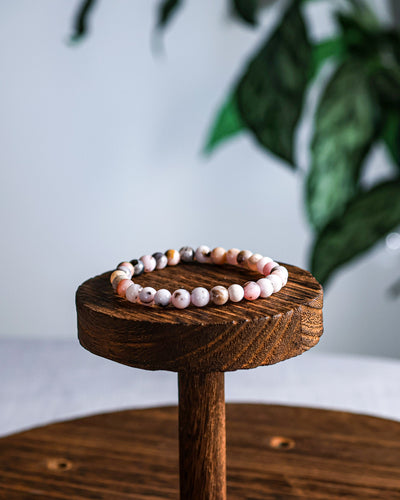
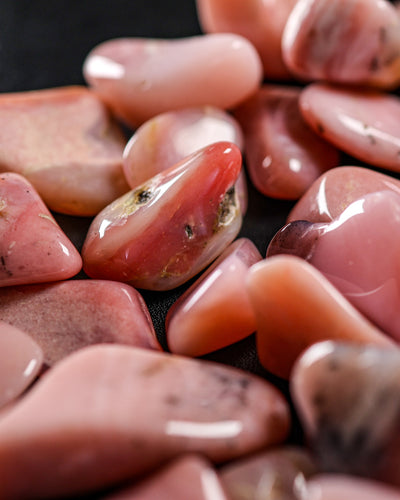
Pink Opal moves quietly into a room and softens everything in it. This blush-toned stone has long been treated as a companion for the tender work of healing and calm, easing a racing mind before it turns to matters of the heart. Where other crystals feel urgent, Pink Opal is patient — it meets grief, stress, and old disappointment with the kind of steadiness that makes love and connection feel safe to attempt again. Held close, it asks for nothing but presence.
Key Traits
- Softens emotional overwhelm
- Encourages calm, steady breathing
- Opens the heart to connection
- Supports gentle intuitive insight
- Eases old grief and heartbreak
Intentions
Brief Overview
Pink Opal is a soft-hued variety of common opal, prized for its milky blush color rather than the fire and flash of precious opal. Formed as silica-rich water hardens within volcanic rock, it carries none of the rainbow play-of-color associated with gem opal — instead offering an even, pastel presence that reads as calm on sight. In crystal healing tradition, it is regarded as a stone of the heart: gentle, steady, and oriented toward emotional repair over dramatic transformation.
Properties
Pink Opal's core work is emotional. Traditionally it is used to quiet an anxious mind, soften grief, and clear space for love to re-enter a life that has been guarded against it. It is also credited with a mild intuitive lift — not a sharp psychic opening, but a soft widening of self-awareness that helps its keeper notice what they actually feel, rather than what they think they should feel.
Metaphysical Properties
- Encourages compassion toward yourself and others
- Softens grief, heartbreak, and old resentment
- Calms an anxious or overactive mind
- Supports honest, tender communication in relationships
- Gently opens intuitive awareness
Physical Properties
- Type: Common opal (mineraloid, hydrated silica)
- Color: Pale to medium pink, often with white or gray matrix veining
- Luster: Waxy to subvitreous
- Structure: Amorphous, non-crystalline; typically massive and opaque to semi-translucent
Meaning & Energy
Pink Opal's meaning is bound up in gentleness as a form of strength. Rather than forcing change, it works the way water works on stone — slowly, without argument, wearing down defenses until what's underneath can finally be touched. Its color has made it a natural symbol of tenderness across the cultures that have mined it, and its energy is often described the same way: soft-spoken, patient, and entirely uninterested in urgency.
Emotions
When your emotions have been held at arm's length for too long, Pink Opal offers a way back in. It doesn't demand that you process everything at once — it simply keeps the door open, so grief, disappointment, or the ache of a strained relationship can surface at a pace you can actually manage. Many people describe holding it during a hard conversation or a quiet cry, using its steadiness to stay present instead of shutting down.
Crystal Pairings
- Rose Quartz – Deepens unconditional love and heart-centered healing
- Rhodonite – Supports forgiveness and emotional repair after conflict
- Moonstone – Softens intuitive insight and eases emotional cycles
- Amethyst – Brings calm, steady clarity to an anxious mind
Science & Origin
Pink Opal belongs to the common opal family — the far more abundant, non-iridescent cousin of the precious opal prized for rainbow flash. Its pastel color comes from trace manganese and iron oxide, with Peruvian material sometimes attributed to organic quinone compounds absorbed during formation, and it forms as silica-saturated water hardens within volcanic host rock in the high-altitude foothills of the Andes.
- Also Known As: Andean Pink Opal, Peruvian Pink Opal, Peppermint Opal (dendrite-bearing material)
- Formation: Hardens from silica-rich water within volcanic host rock, often in hydrothermal veins
- First Discovery: Long gathered by pre-Columbian Andean peoples in Peru; entered the wider gem trade in the 20th century
- Safety Note: Porous and moderately soft; avoid prolonged water exposure, ultrasonic cleaners, and harsh chemicals
Ancient Myths
- Ancient Egyptians called pink opal the "Hope Stone," said to have been worn by pharaohs before undertaking difficult ventures.
- Andean peoples of Peru regarded it as a gift from Pachamama, Mother Earth, carrying gentle healing energy for those who found it.
- The Cherokee counted pink opal among a small circle of stones honored as sacred.
Chakras Table
| Chakra | Connection | Healing Focus | Energy Type |
|---|---|---|---|
| Sacral | Emotional flow and creativity | Softens stress, restores emotional ease | Soothing |
| Heart | Love, compassion, connection | Heals grief, opens space for relationships | Nurturing |
| Crown | Intuition and inner awareness | Supports gentle spiritual clarity | Quiet |
Planets Table
| Planet | Influence | Energy |
|---|---|---|
| Venus | Love, beauty, harmony in relationships | Warm |
| Moon | Emotional tides and intuitive sensitivity | Reflective |
Zodiacs Table
| Zodiac | Attribute | Benefit |
|---|---|---|
| Cancer | Emotional depth | Supports healing and a settled heart |
| Libra | Harmony and partnership | Strengthens balanced, honest relationships |
| Pisces | Sensitivity and intuition | Deepens emotional and intuitive clarity |
Elements Table
| Element | Power | Aspect |
|---|---|---|
| Water | Emotional flow and healing | Softens what has hardened |
| Air | Mental clarity | Lightens an overburdened mind |
Sacred Numbers Table
| Number | Vibration | Meaning |
|---|---|---|
| 6 | Harmony | Love, home, and balanced relationships |
| 9 | Completion | Emotional healing and closure |
Color Variations
- Soft blush pink, the most common and recognized shade
- Pale rose with a milky, opaque body
- Pink with gray or white matrix veining
- Pink with black dendritic inclusions, traded as "Peppermint Opal"
Mohs Scale Hardness
Pink Opal ranks approximately 5.5 on the Mohs scale, with reported hardness across sources ranging from 5 to 6.5. That places it well below quartz and closer in toughness to materials like turquoise — durable enough for occasional wear in a pendant or ring, but soft and porous enough that it scratches more easily than harder gemstones and deserves a bit of extra care.
Chemical Formula
Pink Opal's chemical formula is SiO₂·nH₂O — hydrated silicon dioxide, with water making up roughly 6 to 10 percent of its structure by weight.
- Silicon (Si)
- Oxygen (O₂)
- Water (H₂O), bound within the amorphous silica structure
Summary of Composition
- Mineral Class: Mineraloid (hydrated silica)
- Crystal System: Amorphous, non-crystalline
- Transparency: Opaque to semi-translucent
- Luster: Waxy to subvitreous
Care Instructions
- Keep away from prolonged water exposure and never use an ultrasonic cleaner
- Wipe clean with a soft, dry cloth rather than soap or chemical cleaners
- Store separately from harder stones to prevent scratching
- Avoid extended direct sunlight, which can fade its color over time
Final Summary
Pink Opal isn't in a hurry to fix anything — it simply stays close while healing happens on its own timeline. For anyone rebuilding trust in love, in calm, or in their own quiet intuition, that steady, blush-colored presence is often exactly what's needed.


