


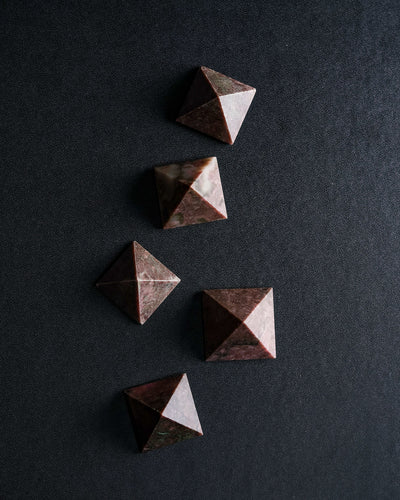
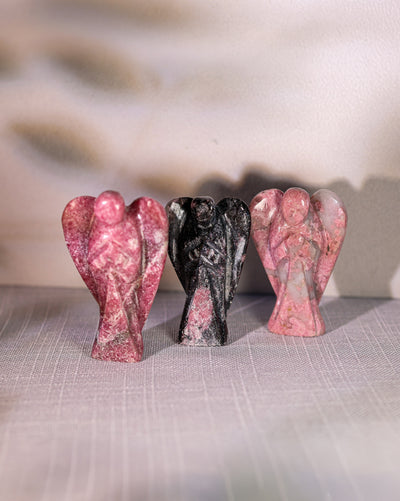
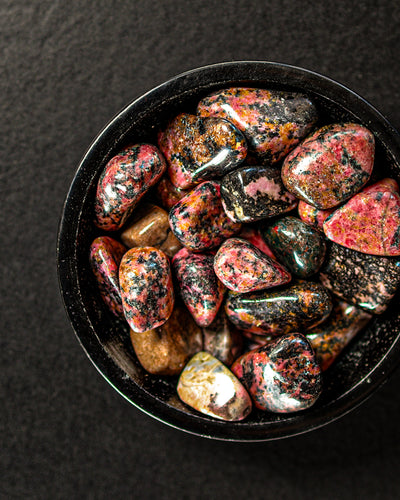
Rhodonite is the stone you reach for when your heart is still tender from something that hasn't healed yet. Its rose-pink body, threaded through with black manganese, mirrors exactly what it does: it holds beauty and old scar tissue in the same breath and asks you to make peace with both. Rhodonite supports love and relationships by teaching forgiveness without self-erasure, and it steadies emotional healing by grounding intense feeling in the body instead of letting it spiral. This is a working stone, not a decorative one — it wants your hardest feelings, not just your good days.
Key Traits
- Rose-pink to brick-red body with black manganese veining
- Heart-chakra stone for compassion and forgiveness
- Grounds intense emotion in the body
- Manganese inosilicate, Mohs 5.5–6.5
- Long linked to Russian craftsmanship and folklore
Intentions
Brief Overview
Rhodonite is a manganese-rich silicate best known for its warm rose-pink color and the dark, web-like veining that runs through nearly every specimen. It has carried a reputation as a heart stone for centuries, prized in Russia both as a decorative material for imperial commissions and as a folk talisman of protection and forgiveness. In crystal healing tradition, it's worked with less for what it promises and more for what it helps you finish — old resentment, unspoken hurt, the parts of a relationship you haven't fully let go of.
Properties
Rhodonite is traditionally used to support the slow, unglamorous work of emotional repair. In crystal healing tradition it's said to bring buried resentment and grief to the surface so it can actually be released, rather than letting it calcify into bitterness or self-blame. It's often worked with for its steadying effect on the heart chakra, helping you extend compassion — to others and to yourself — without losing your footing in the process.
Metaphysical Properties
- Encourages forgiveness without self-abandonment
- Brings buried resentment to the surface for release
- Steadies the heart chakra during emotional repair
- Supports awareness of codependent and people-pleasing patterns
- Grounds intense feeling instead of letting it overwhelm you
Physical Properties
- Type: Manganese inosilicate mineral
- Color: Rose-pink to brownish-red, usually with black manganese oxide veining
- Luster: Vitreous to pearly
- Structure: Triclinic, typically massive or granular rather than well-formed crystals
Meaning & Energy
Rhodonite carries a very specific kind of energy: tender but not soft, grounded but not closed off. It doesn't ask you to bypass pain or rush toward positivity — it asks you to stay present with what hurt, name it honestly, and then set it down. That combination of emotional honesty and forward motion is what makes it feel less like comfort and more like repair.
Emotions
When you're carrying an old hurt — a betrayal, a falling-out, a version of yourself you're still forgiving — Rhodonite gives that feeling somewhere to go. It supports you in naming resentment or anger instead of swallowing it, and in extending compassion to yourself for however long healing actually takes. Held or worn during a hard conversation, it can help you stay grounded instead of reactive, so you respond from strength rather than old wounds.
Crystal Pairings
- Rose Quartz – deepens emotional softness and compassion
- Black Tourmaline – grounds heart healing and adds protective boundaries
- Clear Quartz – amplifies emotional release and clarity
- Lepidolite – eases racing thoughts during heart-centered healing
Science & Origin
Rhodonite takes its name from the Greek rhodon, "rose," a nod to its blush-to-brick color. It was first formally described from Russia's Ural Mountains in 1819, though the region had already prized it for generations — the same deposits later supplied the stone carved for tsarist commissions.
- Also Known As: Rescue Stone, Stone of Forgiveness
- Formation: Forms in manganese-rich metamorphic rock and hydrothermal deposits, with black manganese oxide veining developing along fractures over time
- First Discovery: 1819, Ural Mountains, Russia
- Safety Note: Safe to handle in tumbled or polished form; avoid prolonged water contact on raw manganese-oxide veining
Ancient Myths
- In Russian folk tradition, rhodonite was called the "eagle stone," or orlets, from the belief that eagles lined their nests with it to protect and strengthen their young — parents later placed a piece in a child's cradle for the same protection.
- Carvers in the Ural Mountains prized rhodonite for imperial commissions, and it was used for one of the sarcophagi at St. Petersburg's Peter and Paul Cathedral, cementing its reputation as a stone fit for royalty.
- Travelers in old Russia carried rhodonite as a talisman for safe return, trusting its grounded pink ray to guide them back to the people they loved.
Chakras Table
| Chakra | Connection | Healing Focus | Energy Type |
|---|---|---|---|
| Root | Grounded love | Stability during emotional release | Physical |
| Heart | Primary center of the stone | Compassion, forgiveness, repair | Emotional |
Planets Table
| Planet | Influence | Energy |
|---|---|---|
| Venus | Love & harmony | Warmth in relationships |
| Mars | Courage & action | Strength to set boundaries |
Zodiacs Table
| Zodiac | Attribute | Benefit |
|---|---|---|
| Taurus | Steadfastness | Nurtures loyal, grounded love |
| Aries | Boldness | Tempers impulsiveness with empathy |
| Leo | Passion | Balances pride with heart-centered wisdom |
Elements Table
| Element | Power | Aspect |
|---|---|---|
| Earth | Stability | Keeps healing grounded in the body |
| Fire | Transformation | Turns old pain into forward motion |
Sacred Numbers Table
| Number | Vibration | Meaning |
|---|---|---|
| 1 | Individuality | Rebuilding confidence and self-worth |
| 6 | Harmony | Compassion, nurturing, reconciliation |
| 9 | Completion | Releasing what's finished so you can move on |
Color Variations
- Classic rose-pink with black manganese webbing
- Deep brick-red to maroon in more iron-rich specimens
- Pale blush pink with minimal veining, often from Madagascar
- Rare gem-quality translucent crystals, faceted only occasionally
Mohs Scale Hardness
Rhodonite sits at 5.5 to 6.5 on the Mohs scale, similar to many feldspars. That's durable enough for everyday jewelry and tumbled stones with reasonable care, but soft enough that it can scratch if stored loosely against harder minerals like quartz.
Chemical Formula
Rhodonite's chemical formula is (Mn,Fe,Mg,Ca)SiO₃ — a manganese-dominant silicate that typically carries smaller amounts of iron, magnesium, and calcium substituting into the structure.
- Manganese (Mn): the dominant element responsible for the pink-to-red body color
- Silicon and oxygen (SiO₃): form the inosilicate, or chain-silicate, structure
- Iron, magnesium, calcium: trace substitutions that vary the exact shade
- Manganese oxide: forms the black veining along fractures
Summary of Composition
- Mineral Class: Inosilicate
- Crystal System: Triclinic
- Transparency: Opaque to translucent
- Luster: Vitreous to pearly
Care Instructions
- Clean with a soft, dry or lightly damp cloth
- Avoid prolonged soaking, especially on raw manganese-veined pieces
- Store separately from harder stones like quartz or amethyst to prevent scratching
- Keep out of direct, prolonged sunlight to preserve color depth
Final Summary
Rhodonite doesn't erase what hurt you — it helps you carry it differently. Held close during the work of forgiving, grounding, or simply staying steady, it turns old wounds into quiet strength instead of buried weight.


