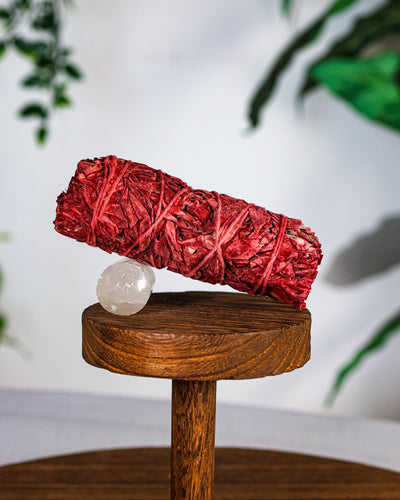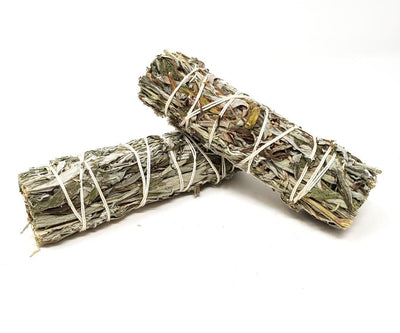
Some nights the mind refuses to hand the day over. It replays a conversation, rehearses tomorrow, and keeps the body awake in a room that has already gone dark. Mugwort, sold across the smudge trade as Black Sage, is the plant people have reached for in exactly that hour for more than a thousand years, burned in a thin ribbon of smoke that smells faintly of pepper, mint, and damp wood. Where a bundle of white sage sweeps a room clean, mugwort lowers the lights and supports intuition and clarity, holding a quiet perimeter of protection around whatever surfaces once you turn inward.
Key Traits
- Grey-green lobed leaves with silver-white undersides on reddish stems
- Soft, spicy, faintly peppermint smoke rather than the sharp resin of true sage
- Traditionally burned before sleep, meditation, scrying, or journaling
- An herb of the Artemisia family, not a botanical sage despite the trade name
- Associated with the moon, with dreaming, and with the inward turn
Intentions
Brief Overview
Mugwort is Artemisia vulgaris, a wayside perennial that grows along roadsides, riverbanks, and disturbed ground across Europe, temperate Asia, and North America. In the American smudge trade it is bundled and sold as Black Sage, a name it shares with the western species Artemisia douglasiana and Artemisia nova, and occasionally with Salvia mellifera, a true Salvia that is a different plant entirely. Whichever Artemisia is in the bundle, the traditional use is consistent: it is burned for dreams, visions, introspection, and protection during inward work, and it is one of the few ritual herbs valued more for what it opens than for what it clears away.
Properties
Mugwort works at the seam between waking and sleeping. Folk practice reaches for it to support dream recall, to soften the mental chatter that keeps a person circling the same thought, and to give divination work a settled, alert quality. It is not a stimulant and not a sedative; it is an herb of attention turned inward, traditionally paired with a scrying mirror, a journal, or a pillow. Its second and older reputation is protective, running back through the Anglo-Saxon charms and the Roman roads, where it was carried against weariness and against harm on the way.
Metaphysical Properties
- Supports vivid, memorable dreaming and easier dream recall
- Sharpens intuition and steadies the mind before divination or scrying
- Offers a protective boundary during meditation, trance, and inward work
- Encourages honest introspection without the harshness of self-criticism
- Clears stale, heavy air from a room while inviting quiet rather than brightness
Physical Properties
- Type – Dried aromatic botanical, genus Artemisia, family Asteraceae
- Color – Grey-green upper leaf, silver-white beneath, stems flushed reddish-purple
- Luster – Matte with a fine downy sheen on the leaf underside
- Structure – Deeply lobed pinnate leaves on erect woody-based stems, bundled and tied for burning
Meaning & Energy
Mugwort carries the character of the moon: not bright, not loud, but persistent and revealing. The Anglo-Saxons called it Una, the oldest of herbs, and the name fits the way it behaves in ritual, arriving with the authority of something that has been doing this work far longer than we have. Its energy is receptive rather than assertive. It does not push a room into order; it slows the room down until you can hear what was already there.
Emotions
Reach for mugwort when your feelings have gone underground and you can tell something is moving but cannot name it. It suits the tender, unglamorous work of processing: the grief that only shows up at night, the decision you keep avoiding, the resentment you have not admitted to yet. Burned in a small amount before bed or before you write, it supports the kind of calm that lets you look at something difficult without flinching from it. You are not being asked to fix anything, only to stop looking away.
Crystal Pairings
- Amethyst – Settles a racing mind at bedtime and supports clearer dream recall
- Labradorite – Holds a protective edge around trance, journeying, and deep inward work
- Moonstone – Deepens the lunar, receptive quality mugwort is already known for
- White Sage – Clears the room first so mugwort's smoke has quiet to work in
Science & Origin
Mugwort belongs to the sunflower and daisy family, Asteraceae, not to the mint family that holds the true sages. Its scent comes from volatile oils concentrated in the leaf, chiefly cineole and camphor alongside small quantities of thujone, the bitter compound better known from wormwood and traditional absinthe. The amounts present in a smudge bundle are low, and burning is not the same as ingesting, but the plant's chemistry is the reason it is treated with more care than a bundle of lavender.
- Also Known As – Black Sage, Dream Weed, Magical Sage, Artemis Herb, St. John's Plant, Sailor's Tobacco, Felon Herb
- Formation – Herbaceous perennial of roadsides, riverbanks, and disturbed ground; harvested in leaf, dried, and hand-tied into bundles
- First Discovery – Named first among the nine sacred herbs in the tenth-century Anglo-Saxon Lacnunga manuscript; classified as Artemisia vulgaris by Linnaeus in 1753
- Safety Note – For ritual burning only, never internal use. Avoid during pregnancy and nursing. Those sensitive to ragweed may react to the daisy family. Burn over a fireproof dish with ventilation and extinguish in sand rather than water
Ancient Myths
- The Anglo-Saxon Nine Herbs Charm addresses mugwort before all other plants, naming it Una, the oldest of herbs, with power against poison and against sickness carried on the air.
- The genus Artemisia takes its name from Artemis, goddess of the moon and of wild places, tying the plant to lunar timing and to women's traditions across the classical world.
- In European midsummer custom mugwort was called St. John's plant, worn as a girdle on St. John's Eve and cast into the bonfire so the year's misfortune would burn away with it.
Chakras Table
| Chakra | Connection | Healing Focus | Energy Type |
|---|---|---|---|
| Third Eye | Primary | Dream recall, inner sight, honest self-perception | Receptive and perceptive |
| Crown | Secondary | Quiet connection during meditation and trance | Still and opening |
Planets Table
| Planet | Influence | Energy |
|---|---|---|
| Moon | Dreams, cycles, the inward turn, intuition after dark | Reflective |
| Venus | Traditional herbal rulership; tenderness toward the self | Softening |
Zodiacs Table
| Zodiac | Attribute | Benefit |
|---|---|---|
| Cancer | Lunar, feeling-led, protective of home | Gives emotional undercurrents a place to surface safely |
| Pisces | Dreaming, permeable, imaginative | Adds a protective edge to an already open inner world |
Elements Table
| Element | Power | Aspect |
|---|---|---|
| Earth | Rootedness through the body and the breath | Keeps inward work from drifting |
| Air | Thought, dream imagery, message | Carries what the mind has been holding back |
Sacred Numbers Table
| Number | Vibration | Meaning |
|---|---|---|
| 9 | Completion and old knowledge | Mugwort stands first among the nine herbs of the Anglo-Saxon charm |
| 7 | Inner sight and quiet study | Suits solitary dreamwork, scrying, and reflective ritual |
| 2 | Duality and threshold | The plant of the seam between waking and sleeping |
Color Variations
- Grey-green – The standard dried bundle, soft-toned and slightly dusty in appearance
- Silver-white – The felted underside of every leaf, visible whenever the bundle is turned
- Bronze to near-black green – Drought-stressed or late-season growth, the shade that earned the trade name Black Sage
- Reddish-purple – The stems, which stay noticeably darker than the foliage even after drying
Mohs Scale Hardness
Mugwort has no Mohs value, as the scale measures mineral scratch resistance and this is a botanical. Practically, treat it as fragile: dried Artemisia leaf crumbles under pressure, sheds easily when handled, and will powder in a drawer if crushed. Store bundles loosely and lift them by the wrapped end rather than the leaf.
Chemical Formula
A plant has no single formula, but the compound most responsible for mugwort's character is thujone, C₁₀H₁₆O, present in small amounts alongside 1,8-cineole (C₁₀H₁₈O) and camphor (C₁₀H₁₆O).
- Carbon (C) – 10 atoms, forming the bicyclic terpene skeleton
- Hydrogen (H) – 16 atoms, completing the ring structure
- Oxygen (O) – 1 atom, the ketone group that carries the sharp, bitter note
Summary of Composition
- Mineral Class – None; botanical, family Asteraceae, genus Artemisia
- Crystal System – Not applicable; herbaceous perennial plant matter
- Transparency – Opaque
- Luster – Matte with a fine downy sheen beneath the leaf
Care Instructions
- Store your bundle in a dry, dark place with air movement; sealed plastic invites mildew
- Light the tip, let the flame catch, then blow it out so the bundle smoulders rather than burns
- Rest it on a fireproof dish and extinguish it by pressing the lit end into sand, never water
- Open a window before you begin and keep smoke away from pets, infants, and anyone sensitive to the daisy family
Final Summary
Mugwort is the herb you burn when the answer is not going to arrive while you are busy. It has been called the oldest of herbs for a thousand years, and it still does the same quiet work: lowering the noise, guarding the edges, and letting the night give back what the day would not. Light it, let the smoke thin out, and pay attention to what you dream.