


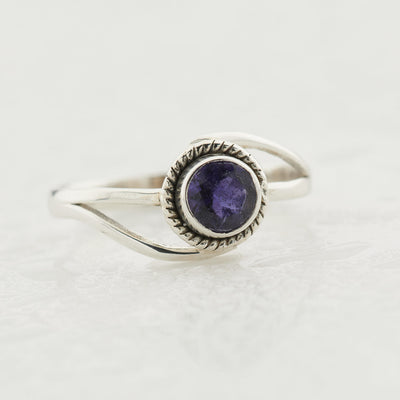
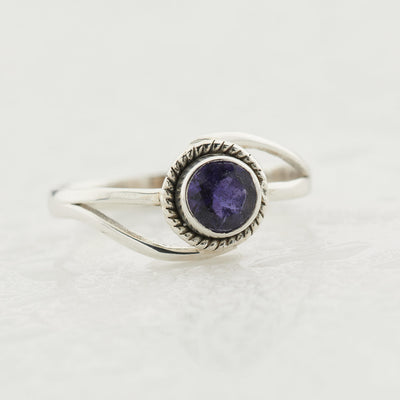
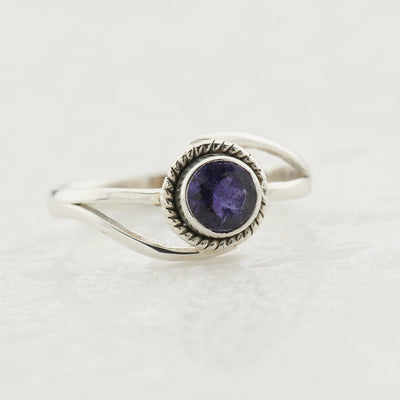
You know exactly what you think until someone else walks into the room. Iolite is the stone for that moment: a violet-blue vision stone traditionally used for intuition and clarity, and for the confidence to say what you see. Turn it in your fingers and the color slides from deep violet to pale blue to straw, one crystal giving three different answers depending on where you stand. It is a tool for finding your own angle and holding it.
Key Traits
- Shifts from violet-blue to pale blue to straw yellow as you turn it
- Gem variety of the mineral cordierite, once sold as water sapphire
- Known in crystal tradition as a vision stone for the third eye
- Used to support self-expression free of other people's expectations
- Not typically treated, so its color is its own
Intentions
Brief Overview
Iolite is the gem name for cordierite, a hard violet-blue silicate best known for pleochroism, the habit of showing different colors along different crystal directions. Crystal tradition treats it as a vision stone: one that activates the third eye and supports visualization and intuitive understanding once the chakras are aligned. It has a long association with shamanic ceremony and inward work, and with the kind of self-knowledge that lets you act from who you are instead of who you are expected to be.
Properties
Iolite is traditionally used to stimulate connection with inner knowing, making it a companion for meditation, visualization and any decision you need to make from the inside out. It is associated with understanding the roots of old habits you have outgrown, clearing crowded, repetitive thinking, and easing discord between people. In crystal tradition it is also said to re-energize the aura on contact and bring the subtle bodies into alignment.
Metaphysical Properties
- Traditionally activates the third eye and supports visualization
- Said to strengthen connection with inner knowing
- Used in shamanic ceremony as a companion for out-of-body travel
- Associated with clearing cluttered, repetitive thought
- Encourages taking responsibility for yourself within relationships
Physical Properties
- Type: Cordierite, a magnesium iron aluminum silicate
- Color: Violet-blue to blue, turning pale blue, gray or straw yellow with the viewing angle
- Luster: Vitreous (glassy)
- Structure: Orthorhombic, in short prismatic crystals
Meaning & Energy
Iolite means perspective. A stone that is violet from one side and nearly colorless from another makes a plain point: what you see depends on where you look from, and you are allowed to choose your vantage. Its energy is cool, steady and inward, closer to a held breath than a spark. People work with it when they want fewer opinions and one clear view, and when they are ready to act on what that view shows them.
Emotions
When a relationship has worn into the same argument, or you catch yourself reshaping your answer to keep the peace, iolite is the stone traditionally kept close. It is associated with releasing discord and with standing on your own feet, so that you stop leaning on another person to tell you who you are. It will not do the work for you. What it offers is a steadier look at your own part, and the nerve to say the true thing kindly. Hold it before a hard conversation, or keep it by you while you work out what you actually want.
Crystal Pairings
- Sodalite – steadies your words so honest conversations stay calm and clear
- Labradorite – adds a layer of protection while your intuition opens
- Lapis Lazuli – lends authority and courage to speaking your truth
- Amethyst – quiets the mind for meditation and reflective work
Science & Origin
Iolite is gem-quality cordierite, a magnesium iron aluminum cyclosilicate that grows where clay-rich rocks are heated and squeezed during metamorphism, and occasionally in granites and pegmatites. Iron supplies the violet-blue, and the crystal structure absorbs light differently along each of its three directions, which is why one stone can look violet-blue, pale blue and straw yellow in turn. Unlike most blue gems, iolite is not typically heated, dyed or otherwise treated.
- Also Known As: Cordierite, Water Sapphire, Dichroite
- Formation: Forms during contact or regional metamorphism of aluminum-rich, clay-based rocks, and in some granites and pegmatites
- First Discovery: Described in 1813 from specimens found at Níjar, Almería, Spain, and named cordierite for French geologist Louis Cordier
- Safety Note: Has a cleavage plane and often internal fractures; avoid hard knocks, sudden temperature changes, and ultrasonic or steam cleaners
Ancient Myths
- A popular seafaring legend says Viking navigators sighted the sky through thin slices of iolite to find the sun on overcast days, earning it the name Viking's Compass. The idea was proposed by a Danish archaeologist in the 1960s and remains debated; many researchers favor Iceland spar as the sunstone of the sagas.
- Gem traders long sold iolite as water sapphire for its sapphire-like blue, though the two are unrelated minerals and the name is now considered misleading.
- In shamanic ceremony iolite has been carried as a vision stone, held to open the third eye and accompany out-of-body travel.
Chakras Table
| Chakra | Connection | Healing Focus | Energy Type |
|---|---|---|---|
| Throat | Secondary; supports speaking from your own perspective | Honest, unforced self-expression | Clarifying |
| Third Eye | Primary; the traditional placement for this vision stone | Visualization and intuitive understanding | Illuminating |
| Crown | Tertiary; opens quiet, receptive awareness | Stillness in meditation and reflection | Receptive |
Planets Table
| Planet | Influence | Energy |
|---|---|---|
| Neptune | Intuition, vision and dreams | Subtle, inward |
| Venus | Relationships and harmony | Warm, balancing |
Zodiacs Table
| Zodiac | Attribute | Benefit |
|---|---|---|
| Taurus | Steady and loyal, slow to shift position | Offers a fresh angle without losing your footing |
| Libra | Harmony-seeking and relationship-minded | Supports honesty over keeping the peace |
| Sagittarius | Truth-seeking and independent | Focuses a wide search into one clear view |
Elements Table
| Element | Power | Aspect |
|---|---|---|
| Water | Intuition and emotional depth | Reflective |
| Air | Thought, speech and perspective | Clarifying |
Sacred Numbers Table
| Number | Vibration | Meaning |
|---|---|---|
| 9 | Completion and insight | Seeing the whole picture before you move on |
Color Variations
- Violet-blue – the saturated, sapphire-like shade most prized in gems
- Gray-blue – the softer everyday color of most beads and tumbled stones
- Pale yellow to colorless – the side view of the same crystal, a result of pleochroism
- Bloodshot iolite – a Sri Lankan variety with a reddish sheen from iron oxide inclusions
Mohs Scale Hardness
Iolite rates 7 to 7.5 on the Mohs scale, about as hard as quartz, so everyday dust and handling will not scratch it. Hardness is not the same as toughness, though: iolite has a cleavage plane and can split from a sharp blow, so bracelets and rings deserve a little care around hard surfaces.
Chemical Formula
Iolite's chemical formula is (Mg,Fe)2Al4Si5O18, a magnesium iron aluminum silicate.
- Magnesium (Mg) and Iron (Fe) – share the same site in the structure; iron gives the violet-blue color
- Aluminum (Al) – part of the structural framework
- Silicon (Si) and Oxygen (O) – form the six-membered silicate rings that define a cyclosilicate
Summary of Composition
- Mineral Class: Cyclosilicate
- Crystal System: Orthorhombic
- Transparency: Transparent to translucent
- Luster: Vitreous
Care Instructions
- Wash it in warm, soapy water with a soft cloth, then dry it well
- Skip ultrasonic and steam cleaners, which can open up internal fractures
- Protect it from hard knocks and sudden temperature changes; iolite has a cleavage plane and can split
- Store it apart from harder gems so it stays unscratched, and refresh it overnight in moonlight when it feels dull to you
Final Summary
Iolite never shows the same face twice, and that is its whole teaching: the view changes when you do. Keep it close when you are ready to stop borrowing other people's eyes. What you see next will be yours.


