


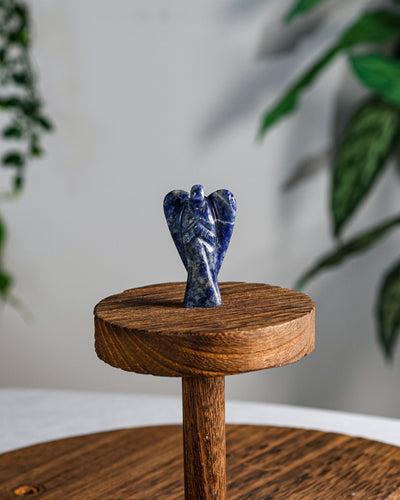

Sodalite is the blue that thinks. Where lapis dazzles, this stone works quietly, drawing a straight line between your reasoning mind and your quieter inner knowing so the two stop arguing and start agreeing. It is prized for intuition and clarity, and for the calm and stress relief it offers when the mind runs hot, all without dulling a single thought. Hold a piece and the noise thins; what is actually true gets easier to hear.
Key Traits
- Unites rational thought with intuitive insight
- Clears mental confusion and rigid, outworn thinking
- Brings emotional balance when feelings run high
- Strengthens self-esteem and fidelity to your own truth
- Long associated with clearing electromagnetic clutter
Intentions
Brief Overview
Sodalite is a royal-blue stone marbled with white, prized as much for the way it clears the head as for the way it looks. Traditionally it is the stone reached for when logic and instinct feel at odds, when the mind is cluttered, or when it is time to say something true out loud. It works on thought and feeling at once, which is why it sits so naturally at the Third Eye and Throat.
Properties
Sodalite settles an overactive mind and organizes it. It dissolves mental confusion and the fixed ideas that keep you stuck, making room for new understanding, and it steadies the emotions underneath the thinking, easing overwhelm and defensiveness. As it clears, it strengthens self-trust, so the clarity it brings is not cold but yours to act on.
Metaphysical Properties
- Bridges logic and intuition into a single clear signal
- Stimulates the Third Eye and deepens meditation
- Releases old conditioning and rigid mental patterns
- Encourages honesty, idealism, and standing by your beliefs
- Brings harmony and trust to group work and shared purpose
Physical Properties
- Type: Tectosilicate, feldspathoid of the sodalite group
- Color: Royal blue to violet-blue, often veined with white calcite
- Luster: Vitreous to greasy
- Structure: Cubic (isometric); usually massive, with distinct crystals rare
Meaning & Energy
The meaning of sodalite lives in the meeting of two things that rarely cooperate: the analytical mind and the intuitive one. Its energy is cool and clarifying rather than electric, less a jolt than a settling. It draws information from the quieter, higher reaches of the mind down to a place you can actually use it, which is why it has such a long reputation as a stone of truth and rational insight.
Emotions
When your thoughts spiral and everything feels urgent, sodalite helps you exhale. It softens a defensive, hypersensitive edge and reaches for the core fears, guilt, and control patterns that keep you from being fully yourself. In their place it builds self-esteem and self-acceptance, so you can meet your own shadow without judgment and speak from a steadier center.
Crystal Pairings
- Clear Quartz – amplifies sodalite's mental clarity and sharpens focus
- Lapis Lazuli – deepens truth-telling and Third Eye insight
- Amethyst – adds calm and quiets an overactive mind
- Black Tourmaline – grounds and shields, echoing sodalite's clearing nature
Science & Origin
Sodalite is a sodium-rich aluminosilicate first described by Thomas Thomson in 1811 from Greenland and named for its sodium content. Most material is massive rather than crystalline, forming the familiar blue stone veined with white calcite, and most specimens fluoresce orange under ultraviolet light.
- Also Known As: Blue Sodalite, Alomite, Princess Blue, Sunset Sodalite
- Formation: Crystallizes in silica-poor, sodium-rich igneous rocks such as nepheline syenites, and in alkaline pegmatites and volcanic ejecta
- First Discovery: 1811, Ilimaussaq complex, Greenland
- Safety Note: Safe to handle; rinse only briefly, avoid salt, and do not use in drinkable elixirs
Ancient Myths
- Because it so closely resembles lapis lazuli, sodalite was long mistaken for and sold as its costlier cousin, and some older lapis lore is now retold about it.
- When the Princess of Wales admired Bancroft sodalite at the 1901 Pan-American Exposition, she ordered a shipment to decorate Marlborough House in London; the Ontario quarry became the Princess Sodalite Mine and its stone was sold as Princess Blue.
- Modern crystal tradition calls sodalite the Poet's Stone and a Stone of Truth, carried to encourage honesty and clear self-expression.
Chakras Table
| Chakra | Connection | Healing Focus | Energy Type |
|---|---|---|---|
| Third Eye | Primary: intuition and inner sight | Mental clarity and insight | Receptive, cooling |
| Throat | Secondary: honest expression | Speaking and verbalizing truth | Expressive, communicative |
Planets Table
| Planet | Influence | Energy |
|---|---|---|
| Jupiter | Wisdom, expansion, and higher truth | Broadening, optimistic |
| Uranus | Sudden insight and original thinking | Awakening, inventive |
Zodiacs Table
| Zodiac | Attribute | Benefit |
|---|---|---|
| Virgo | Analytical precision | Brings intuition into careful, orderly thinking |
| Sagittarius | Truth-seeking idealism | Grounds big-picture vision in clear reason |
Elements Table
| Element | Power | Aspect |
|---|---|---|
| Air | Thought and communication | Clear reasoning |
| Water | Emotional flow | Soothing and cleansing |
Sacred Numbers Table
| Number | Vibration | Meaning |
|---|---|---|
| 4 | Order and stability | Grounded structure that steadies the mind |
| 8 | Balance and inner authority | Self-trust that turns insight into action |
Color Variations
- Deep royal blue laced with white calcite veins, the most familiar form
- Lighter denim-blue, softly mottled and cloud-like
- Rich violet-blue in finer, more saturated specimens
- Hackmanite, a variety that shifts between pink and blue as light changes
Mohs Scale Hardness
Sodalite rates roughly 5.5 to 6 on the Mohs scale, which makes it firm enough to shape and polish but softer than quartz. In practice this means it wears well as a tumbled stone or carving yet can scratch or chip against harder gems, so it is best stored on its own rather than jumbled with tougher crystals.
Chemical Formula
Sodalite is a sodium aluminium silicate chloride with the formula Na8Al6Si6O24Cl2.
- Na – Sodium, the defining element the stone is named for
- Al – Aluminium, part of the aluminosilicate framework
- Si – Silicon, forming the silicate structure
- O – Oxygen, bound throughout the lattice
- Cl – Chlorine, held within the cage-like framework
Summary of Composition
- Mineral Class: Tectosilicate (feldspathoid, sodalite group)
- Crystal System: Cubic (isometric)
- Transparency: Transparent to translucent in rare crystals; translucent to opaque in massive form
- Luster: Vitreous to greasy
Care Instructions
- Rinse briefly under cool water or wipe with a damp cloth, then dry promptly
- Skip long soaks and salt, which can dull the polish
- Cleanse with smoke, sound, or a night on a selenite plate
- Store separately from harder stones to prevent scratches
Final Summary
Sodalite is the stone for the moment your head is full and your truth is somewhere underneath it. It clears the clutter, reconciles logic with intuition, and hands the quiet back to you along with the confidence to say what you mean. Keep one close when you need to think clearly and stay honest with yourself.


