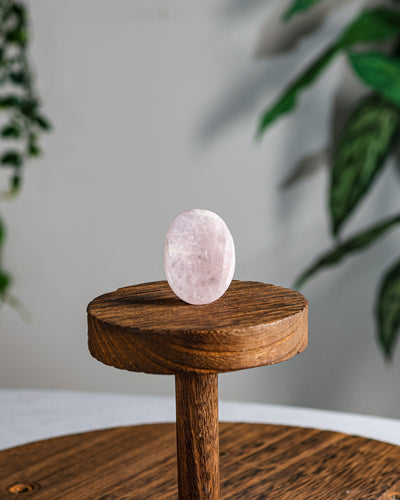
Yerba Santa, the holy herb of California's dry hills, carries a gentler smoke than most botanicals reached for after a hard season. Burned for healing and confidence & strength, it does not clear a room so much as sit with it, offering quiet support while a heart mends at its own pace. This is the bundle for tender seasons, when strength needs to feel soft rather than sharp.
Key Traits
- Long, sticky olive green leaves with a resinous, balsamic scent
- A resinous evergreen shrub of the borage family, native to California and Oregon
- Burned for matters of the heart more often than for clearing a space
- Named the holy herb by Spanish missionaries after Indigenous Californian use
- A gentler, softer smoke than sharper botanicals like desert sage
Intentions
Brief Overview
Yerba Santa, Eriodictyon californicum and related species, is a resinous evergreen shrub of the borage family native to the dry hills of California and Oregon. Scott Cunningham writes that it is carried to attain beauty, added to baths for the same purpose, and kept close for spiritual strength, psychic ability, and protection, and notes that modern smoke-cleansing practice often reaches for it in matters of the heart.
Properties
Yerba Santa works as a soft, steadying companion rather than a sweeping reset. Its smoke is reached for during a tender season, after heartbreak, or any time strength needs to feel gentle rather than forceful. Folk tradition credits it with opening the heart, supporting emotional release, and lending a quiet sense of spiritual strength to whoever carries or burns it.
Metaphysical Properties
- Supports emotional release and a heart that is still mending
- Traditionally carried or burned to encourage a felt sense of inner beauty
- Lends quiet spiritual strength during difficult or tender seasons
- Offers gentle protection without a harsh or overpowering smoke
- Supports psychic awareness and a softer form of intuition
Physical Properties
- Type – Dried resinous shrub leaves, genus Eriodictyon, family Boraginaceae
- Color – Olive to deep green leaves, sticky and resinous to the touch
- Luster – Slightly glossy from natural leaf resin
- Structure – Long, narrow leaves on woody stems, bundled for burning
Meaning & Energy
Yerba Santa carries the character of something that has learned patience with tenderness. It does not ask a wound to close quickly, and it does not mistake softness for weakness. Burned in a home, it brings a quiet, steadying presence, the kind that sits beside you rather than pushing you forward.
Emotions
Reach for Yerba Santa when your heart feels bruised rather than simply tired, or when the strength you need has to be gentle to be useful at all. It suits the season after a loss, the slow work of rebuilding confidence, or any stretch where you need protection that does not feel harsh. You are not asked to rush your healing here. You are given permission to be both tender and strong at the same time.
Crystal Pairings
- Rose Quartz – Deepens the tenderness Yerba Santa opens in the heart
- Black Tourmaline – Reinforces the gentle protection Yerba Santa offers
- Amethyst – Softens the healing process Yerba Santa supports
- Rhodonite – Echoes Yerba Santa's focus on emotional release and heart healing
Science & Origin
Yerba Santa is most often Eriodictyon californicum, a resinous evergreen shrub of the borage family native to the dry hills of California, with related species extending into Oregon. Its long, sticky leaves carry a balsamic, resinous fragrance that becomes more pronounced when the dried leaves are burned.
- Also Known As – Holy Herb, Sacred Herb, Mountain Balm, Bear Weed
- Formation – Resinous evergreen shrub, leaves harvested and air-dried
- First Discovery – Used by Chumash and other Indigenous Californian peoples long before Spanish colonists recorded and named it in the 18th century
- Safety Note – Burn in a ventilated space over a fireproof dish
Ancient Myths
- Spanish missionaries in California named the plant yerba santa, the holy herb, after learning of its virtues from Indigenous peoples.
- Cunningham lists its folk names as Sacred Herb, Holy Herb, and Mountain Balm, a record of the reverence it has carried.
- Tradition recorded by Cunningham holds that yerba santa leaves worn around the neck were believed to offer protection from harm.
Chakras Table
| Chakra | Connection | Healing Focus | Energy Type |
|---|---|---|---|
| Heart | Primary | Supporting a heart that is still mending | Soft and steadying |
| Third Eye | Secondary | Opening a gentler, quieter form of intuition | Subtle and receptive |
Planets Table
| Planet | Influence | Energy |
|---|---|---|
| Venus | Traditional rulership of beauty, love, and inner worth | Soft and affirming |
| Moon | Traditional rulership of emotion and quiet intuition | Reflective and gentle |
Zodiacs Table
| Zodiac | Attribute | Benefit |
|---|---|---|
| Libra | Balanced, relational, drawn to harmony | Supports gentle emotional balance and beauty |
| Cancer | Nurturing, sensitive, deeply feeling | Echoes the herb's focus on heart healing |
Elements Table
| Element | Power | Aspect |
|---|---|---|
| Water | Emotion, intuition, gentle flow | Supports the softening and release the smoke invites |
Sacred Numbers Table
| Number | Vibration | Meaning |
|---|---|---|
| 6 | Harmony and restoration | Reflects Venus's gentle, affirming influence on Yerba Santa |
| 2 | Balance and quiet partnership | Reflects the Moon's reflective, emotional influence on Yerba Santa |
Color Variations
- Olive green – The common shade of most dried leaves
- Deep forest green – Fresher or less sun-exposed leaves
- Yellow-green – Older or more weathered leaves
- Amber-tinted – Leaves with visible natural resin
Mohs Scale Hardness
Yerba Santa has no Mohs value, since the scale measures mineral hardness and this is a dried botanical. In practical terms, treat its leaves as delicate: they are naturally sticky and can crumble once fully dried, so handle bundles gently and store them where they will not be crushed.
Chemical Formula
Yerba Santa has no single formula, but its resinous, balsamic scent comes chiefly from flavonoid compounds, including eriodictyol, built from carbon, hydrogen, and oxygen atoms.
- Carbon (C) – Forms the compound's core ring structure
- Hydrogen (H) – Fills out the molecule's ring and chain bonds
- Oxygen (O) – Present in the flavonoid groups behind the leaf's resinous character
Summary of Composition
- Mineral Class – None; botanical, family Boraginaceae, genus Eriodictyon
- Crystal System – Not applicable; resinous evergreen shrub
- Transparency – Opaque
- Luster – Slightly glossy from natural leaf resin
Care Instructions
- Store dried leaves in a sealed container away from direct light and heat
- Burn small amounts over a fireproof dish in a well-ventilated space
- Handle bundles gently, since the sticky, resinous leaves can crumble
- Refresh bundles occasionally, since the leaves' fragrance softens over time
Final Summary
Yerba Santa has spent generations proving that strength does not have to be loud to be real. Burn a little during a tender season, and let its soft, resinous smoke remind you that healing at your own pace is still healing.