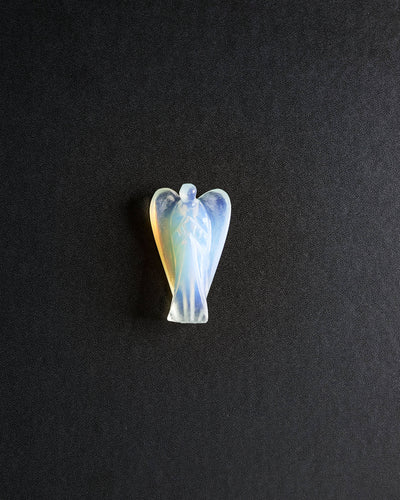
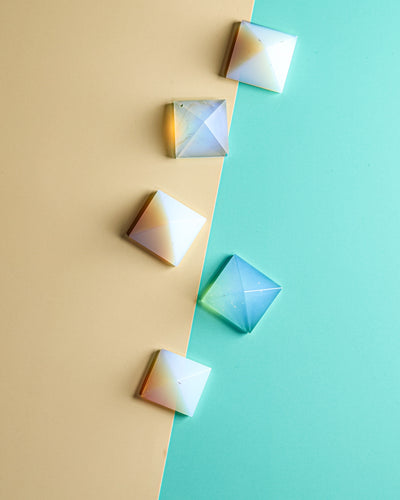
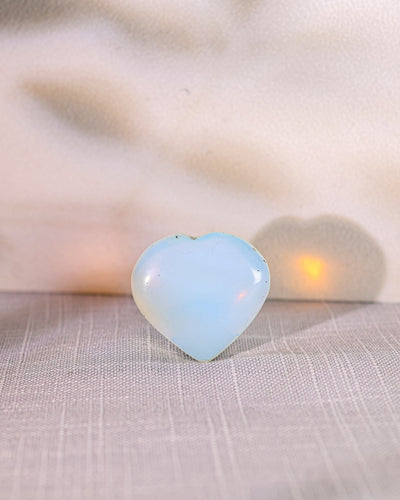
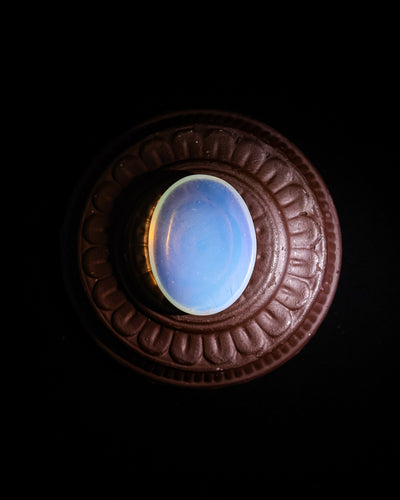
Some days the noise inside runs louder than anything outside, a restless static that makes it hard to think clearly or say what you actually mean. Opalite meets that static with an unusual stillness, a cool milk-and-moonlight calm that settles the frayed edges and lets your own intuition surface again. Though it is a man-made opalized glass rather than a mined stone, its soft blue glow has earned a real place on the meditation cushion and the nightstand. Hold it, and the mind grows quiet enough to hear itself.
Key Traits
- A cool, milky glow that reads as instant calm
- Man-made opalized glass, prized for its opal-like shimmer
- Gently sharpens intuition and inner listening
- Eases honest, unforced communication
- A steadying companion through change and transition
Intentions
Brief Overview
Opalite is one of the few stones on the shelf that is openly made by human hands. It is an opalescent glass, engineered in modern times to capture the dreamy shimmer of natural opal at a fraction of the cost. What it lacks in geological pedigree it makes up for in feel: collectors and practitioners keep returning to it for its soft, cooling presence and the way it seems to take the temperature down on an overheated mind. It is a stone of quiet, and of the clarity that quiet makes possible.
Properties
Opalite works like a slow exhale. Its calm is not sedating so much as clearing; it eases the mental clutter that muffles intuition, so subtle impressions and gut feelings have room to register. Many keep it close during meditation, journaling, or difficult conversations, where its steadying influence helps them stay open rather than reactive. It is often reached for during periods of change, when the ground feels unsettled and a little inner stillness goes a long way.
Metaphysical Properties
- Calms mental static and eases everyday stress
- Opens and clears intuition and inner listening
- Supports honest, gentle communication
- Encourages emotional balance during transitions
- Invites a soft, receptive state well suited to meditation
Physical Properties
- Type: Man-made opalized glass (amorphous silica)
- Color: Milky white with blue and violet iridescence
- Luster: Vitreous to opalescent
- Structure: Amorphous, no crystalline structure
Meaning & Energy
Opalite carries the meaning of the threshold, the pause between what was and what comes next. Its glow shifts with the light behind it, milky in shadow and lit with blue when the sun catches it, and that changeability is part of its character: it speaks to moving between states with grace. As an energy it is cool and lunar rather than fiery, less about pushing forward and more about softening, settling, and seeing clearly before you act.
Emotions
When your feelings are running high or tangled, Opalite offers a place to set them down. It can help you name what you feel without being swept away by it, and it softens the urge to shut down or lash out when a conversation gets tender. If you tend to hold your words back, it gently encourages you to speak; if you tend to spill them, it helps you slow down and choose. The result is a steadier, kinder relationship with your own emotions, and with the people you share them with.
Crystal Pairings
- Moonstone – deepens intuition and emotional flow for a gentle, lunar pairing
- Amethyst – adds calm and mental clarity for meditation and rest
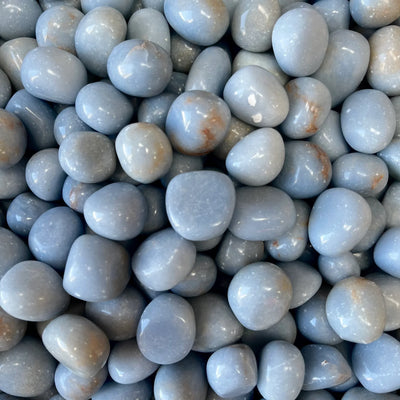
- Angelite – supports peaceful, honest communication when words feel hard to find
- Clear Quartz – amplifies and focuses Opalite's calming intention
Science & Origin
Opalite is not a mineral but a manufactured opalescent glass, made primarily from silica and fused with dolomite and metal oxide additives that scatter light to create its blue-white sheen, rather than by any internal rainbow structure. It is a modern product made to echo the look of natural opal and moonstone, and it is sometimes sold as "opal moonstone" even though it is neither. Small air bubbles trapped during manufacturing are a common telltale sign of its glass origin.
- Also Known As: Opalized Glass, Glass Opalite, Sea Opal, Opal Moonstone (a misleading trade name), Argonon or Argenon, Ice-Cream Stone
- Formation: Man-made; silica-based glass melted with dolomite and metal oxide additives, then cooled and solidified
- First Discovery: Man-made, with no single fixed date; the broader lab-created opal field traces to Pierre Gilson's 1972 synthetic opal, though today's glass Opalite is a separate, later product
- Safety Note: Brittle glass that can chip to sharp edges; cleanse gently with water and avoid harsh chemicals; not for drinkable elixirs
Ancient Myths
- As a modern man-made glass, Opalite has no ancient legend of its own; the lore around it is borrowed from natural opal and moonstone.
- Because it mirrors opal's shimmer, sellers have lent it opal's old reputation as a stone of vision and inner sight.
- Its pale, moonlit glow has led modern crystal circles to link it, like moonstone, to the moon and to intuition.
Chakras Table
| Chakra | Connection | Healing Focus | Energy Type |
|---|---|---|---|
| Heart | Softens emotional guardedness | Emotional balance and openness | Soothing |
| Third Eye | Opens intuition and inner sight | Insight and inner listening | Perceptive |
| Crown | Links to quiet awareness and stillness | Mental calm and clarity | Receptive |
Planets Table
| Planet | Influence | Energy |
|---|---|---|
| Moon | Governs emotion, intuition, and cycles | Cool, reflective, receptive |
Zodiacs Table
| Zodiac | Attribute | Benefit |
|---|---|---|
| Cancer | Emotional depth and sensitivity | Calms feeling and steadies mood swings |
| Pisces | Dreamy intuition and compassion | Gives sensitive intuition a calm, clear channel |
Elements Table
| Element | Power | Aspect |
|---|---|---|
| Water | Flow and feeling | Emotional cleansing and adaptability |
Sacred Numbers Table
| Number | Vibration | Meaning |
|---|---|---|
| 2 | Receptivity and harmony | Listening, sensitivity, and partnership, the Moon's number |
Color Variations
- Blue against a dark background, the most familiar look
- Milky white with a warm orange or pink glow against a light background
- Violet and lavender flashes when light strikes at an angle
- Soft aqua-green tones in some pieces
Mohs Scale Hardness
Opalite sits at roughly 5 to 6 on the Mohs scale, close to natural opal and ordinary window glass. That makes it firm enough to hold a smooth polish and everyday wear, yet soft enough to scratch against harder stones or steel and brittle enough to chip if dropped. Store it apart from quartz and other harder crystals, and handle it with a little care.
Chemical Formula
As a silica glass, Opalite is built mainly on silicon dioxide, written SiO2, fused with dolomite and metal oxide additives that create its opalescent, light-scattering glow.
- Silicon (Si) – the glass-forming backbone, bonded with oxygen
- Oxygen (O) – the other half of the silica network
- Dolomite and metal oxide additives – added to scatter light and produce the blue-white sheen
Summary of Composition
- Mineral Class: Not a true mineral, man-made glass
- Crystal System: None (amorphous)
- Transparency: Translucent to opalescent
- Luster: Vitreous to opalescent
Care Instructions
- Rinse gently with lukewarm water and dry with a soft cloth
- Keep away from harsh chemicals, perfumes, and prolonged salt
- Store separately so harder stones do not scratch it
- Recharge under moonlight rather than harsh, prolonged sun
Final Summary
Opalite asks nothing dramatic of you, only that you slow down enough to hear yourself. Cool, luminous, and quietly steadying, it turns a noisy mind into a clear one and a guarded heart into an open one. For anyone moving through change, it is a small, glowing anchor for calm and clarity.