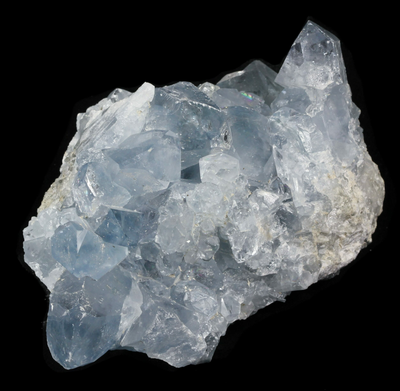
Angelite settles a room the way a held breath finally lets go. Pale blue and quietly luminous, this gentle stone is worked with for Calm & Stress Relief and Intuition & Clarity, easing an overactive mind while opening a clearer, more honest line of communication with yourself and the people around you. It asks little and gives a steady, patient kind of quiet in return.
Key Traits
- Pale sky-blue to white coloring, often with fine white veining
- Soft, water-soluble stone formed from compressed anhydrite
- Long associated with calm, honest communication
- Traditionally carried for meditation and quiet reflection
- One of the softer stones in the collection — handle gently
Intentions
Brief Overview
Angelite is a soft, pale blue stone long connected to peace, patience, and clear-headed communication. Formed as compressed anhydrite, it carries a quiet, settled energy that crystal workers have traditionally reached for when a mind needs slowing down or a difficult conversation needs a gentler tone.
Properties
Angelite is traditionally worked with to quiet mental noise and steady the emotional undercurrent beneath it, making space for clearer thought and more honest expression. It is often placed near the throat to support speaking plainly and kindly, and is carried into meditation for its settled, unhurried presence.
Metaphysical Properties
- Traditionally used to quiet an overactive, racing mind
- Long associated with honest, compassionate communication
- Believed to deepen tuning during meditation and quiet reflection
- Carried as a gentle companion for emotional processing
- Associated in crystal-working tradition with a settled sense of inner peace
Physical Properties
- Type: Anhydrite (calcium sulfate)
- Color: Pale blue to blue-grey, often with white veining
- Luster: Vitreous to pearly
- Structure: Massive, compact aggregate; orthorhombic when crystalline
Meaning & Energy
Angelite carries the kind of calm that comes from settling, not silencing — the sense of a room going quiet after something loud has finally stopped. Its pale color and soft texture mirror the emotional register it is worked with for: patience over urgency, plain speech over performance. Held during meditation or kept near the throat, it is traditionally treated as an invitation to slow down long enough to hear what is actually true.
Emotions
When your thoughts are moving faster than you can sort through them, Angelite offers a place to set them down for a moment. It is traditionally reached for when you need to say something honest but are worried about saying it unkindly, or when grief or worry has left you feeling scattered. Rather than pushing feeling away, it gives you room to meet it calmly, on your own terms.
Crystal Pairings
- Celestine – the mineral family Angelite is often compared to, deepening calm and quiet spiritual attunement
- Blue Lace Agate – softens communication further and supports gentle, unhurried self-expression
- Sodalite – adds clarity and structure to Angelite's calm for grounded, honest conversations
- Aquamarine – reinforces Angelite's throat-centered calm with a steadying, emotionally soothing presence
Science & Origin
Angelite is the trade name given to a pale blue form of anhydrite, a calcium sulfate mineral that forms in evaporite deposits as ancient seas or mineral-rich waters lose their water content over time. Commercial-scale deposits in Peru, first widely worked in the 1980s, remain the material's best-known source.
- Also Known As: Blue Anhydrite, Angel Stone
- Formation: Forms in evaporite deposits as calcium sulfate solutions dehydrate over long geological timescales, often in the same environments that produce gypsum and celestite.
- First Discovery: Large-scale Peruvian deposits brought to market in the 1980s, which gave the trade name its modern popularity
- Safety Note: Angelite is soft and water-soluble — avoid soaking, ultrasonic cleaners, and prolonged sun exposure, all of which can fade its color or damage its surface.
Ancient Myths
- New Age tradition names Angelite one of the "stones of consciousness," said to open a waking line of contact with the angelic realm — the belief that gave the stone its modern name.
- Because Angelite forms as celestite is compressed over vast spans of geological time, folklore has long carried celestite's own reputation as a stone of long-distance communication into Angelite's story as well.
- Healers within crystal-working tradition have carried Angelite into meditative and out-of-body practice, said to keep the practitioner gently tethered to ordinary awareness while attention wanders further afield.
Chakras Table
| Chakra | Connection | Healing Focus | Energy Type |
|---|---|---|---|
| Throat | Central pathway for honest self-expression | Supporting calm, clear communication | Cooling |
| Third Eye | Seat of quiet inner perception | Deepening meditative focus and intuition | Receptive |
| Crown | Point of connection to wider awareness | Encouraging a settled, contemplative state of mind | Subtle |
Planets Table
| Planet | Influence | Energy |
|---|---|---|
| Uranus | Brings sudden clarity and honest insight | Airy, alert |
| Neptune | Deepens intuitive and reflective states | Fluid, dreamlike |
Zodiacs Table
| Zodiac | Attribute | Benefit |
|---|---|---|
| Aquarius | Independent, forward-thinking communication | Helps express original ideas with calm conviction |
| Libra | A natural pull toward harmony and fairness | Supports diplomatic, even-tempered conversation |
Elements Table
| Element | Power | Aspect |
|---|---|---|
| Air | Governs thought, communication, and mental clarity | Clears mental clutter for calmer, plainer speech |
| Water | Governs emotion and intuition | Softens emotional tension into steadier feeling |
Sacred Numbers Table
| Number | Vibration | Meaning |
|---|---|---|
| 2 | The number of balance and partnership | Reflects Angelite's gift for calm, honest exchange between people |
Color Variations
- Pale sky blue — the most common and widely traded form
- Blue-grey with soft white veining, resembling wisps of cloud
- Occasional white or cream-toned material with minimal blue coloring
Mohs Scale Hardness
At roughly 3.5 on the Mohs scale, Angelite is a soft stone that scratches easily and should be kept away from harder materials in storage. This softness is part of why it works its way into jewelry less often than tumbled or display pieces — it rewards gentle handling rather than daily wear.
Chemical Formula
Angelite is composed of anhydrite, with the chemical formula CaSO4.
- Ca — Calcium
- S — Sulfur
- O4 — Oxygen (four atoms)
Summary of Composition
- Mineral Class: Sulfate (anhydrite)
- Crystal System: Orthorhombic
- Transparency: Translucent to opaque
- Luster: Vitreous to pearly
Care Instructions
- Never soak in water — Angelite is water-soluble and can dissolve or pit over time
- Avoid ultrasonic and steam cleaners entirely
- Keep out of direct, prolonged sunlight to prevent fading
- Store separately from harder stones to avoid surface scratches
Final Summary
Angelite does not demand attention so much as invite a slower pace — a pale, quiet stone for the moments when your mind is louder than the room around you. Kept close, it offers exactly what its softness suggests: patience, honesty, and permission to speak and think a little more gently.