Key Traits
- Pairs visionary iolite with grounding granite and azurite
- Rare combination stone from the Karakoram range
- Blue azurite orbs set in pale gray-violet stone
- Prized for meditation and focused intuition work
- One-of-a-kind pattern in every piece
Intentions
Brief Overview
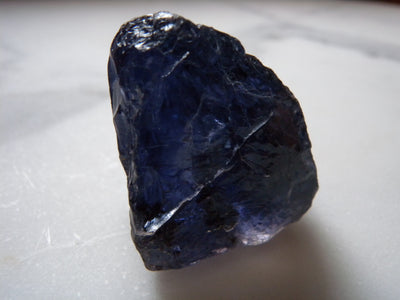
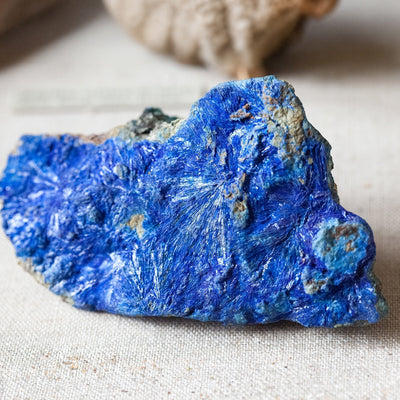
Iolite K2 (Azurite) is a rare combination stone from Pakistan's Karakoram range, pairing a pale granite base with vivid blue azurite nodules and gray-violet iolite crystals. Discovered in the glacial moraine below K2 in the early 2000s, it is prized both for its striking, one-of-a-kind pattern and for the layered clarity its three components bring together.
Properties
This stone works on two registers at once: the granite keeps you grounded while the azurite and iolite open a clearer channel to your own intuition. It is often kept close during meditation, journaling, or any work that asks you to see clearly without losing your footing in the process.
Metaphysical Properties
- Sharpens focus and intuitive insight during meditation
- Grounds visionary or scattered mental energy in the body
- Traditionally used to clear blocks to honest communication
- Supports calm, steady reflection during decision-making
- Believed to align mental clarity with practical follow-through
Physical Properties
- Type: Granite matrix with azurite and iolite (cordierite) inclusions
- Color: Pale gray-violet with deep blue orbs
- Luster: Vitreous to dull (granular)
- Structure: Granular igneous matrix with mineral nodules
Meaning & Energy
Iolite K2 (Azurite) means clarity that stays rooted. Its energy pairs the sky-deep insight of azurite and iolite with the unshakable patience of granite, so vision never floats too far from the ground that has to carry it out.
Emotions
When your thoughts are moving faster than your footing, this stone offers somewhere to slow down. You may notice it easing mental static during meditation, or steadying you when intuition and practicality seem to be pulling in different directions.
Crystal Pairings
- Iolite – the visionary parent stone, doubling this piece's third-eye focus
- Azurite – the stone's own blue partner, deepening intuitive and psychic insight
- Amethyst – brings calming clarity to complement the stone's grounded vision
- Labradorite – adds protective shimmer to this stone's steady, quiet focus
Science & Origin
Iolite K2 (Azurite) is a granite host rock carrying later-formed azurite nodules and separately crystallized iolite (cordierite), all sourced from the same Karakoram deposits near K2.
- Also Known As: K2 Stone, K2 Granite, Azurite Granite
- Formation: Formed as granite crystallized deep underground, then later fractured to allow copper-rich fluids to deposit azurite nodules, with iolite (cordierite) crystallizing separately within the same granite body.
- First Discovery: Early 2000s, in glacial moraine at the base of K2 in Pakistan's Karakoram range
- Safety Note: Azurite is a copper carbonate that can be sensitive to moisture and prolonged water exposure, which may dull its color over time — wipe clean with a dry or barely damp soft cloth rather than soaking.
Ancient Myths
- Norse sailors are said to have carried a light-splitting “sunstone” to find the sun's position through Atlantic overcast — a stone many mineralogists identify as iolite.
- Ancient Egyptian artisans ground azurite into a deep blue pigment used in eye paint and adornment, prizing the stone as a marker of inner sight and unseen knowledge.
- Balti porters who first carried these stones down from the moraine below K2 treated them as a keepsake of the mountain's watchful presence, kept for protection on future climbs.
Chakras Table
| Chakra | Connection | Healing Focus | Energy Type |
|---|---|---|---|
| Root | Anchors visionary insight in the body | Grounding excess mental energy | Stabilizing |
| Throat | Clears blocks to honest expression | Supporting clear communication | Purifying |
| Third Eye | Sharpens inner sight and intuitive focus | Deepening meditation and vision | Activating |
Planets Table
| Planet | Influence | Energy |
|---|---|---|
| Neptune | Vision, intuition, the subconscious | Dreamlike, perceptive |
| Mercury | Communication, mental clarity | Quick, discerning |
Zodiacs Table
| Zodiac | Attribute | Benefit |
|---|---|---|
| Sagittarius | Restless seeker of truth and distant horizons | Channels wandering curiosity into focused insight |
| Virgo | Detail-oriented, analytical mind | Grounds mental clarity in practical discernment |
Elements Table
| Element | Power | Aspect |
|---|---|---|
| Air | Mental clarity and communication | Visionary thought |
| Earth | Grounding and physical stability | Steadying |
Sacred Numbers Table
| Number | Vibration | Meaning |
|---|---|---|
| 7 | Inner wisdom and spiritual insight | A seeker's number tied to quiet reflection and discovered truth |
| 4 | Structure and stability | The number of solid foundations, echoing the stone's granite base |
Color Variations
- Pale gray granite with deep blue azurite orbs — the classic look
- Denser violet-gray zones where iolite crystals cluster
- Occasional white feldspar veining running through the base
- Darker charcoal-gray granite in denser specimens
Mohs Scale Hardness
At roughly 6.5 on the Mohs scale — the hardness of its dominant granite matrix — this stone resists everyday scuffing well, though the softer azurite orbs (closer to 3.5–4) are more delicate and should be protected from sharp knocks.
Chemical Formula
As a combination stone, Iolite K2 (Azurite) has no single formula: its granite base is largely silicate (feldspar and quartz), its azurite is a copper carbonate hydroxide (Cu₃(CO₃)₂(OH)₂), and its iolite is a magnesium-iron aluminum cyclosilicate.
- Silicon and aluminum (Si, Al) — form the granite's feldspar and quartz
- Copper (Cu) — gives the azurite orbs their deep blue color
- Magnesium and iron (Mg, Fe) — key components of the iolite (cordierite) crystals
Summary of Composition
- Mineral Class: Silicate matrix (granite) with carbonate (azurite) and cyclosilicate (iolite) inclusions
- Crystal System: Mixed (granite: variable; azurite: monoclinic; iolite: orthorhombic)
- Transparency: Opaque
- Luster: Vitreous to dull
Care Instructions
- Wipe clean with a dry or barely damp soft cloth — avoid soaking.
- Keep out of direct sunlight for long periods to protect the azurite's blue color.
- Store away from harder gemstones to prevent scratching the softer azurite spots.
- Avoid ultrasonic cleaners and harsh chemical solutions entirely.
Final Summary
Iolite K2 (Azurite) is proof that vision and groundedness can share the same stone. It steadies a wandering mind long enough for real insight to land, and holds it there once it does.