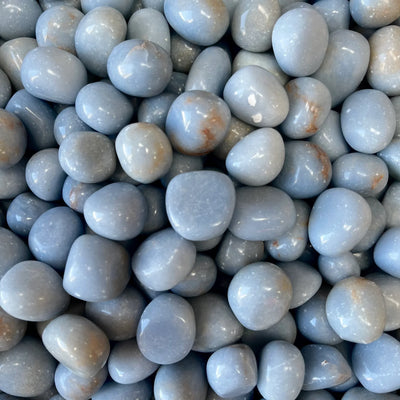
Celestine holds the color of a sky just before dawn — pale, translucent blue tipped with light. Named from the Latin word for "celestial," it has a way of softening a room without doing much at all, which is the quiet genius of the stone. It is turned to for Calm & Stress Relief and Intuition & Clarity, offering a steady lift out of mental noise and into something closer to stillness. Few crystals feel this openly serene in the hand.
Key Traits
- Pale sky-blue coloration with a luminous, almost lit-from-within glow
- Fragile strontium sulfate with a delicate vitreous luster
- Associated with the upper chakras — Throat, Third Eye, and Crown
- Traditionally linked to dream work, meditation, and intuitive reception
- Famously occurs in hollow geodes lined with bladed crystal formations
Intentions
Brief Overview
Celestine is a pale blue strontium sulfate crystal (SrSO4) first formally described in 1799. It is recognized for its translucent heavenly hue, its tabular crystal habit, and its striking appearance inside geodes — particularly those sourced from Madagascar. In metaphysical practice, it is considered one of the gentlest stones available, favored for calming an overactive mind, mental clarity, and spiritual attunement.
Properties
Celestine works like a slow exhale. It eases mental chatter, opens the upper chakras, and creates a soft channel for intuition without overwhelming the senses. Where stronger stones push, Celestine gently draws you upward — into clearer thought, quieter emotion, and a more receptive state of mind. It is a stone for people who need less noise, not more force.
Metaphysical Properties
- Calms an overactive mind and supports restorative sleep
- Opens the Throat Chakra for clearer, gentler self-expression
- Heightens intuitive reception at the Third Eye
- Supports meditation by lifting awareness into subtler frequencies
- Promotes feelings of divine connection and inner peace
Physical Properties
- Type: Strontium sulfate mineral (barite group)
- Color: Pale sky blue; also colorless, white, yellow, and light gray
- Luster: Vitreous to pearly
- Structure: Orthorhombic crystal system, typically tabular or prismatic
Meaning & Energy
Celestine carries the meaning of its name — a bridge between earthbound awareness and something quieter, higher, farther out. Its energy is not bold. It is the feeling of looking up at a soft blue sky and remembering, briefly, that things are larger than the moment you're in. That sense of perspective is what the stone offers: not escape, but spaciousness.
Emotions
If you find your thoughts running faster than you can keep up with, Celestine helps slow the pace. It softens a racing mind without numbing it, making space for you to actually hear yourself. You may find it useful during transitions, grief, or periods of spiritual questioning — times when comfort matters more than certainty. Keep it near you when you want to feel held, not fixed.
Crystal Pairings
- Amethyst – Deepens meditation and supports intuitive dreaming
- Selenite – Clears and amplifies Celestine's gentle upper-chakra energy
- Blue Lace Agate – Enhances calm communication and soothes the throat
- Angelite – Reinforces angelic connection and peaceful expression
Science & Origin
Celestine is strontium sulfate (SrSO4), a member of the barite mineral group. It forms in sedimentary environments, often associated with limestone, dolomite, and evaporite deposits. It is the principal ore of strontium, the element that produces the vivid red color seen in fireworks and emergency flares.
- Also Known As: Celestite
- Formation: Sedimentary environments, frequently lining cavities in limestone and dolomite to form geodes
- First Discovery: Formally described in 1799 by German mineralogist Abraham Gottlob Werner
- Safety Note: Soft and brittle (Mohs 3–3.5); avoid water cleansing, salt, and prolonged sunlight, which can fade the blue color
Ancient Myths
- Named from the Latin caelestis, meaning "celestial," a nod to its heavenly blue hue and perceived connection to the skies above
- In 19th-century spiritualist circles, Celestine was considered a stone of communication with angelic realms and was kept near altars and meditation spaces
- Folk tradition held that placing Celestine near a sleeper's bed invited peaceful dreams and protected against night terrors
Chakras Table
| Chakra | Connection | Healing Focus | Energy Type |
|---|---|---|---|
| Throat | Primary alignment | Clear, gentle expression | Soft, flowing |
| Third Eye | Strong resonance | Intuitive reception | Quietly perceptive |
| Crown | Supportive link | Spiritual connection | Elevating, serene |
Planets Table
| Planet | Influence | Energy |
|---|---|---|
| Neptune | Dreams and higher intuition | Mystical, receptive |
| Venus | Emotional harmony and beauty | Gentle, softening |
Zodiacs Table
| Zodiac | Attribute | Benefit |
|---|---|---|
| Gemini | Mental agility | Quiets an overactive mind |
| Pisces | Intuitive sensitivity | Strengthens spiritual reception |
| Libra | Balance and harmony | Restores emotional equilibrium |
Elements Table
| Element | Power | Aspect |
|---|---|---|
| Air | Clarity of thought | Mental and intuitive lift |
| Water | Emotional flow | Softening and release |
Sacred Numbers Table
| Number | Vibration | Meaning |
|---|---|---|
| 2 | Harmony | Balance, partnership, gentle cooperation |
| 8 | Infinity | Spiritual connection and cyclical renewal |
Color Variations
- Sky Blue: The classic and most prized form, luminous and pale
- Colorless to White: Transparent crystals with a glassy, icy appearance
- Pale Yellow: Gentle warm-toned variety associated with sulfur-bearing deposits
- Light Gray: Subtly muted form often found in sedimentary matrix
Mohs Scale Hardness
Celestine measures between 3 and 3.5 on the Mohs scale, making it one of the softer crystals commonly sold. In practical terms, this means the surface can be scratched easily by a fingernail file or coin, and crystal tips can break with minimal pressure. It should be displayed rather than carried, and never cleansed with water or salt.
Chemical Formula
The chemical formula for Celestine is SrSO4, representing strontium sulfate.
- Sr: Strontium — the defining element, also the source of red pigment in pyrotechnics
- S: Sulfur — a common non-metal found throughout the barite mineral group
- O4: Four oxygen atoms forming the sulfate anion
Summary of Composition
- Mineral Class: Sulfate (barite group)
- Crystal System: Orthorhombic
- Transparency: Transparent to translucent
- Luster: Vitreous, occasionally pearly on cleavage surfaces
Care Instructions
- Never cleanse with water, salt, or liquid solutions — Celestine is soluble and fragile
- Keep out of prolonged direct sunlight, which can fade the pale blue hue
- Store in a padded box or on a stable surface away from harder stones that could scratch it
- Cleanse with moonlight, sound, or dry sage smoke instead of traditional methods
Final Summary
Celestine is the stone you reach for when you need to remember how to be quiet. It doesn't demand transformation — it simply opens a window and lets the sky in. Keep it close when life feels loud, and let its pale blue steadiness do what it has always done: soften, lift, and remind you that peace was never far.