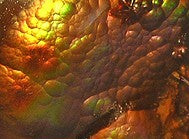
Black Opal holds its color the way a night sky holds starlight — a dark, quiet ground that makes every flash inside it burn brighter. Long worked with for Intuition & Clarity and Confidence & Strength, this rare opal is treated in crystal tradition as a mirror, reflecting back whatever is ready to be seen so it can finally be understood. It rewards patience with depth.
Key Traits
- Dark grey-to-black body tone with vivid internal play-of-color
- The rarest and most prized member of the precious opal family
- Formed from hydrated silica rather than a true crystalline structure
- Long treated in tradition as a mirror for hidden feeling and self-worth
- Best known from the Lightning Ridge fields of New South Wales, Australia
Intentions
Brief Overview
Black Opal is the rarest and most sought-after form of precious opal, prized for the way its dark body tone intensifies the color flashing beneath its surface. Formed from microscopic spheres of silica rather than a crystal lattice, it has long been treated in crystal tradition as a stone of deep intuition, self-worth, and honest reflection.
Properties
Black Opal is traditionally worked with as an amplifier — a stone believed to take whatever feeling or thought is already present and bring it more clearly into view. It is often reached for when self-worth needs reinforcing or when old feelings need a safe surface to rise to, and is treated as a steady companion for meditation and quiet inner work.
Metaphysical Properties
- Traditionally believed to sharpen intuition and psychic perception
- Associated with strengthening self-worth and quiet personal confidence
- Used in crystal-working tradition to surface buried feeling for release
- Long treated as a protective stone that shields personal energy
- Believed to deepen focus and insight during meditation
Physical Properties
- Type: Precious opal (mineraloid, hydrated silica)
- Color: Dark grey to black body tone with multicolor play-of-color flashes
- Luster: Vitreous, resinous, and waxy by turns
- Structure: Amorphous; formed from stacked spheres of hydrated silica
Meaning & Energy
Black Opal's dark ground is not emptiness — it is contrast, the condition that lets its color be seen at all. Worked with in that spirit, it is treated less as a stone that adds something new and more as one that reveals what was already there, amplifying thought, feeling, and intuition until they are too vivid to ignore. That amplifying quality is why tradition pairs it so closely with self-worth: it does not manufacture confidence, it clarifies it.
Emotions
Black Opal is traditionally reached for when a feeling has been sitting quietly under the surface longer than you meant to let it. It does not rush that feeling into the open — it simply removes the dimness around it, so you can finally recognize what you have been carrying and decide what to do with it. Many find its presence steadying during periods of real change, when the old sense of yourself is loosening and something clearer has not quite settled in yet.
Crystal Pairings
- Moonstone – softens Black Opal's intensity with gentler, more receptive intuitive flow
- Labradorite – reinforces Black Opal's transformative, protective energy during periods of change
- Smoky Quartz – grounds Black Opal's amplifying effect for steadier, more centered processing
- Fire Agate – adds warm, grounded confidence alongside Black Opal's deeper introspective work
Science & Origin
Black Opal forms when silica-rich water seeps into cracks and cavities in sedimentary rock and slowly deposits microscopic spheres of hydrated silica in a regular, stacked arrangement. When those spheres are uniform in size, they diffract light into the spectral flashes known as play-of-color, an effect made more striking by the dark grey-to-black body tone unique to this variety.
- Also Known As: Precious Black Opal
- Formation: Forms as silica-rich water deposits microscopic silica spheres in sedimentary rock cavities over long periods, with a dark ironstone or clay-rich host giving the finished stone its black body tone.
- First Discovery: Lightning Ridge, New South Wales, Australia, discovered in the late 1800s and worked commercially from around 1901
- Safety Note: Black Opal contains water within its structure and can crack if allowed to dry out or if exposed to sudden temperature changes — avoid prolonged heat, harsh chemicals, and ultrasonic cleaners.
Ancient Myths
- Aboriginal Australian tradition holds that the creator spirit descended to earth along a rainbow, and that opal formed in the places where its colors touched the ground.
- The ancient Romans linked opal generally with hope and good fortune, with Pliny the Elder describing its shifting play of color as combining the finest qualities of every other gem.
- Bedouin folklore held that opals fell from the sky during lightning storms, carrying flashes of the storm's fire inside them — a story that echoes in the naming of Lightning Ridge, the Australian source of the world's finest black opal.
Chakras Table
| Chakra | Connection | Healing Focus | Energy Type |
|---|---|---|---|
| Root | Foundation of physical presence and security | Grounding intuitive insight into practical confidence | Stabilizing |
| Sacral | Seat of emotional flow and creativity | Helping process and release stored emotional tension | Fluid |
| Crown | Point of connection to deeper insight | Deepening meditative and intuitive awareness | Expansive |
Planets Table
| Planet | Influence | Energy |
|---|---|---|
| Pluto | Governs deep transformation and hidden truth | Intense, penetrating |
| Venus | Brings beauty, balance, and creative expression | Warm, harmonizing |
Zodiacs Table
| Zodiac | Attribute | Benefit |
|---|---|---|
| Scorpio | A natural pull toward depth and transformation | Supports honest self-examination and emotional courage |
| Libra | An instinct for balance and appreciation of beauty | Encourages fair-minded reflection and calm decision-making |
Elements Table
| Element | Power | Aspect |
|---|---|---|
| Fire | Governs transformation and vivid inner energy | Fuels the intensity behind Black Opal's play-of-color symbolism |
| Water | Governs emotion and intuitive depth | Supports the surfacing and release of buried feeling |
Sacred Numbers Table
| Number | Vibration | Meaning |
|---|---|---|
| 8 | The number of depth, power, and reward for patience | Reflects the rarity and slow formation behind Black Opal's intensity |
Color Variations
- Classic black — the darkest, most prized body tone with vivid play-of-color
- Dark grey to blue-grey — slightly lighter bodied but still highly valued
- Multi-color flash material showing red, green, blue, and orange in the same stone
- Boulder black opal, where thin opal veins remain attached to dark ironstone host rock
Mohs Scale Hardness
At roughly 5.5 to 6 on the Mohs scale, Black Opal is a comparatively soft and somewhat brittle stone that can chip or crack under impact, so it is best kept away from harder gemstones and protected from knocks during storage and wear.
Chemical Formula
Black Opal is composed of hydrated silicon dioxide, with the chemical formula SiO2·nH2O, meaning it contains a variable amount of water bound within its silica structure.
- Si — Silicon
- O2 — Oxygen (two atoms)
- nH2O — a variable amount of structurally bound water
Summary of Composition
- Mineral Class: Mineraloid (hydrated silica, opal group)
- Crystal System: Amorphous (non-crystalline)
- Transparency: Opaque to translucent
- Luster: Vitreous, resinous, and waxy by turns
Care Instructions
- Avoid prolonged heat or sudden temperature changes, which can crack the stone
- Never use ultrasonic or steam cleaners
- Keep away from harsh chemicals and abrasive cleaning products
- Store separately, wrapped softly, to prevent chipping against harder stones
Final Summary
Black Opal does not compete for attention — its dark ground simply makes sure that whatever light is present cannot be ignored. Kept close, it asks you to trust what rises to the surface, and to let your own depth be part of what makes you clear.