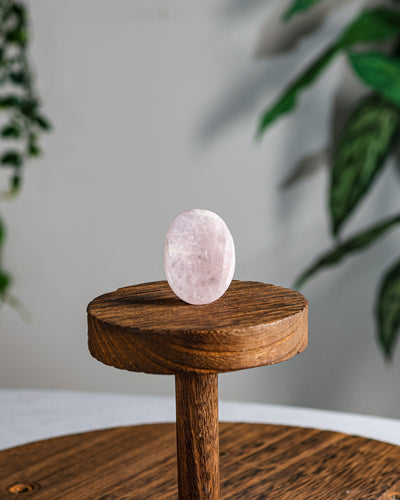
Aquamarine has the particular quality of water that is perfectly clear — not wild and oceanic but still and transparent, so you can see the bottom. It is a calm stone, but not a passive one. Associated with calm and clarity, it brings the kind of composed steadiness that makes difficult conversations possible, emotional crossroads navigable, and the truth — your truth — more accessible than it usually is. Sailors trusted it on open water. The same quality serves you equally well on dry land.
Key Traits
- Soothes anxiety and emotional agitation without numbing — it clears, rather than suppresses
- Supports the courage required to speak honestly when the stakes feel high
- Connects emotional knowing with clear expression — useful for those who feel things deeply but struggle to articulate them
- Offers cooling relief during periods of emotional intensity, grief, or sustained stress
- Works well in negotiation, difficult conversations, or situations requiring both honesty and composure
Intentions
Brief Overview
Aquamarine is a beryl variety colored by trace iron, found in granitic pegmatites and alluvial deposits across Brazil, Pakistan, Mozambique, Russia, and Nigeria. Its name, from the Latin for seawater, reflects both its color and its ancient cultural role as a stone of the ocean. For at least two thousand years it has been used as a talisman of safe passage, emotional clarity, and truthful speech. In crystal practice today, it is primarily associated with the throat chakra, emotional courage, and the kind of calm that is not absence of feeling but clarity of perspective — the ability to see through turbulence to what matters.
Properties
Aquamarine is a cooling, clarifying stone with a particular relationship to emotional honesty. It does not eliminate feelings so much as create the conditions in which you can hold them without being overwhelmed. Its most consistent function in practice is to bridge the emotional body and the throat — helping those who feel deeply to also speak clearly, and helping those who speak readily to first feel accurately. It is a stone for the moments when composure and authenticity are both required simultaneously, and when the pressure of a conversation or emotional situation makes one of those things difficult to maintain.
Metaphysical Properties
- Calms emotional turbulence by establishing a clear inner baseline — works more like a stabilizer than a sedative
- Opens and activates the throat chakra, supporting honest, composed communication in high-stakes situations
- Supports intuitive clarity — particularly the kind that requires quieting external noise to hear an internal signal
- Encourages emotional courage: the capacity to remain present and truthful when vulnerability feels risky
- Supports healing of grief, loss, and emotional overwhelm by bringing perspective without bypassing feeling
Physical Properties
- Type: Silicate mineral — beryl variety
- Color: Pale blue to deep blue-green; teal; most prized specimens are a clear, saturated sky blue
- Luster: Vitreous (glassy)
- Structure: Hexagonal prismatic crystals, often with striated faces and a clean, columnar form
Meaning & Energy
The energy Aquamarine carries is not dramatic. It does not announce itself or produce sudden shifts — it functions more like tide: consistent, directional, quietly powerful. Over time, it creates the conditions for honesty with yourself and others, for emotional clarity that doesn't require forcing, for the kind of composed strength that holds up in the conversations you have been avoiding. Its relationship to the ocean is apt: the sea does not fight what it carries. It simply moves it, steadily and without apology, to where it needs to go. Aquamarine carries that same quality into your emotional life.
Emotions
If anxiety speaks quickly in you — if you tend toward overthinking, emotional flooding, or the particular pattern of shutting down when feelings run high — Aquamarine offers a different tempo. It slows the internal current to something navigable. When you are holding a difficult conversation you need to have, a grief that has nowhere to go, or an emotional truth you have not yet found the words for, this stone has a specific and useful function. It does not resolve the emotional situation. But it makes you more capable of being present inside it, and that changes what becomes possible.
Crystal Pairings
- Rose Quartz – Combines Aquamarine's clear emotional honesty with rose quartz's warmth and compassion; useful for relationship conversations requiring both truth and care
- Amethyst – Deepens the calming effect and adds intuitive access; a classic pairing for meditation, grief work, and emotional processing
- Labradorite – Pairs Aquamarine's clear emotional signal with labradorite's capacity for perceptual depth and inner vision
- Blue Lace Agate – A gentler, softer pairing that layers two throat-activating stones for situations requiring very careful, patient communication
Science & Origin
Aquamarine is a beryl variety — part of the same mineral family as emerald, morganite, and heliodor — colored by ferrous iron (Fe2+) within the hexagonal crystal structure. It forms in granitic pegmatites and is found in alluvial deposits where pegmatite bodies have eroded over time. The most significant source globally is the state of Minas Gerais in Brazil, which has produced some of the largest and finest Aquamarine crystals ever recorded. Heat treatment is commonly applied to commercial specimens to reduce greenish tones and achieve a purer blue color.
- Also Known As: Blue Beryl, Sea-Blue Beryl, Sailor's Stone
- Formation: Granitic pegmatites; also found in alluvial deposits from eroded pegmatite; forms as long hexagonal prismatic crystals
- First Discovery: Known in antiquity for at least 2,000 years; named in writing by Pliny the Elder in the 1st century CE; modern mineralogical classification as a beryl variety established in the 18th century
- Safety Note: Safe to handle and wear; water-safe for brief cleansing; avoid prolonged sunlight exposure as color may fade over time in some specimens
Ancient Myths
- In ancient Roman and Greek tradition, Aquamarine was known as the sailor's stone — believed to protect seafarers from storms and drowning when carried aboard ships or offered to Neptune. Sailors considered it a direct gift from the sea.
- Ancient Greeks associated Aquamarine with sirens and sea nymphs, believing it washed ashore from their treasure chests. It was thought to carry the sea's energy and to bring fortune to those who treated the ocean with respect.
- In medieval European tradition, Aquamarine was used by oracles and soothsayers who believed it could reveal hidden truths. It was also given between partners as a symbol of faithfulness and was thought to rekindle love in troubled marriages.
Chakras Table
| Chakra | Connection | Healing Focus | Energy Type |
|---|---|---|---|
| Throat | Primary — honest, composed self-expression | Avoidance of difficult conversations, inability to articulate emotional truth | Expressive, courageous |
| Heart | Secondary — emotional clarity and compassionate honesty | Emotional flooding, grief, love-related communication challenges | Soothing, opening |
| Third Eye | Supporting — quiet intuitive clarity | Inability to hear internal signals beneath emotional noise | Clarifying, stilling |
Planets Table
| Planet | Influence | Energy |
|---|---|---|
| Neptune | Governs the emotional depths, intuition, and the dissolution of boundaries | Deepening, clarifying, emotionally truthful |
| Moon | Cyclical emotional awareness and the tides of feeling | Soothing, regulating, responsive |
Zodiacs Table
| Zodiac | Attribute | Benefit |
|---|---|---|
| Pisces | Emotional depth, intuition, and imaginative sensitivity | Provides clarity and grounded expression for Pisces' deep emotional experience |
| Aquarius | Intellectual independence and clear-minded perspective | Supports Aquarius in connecting intellectual clarity to emotional honesty |
| Gemini | Communicative agility and dual-natured perception | Helps Gemini slow down and speak from depth rather than only from speed |
Elements Table
| Element | Power | Aspect |
|---|---|---|
| Water | Emotional flow, intuition, and depth of feeling | Creates the calm current beneath emotional turbulence |
| Air | Mental clarity and the clear movement of thought into words | Supports articulate expression and composed communication |
Sacred Numbers Table
| Number | Vibration | Meaning |
|---|---|---|
| 1 | Clarity, direction, and independent voice | Represents the clear, singular internal signal that Aquamarine helps surface and express |
| 3 | Expression, creativity, and communicative flow | Reflects Aquamarine's primary function as a bridge between feeling and articulate speech |
Color Variations
- Pale Sky Blue: The most common commercial variety; delicate and translucent; associated with gentle calm and soft communicative clarity
- Deep Blue: More saturated specimens, typically from Brazil or Pakistan; stronger throat activation and a more pronounced cooling effect
- Blue-Green (Natural/Unheated): The natural unheated color of many raw specimens; retains both water and earth energy in equal measure; highly valued by collectors
- Teal: Darker, more saturated blue-green; less common; associated with emotional depth and the transition zone between heart and throat
Mohs Scale Hardness
Aquamarine registers at 7.5 on the Mohs scale, placing it firmly in the durable gemstone category. It is harder than most tumbled stones and suitable for everyday jewelry wear when set protectively. It resists scratching from common materials but can be scratched by topaz, corundum, and diamond. Clean with warm soapy water or a soft cloth; ultrasonic cleaning should be avoided if the stone shows inclusions, fractures, or has been treated.
Chemical Formula
Aquamarine is a beryl silicate mineral with the chemical formula Be3Al2(SiO3)6. Its blue-green color is produced by ferrous iron (Fe2+) substituting within the aluminum sites of the crystal lattice. The ratio and oxidation state of iron determines whether the stone appears more blue or more green-blue in natural, unheated form.
- Beryllium (Be): Core element of the beryl structure; relatively rare in the earth's crust
- Aluminum (Al): Forms the structural framework alongside silicate groups
- Silicon (Si) and Oxygen (O): Form the silicate rings (SiO3)6 that define the mineral class
- Iron (Fe2+): Trace chromophore responsible for the blue to blue-green color
Summary of Composition
- Mineral Class: Silicate — cyclosilicate (beryl group)
- Crystal System: Hexagonal
- Transparency: Transparent to translucent
- Luster: Vitreous (glassy)
Care Instructions
- Safe for brief water cleansing — rinse under cool running water and dry thoroughly; avoid prolonged soaking
- Keep away from extended direct sunlight, particularly unheated natural specimens, as color can fade slowly over time with UV exposure
- Store separately from harder gemstones such as topaz and corundum; despite its relative durability, faceted stones can chip if struck against harder materials
- Charge under moonlight or near water; clean with a soft cloth and mild soap if needed for physical cleaning
Final Summary
Aquamarine is not a comfort stone in the usual sense — it does not offer warmth or softness. What it offers is something more useful in the moments that actually require it: composed clarity, the courage to be honest, and the calm that is not the absence of feeling but the ability to hold feeling without being overwhelmed by it. It has been carried on open water for two thousand years. It carries you through the emotional equivalent with the same quiet reliability.