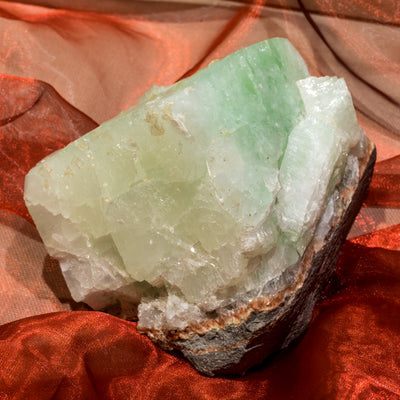
Scolecite grows as fine white needles fanned out into a spray so delicate it looks almost woven, a texture that matches exactly what it offers a busy mind. Known in crystal healing tradition as a peace stone, it is reached for Calm & Stress Relief and Intuition & Clarity, the kind of quiet that makes a crowded meditation practice feel possible again. It does not demand stillness so much as make room for it.
Key Traits
- Grows in radiating sprays of fine, needle-like crystals
- Known in crystal healing tradition as a gentle peace stone
- Deepens meditation and softens a racing mind
- Shares its volcanic origin with apophyllite and stilbite
- Curls when heated, the trait behind its Greek name
Intentions
Brief Overview
Scolecite is a zeolite, a member of the same mineral family as apophyllite and stilbite, forming where mineral-rich water once moved slowly through the gas pockets of ancient basalt. Its crystals grow thin and fibrous, radiating outward from a single point into sprays that can look almost feather-light despite being genuine, solid mineral.
Properties
Scolecite's reputation in crystal healing circles centers almost entirely on stillness. It is used to settle an overactive mind before meditation, to ease the transition into sleep, and to soften emotional tension that has been held too tightly for too long, without pushing any of that release faster than it wants to go.
Metaphysical Properties
- Settles a racing or overstimulated mind before meditation
- Encourages a gentler, more receptive state during inner work
- Softens old emotional tension held in the heart
- Supports restful transitions into sleep
- Deepens connection between quiet intuition and a calm body
Physical Properties
- Type: Zeolite mineral (tectosilicate)
- Color: Colorless to white, occasionally with a faint pink or cream tint
- Luster: Vitreous to silky along the needle sprays
- Structure: Monoclinic
Meaning & Energy
Scolecite's meaning is written into its own structure: countless fine threads growing outward from one shared point, none of them overpowering the others. That is the register the stone works in, a calm that comes from alignment rather than force, useful whenever a mind or a body has been pulling in too many directions and needs one shared center to settle around again.
Emotions
When your thoughts won't slow down at the end of a long day, Scolecite offers something close to permission rather than a fix. You may find it easiest to notice during meditation or right before sleep, when its stillness has the most room to work. It tends to support a soft, unhurried kind of emotional release, the sort that doesn't ask you to relive anything, only to let it go.
Crystal Pairings
- Apophyllite – its closest zeolite relative, deepening shared meditative stillness
- Selenite – clears the space around you before Scolecite settles it further
- Moonstone – softens intuition into the same gentle, receptive register
- Clear Quartz – amplifies the calm clarity Scolecite already carries
Science & Origin
Scolecite is a well-documented member of the zeolite group, first described in the early nineteenth century and named for a physical property rather than a legend. It typically grows alongside other zeolites in the same basalt cavities, which is why specimens are often found sharing a matrix with apophyllite, stilbite, or mesolite.
- Also Known As: No widely used alternate trade name; occasionally grouped informally under Natrolite Group Zeolite
- Formation: Crystallizes from mineral-rich water moving slowly through gas cavities in ancient basalt, alongside other zeolite minerals
- First Discovery: Named in 1813 by German mineralogist Karl Gustav Glocker
- Safety Note: The needle crystals are delicate beneath their radiating sprays, so handle raw clusters gently and keep tumbled pieces away from hard knocks
Ancient Myths
- Scolecite takes its name from the Greek skolex, meaning worm, given by German mineralogist Karl Gustav Glocker in 1813 after watching a heated specimen curl exactly like one under a blowpipe flame.
- It forms in the same volcanic cavities that produced zeolites long used to purify water and temple spaces across South Asia, linking it by geology to a much older tradition of stones associated with cleansing and stillness.
- Because it was identified only in the nineteenth century, Scolecite carries no myth of its own from antiquity; the quiet, meditative reputation it holds today is entirely a modern crystal-healing tradition built around its physical stillness.
Chakras Table
| Chakra | Connection | Healing Focus | Energy Type |
|---|---|---|---|
| Heart | Softens old emotional tension so it can loosen gently | Gentle emotional release | Softening |
| Third Eye | Deepens inner sight during meditation | Quieting mental noise | Opening |
| Crown | Connects a settled mind to a wider sense of stillness | Spiritual receptivity | Expanding |
Planets Table
| Planet | Influence | Energy |
|---|---|---|
| Moon | Governs its gentle, receptive calm | Softening |
| Neptune | Governs dreams, meditation, and spiritual sensitivity | Dissolving |
Zodiacs Table
| Zodiac | Attribute | Benefit |
|---|---|---|
| Cancer | Emotional sensitivity | Gives a racing heart a gentle container |
| Pisces | Dreamy intuition | Focuses drifting attention into quiet clarity |
Elements Table
| Element | Power | Aspect |
|---|---|---|
| Water | Its flowing, emotional-release quality | Softens what has been held too tightly |
| Air | The mental stillness it supports | Clears space for quiet thought |
Sacred Numbers Table
| Number | Vibration | Meaning |
|---|---|---|
| 7 | Introspection and inner knowing | Its steady, meditative resonance |
| 9 | Completion | Closing a cycle of tension gently rather than abruptly |
Color Variations
- Colorless, glassy needle sprays, the clearest and most prized form
- Snow-white sprays, the most commonly seen tumbled and specimen form
- Faint pink-tinted specimens from certain Indian localities
- Pale cream or yellow-tinted sprays, softer in tone than the white form
Mohs Scale Hardness
Scolecite sits at 5.5 on the Mohs scale, softer and considerably more delicate than most quartz-family stones. In practical terms, raw needle-spray specimens are better suited to a meditation shelf than a pocket, while tumbled or polished pieces hold up well enough for careful handling, just not for rough daily wear.
Chemical Formula
The chemical formula is CaAl2Si3O10, with three molecules of structurally bound water completing the zeolite framework.
- Ca (calcium) anchors the mineral's charge balance
- Al (aluminum) and Si (silicon) form the tectosilicate framework
- O (oxygen) completes the silicate structure
- Structurally bound water fills the framework's open channels
Summary of Composition
- Mineral Class: Zeolite (tectosilicate)
- Crystal System: Monoclinic
- Transparency: Transparent to translucent
- Luster: Vitreous to silky
Care Instructions
- Avoid long soaks in water, since the zeolite structure holds water within its own framework
- Keep out of prolonged direct sunlight to protect the crystal's clarity
- Handle raw needle sprays gently; they are more fragile than their beauty suggests
- Cleanse with dry methods such as sound or smoke rather than water when in doubt
Final Summary
Scolecite is not a stone that pushes for change; it simply waits until you're ready to slow down and meets you there. Its fine, radiating needles are a small, exact picture of what calm actually looks like when nothing is forcing it. Keep it near your meditation cushion or your pillow, and let the stillness do what stillness does best.