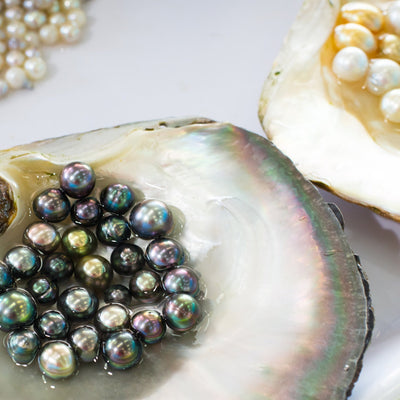
Mother of Pearl is the lining a mollusk lays down against the inside of its own shell, sheet after microscopic sheet, until the surface turns to moving light. Nothing about it announces itself. It works the way a good harbor works, taking the force out of whatever arrives and giving it somewhere to settle, which is why it has been carried for calm and stress relief and for quiet protection far longer than anyone thought to write down the reason. Hold a polished piece and you are holding an animal's patient answer to living inside something sharp.
Key Traits
- An organic gem material grown by living mollusks, not a mineral species
- Iridescence produced by structure and light rather than by pigment
- Soft at 3.5 on the Mohs scale and readily attacked by acids
- Cool and faintly slick against the skin, warming slowly in the hand
- Long worn for composure, quiet protection, and steady feeling
Intentions
Brief Overview
Mother of Pearl, known to gemologists as nacre, is the iridescent inner surface of shells built by pearl oysters, freshwater mussels, and abalone. It is an organic gem material rather than a mineral: calcium carbonate laid down as aragonite platelets and bonded by a protein called conchiolin, grown by a living animal over years. That origin is worth naming plainly, because it explains almost everything else about the material, from its softness to its warmth to the way it holds light. In the shop it arrives as flat polished discs, carved rounds, inlay, and beads, and its color runs from cream white through silver grey to the deep pewter of dark lipped oysters.
Properties
Mother of Pearl is a settling stone rather than a stimulating one. It is traditionally worked with when feeling has outrun composure: the day that will not stop, the conversation replaying at two in the morning, the sense of being weathered by other people's moods. It does not push those states away so much as slow them down, which is why it has long been paired with protection work of the soft kind, the sort that keeps a permeable person from being scoured. Worn steadily it is associated with a returning sense of your own edges, and with an intuition that gets quieter and more accurate at the same time.
Metaphysical Properties
- Long carried to soften emotional overwhelm and restore a sense of composure
- Associated in crystal healing tradition with a gentle protective field for sensitive and porous people
- Worked with to deepen intuition that arrives as impression rather than as argument
- Traditionally kept near mothers, caregivers, and children as an emblem of shelter and belonging
- Used in ritual as a link to tide, cycle, and the rhythm of things that arrive and recede
Physical Properties
- Type: Organic gem material, the nacreous inner shell layer of mollusks
- Color: White, cream, silver grey, pewter, and gold, with pink, green, blue, and violet iridescence
- Luster: Pearly, greasy on unpolished surfaces
- Structure: Overlapping hexagonal aragonite platelets bonded by conchiolin, layered rather than crystalline as a whole
Meaning & Energy
The meaning of this material is written into how it is made. An irritant enters a shell, and the animal answers not by expelling it but by coating it, again and again, until the thing that threatened the interior becomes the most beautiful part of it. That is the whole teaching, and it is unusually literal for a gem material. Mother of Pearl carries a lunar, tidal quality rather than a solar one: reflective rather than radiant, patient rather than urgent, more concerned with what endures than with what impresses. It belongs to the group of stones you reach for when the work is to stay soft without being damaged.
Emotions
If you take on the weather of the room you walk into, this is your material. Mother of Pearl is traditionally worn to ease everyday tension and to keep strong feeling from tipping into overwhelm, giving you a moment between what happens and how you answer it. It is also a self-compassion stone in a practical sense: it tends to surface how much care you extend outward and how little of it you turn back on yourself. Keep a piece where your hand finds it during long days, and let the coolness of the surface be the reminder that you are allowed to slow down before you respond.
Crystal Pairings
- Pearl – Same nacre, worn for dignity and composure under pressure
- Moonstone – Deepens the lunar, cyclical quality and supports intuitive timing
- Rose Quartz – Turns the nurturing register inward toward self-regard
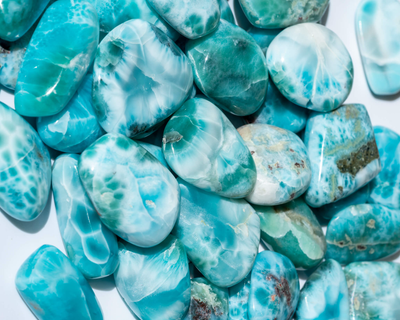
- Larimar – Adds a wider oceanic calm and eases held tension in the throat
Science & Origin
Nacre is a biocomposite, and a famously well engineered one. Rigid aragonite platelets are set in flexible protein in overlapping sheets, an arrangement that forces a crack to deflect at every layer instead of running straight through, so a brittle carbonate ends up behaving as a tough material. The iridescence is structural: the layers are close in thickness to the wavelengths of visible light, so reflections from successive surfaces interfere with one another and the color shifts as you tilt the piece. Most shell on the market is a byproduct of the pearl and seafood industries, with the largest and whitest material coming from Australian and Indonesian waters.
- Also Known As: Nacre, pearl shell, MOP in the jewelry trade
- Formation: Deposited by the mantle of a living mollusk in overlapping sheets of hexagonal aragonite platelets bonded by conchiolin, thickening continuously across the animal's life
- First Discovery: No single discovery date. Nacre has been carved and inlaid since at least 2500 BCE, with objects from ancient Mesopotamia among the earliest surviving examples
- Safety Note: Soft, porous, and readily attacked by acid. Keep it away from vinegar, citrus, salt water, perfume, hairspray, and household cleaners, and never use ultrasonic or steam cleaning. Do not use it to make elixirs or anything intended for drinking
Ancient Myths
- Mesopotamian workshops were setting shell into bitumen more than four thousand years ago, and inlaid objects from that world are among the earliest surviving ornamental uses of nacre. Decorative use of the material is dated to at least 2500 BCE.
- Korean craftspeople have worked shell into lacquer since the Silla period, and the technique known as najeonchilgi reached its height under the Goryeo dynasty between 918 and 1392, when inlaid boxes traveled abroad as royal gifts.
- Italian Franciscan friars carried the carving craft to Bethlehem in the fifteenth century, where it became a local livelihood. By 1727 the traveler Richard Pococke recorded residents making crosses, beads, and models of the Church of the Holy Sepulchre in inlaid shell.
Chakras Table
| Chakra | Connection | Healing Focus | Energy Type |
|---|---|---|---|
| Sacral | Governs feeling, creative flow, and the tides of mood | Letting held emotion move instead of pooling | Fluid and receptive |
| Heart | Center of attachment and self-regard | Turning outward care back toward yourself | Warm and steadying |
| Third Eye | Seat of inner perception | Trusting a quiet impression before you can defend it | Still and reflective |
Planets Table
| Planet | Influence | Energy |
|---|---|---|
| Moon | Rules cycles, tides, memory, and reflected light | Receptive and rhythmic |
| Neptune | Rules dream life, compassion, and the sea | Dissolving and imaginative |
Zodiacs Table
| Zodiac | Attribute | Benefit |
|---|---|---|
| Cancer | The sign of shelter, memory, and belonging | Steadies feeling and strengthens the instinct to protect what matters |
| Pisces | The sign of empathy and inner tides | Softens overwhelm while helping a permeable heart keep its shape |
Elements Table
| Element | Power | Aspect |
|---|---|---|
| Earth | Mineral body and material patience | Grounds feeling in something solid |
| Water | Tide, flow, and reflection | Lets emotion move rather than settle and stay |
Sacred Numbers Table
| Number | Vibration | Meaning |
|---|---|---|
| 2 | Pairing, receptivity, reflection | The number of relationship, of one thing answering another |
| 7 | Inwardness and quiet knowing | The number of the listener rather than the speaker |
Color Variations
- White and cream, the most familiar form, flashing pink, green, and blue where the light turns
- Silver grey, cooler and more restrained, common in freshwater mussel shell
- Black and pewter, from dark lipped oysters of French Polynesia, with peacock and aubergine overtones
- Gold lip, a warm honey rim found on the largest Australian and Indonesian shells
Mohs Scale Hardness
Mother of Pearl sits at about 3.5 on the Mohs scale, which places it among the softest materials worn as jewelry. In practice that means a fingernail will not mark it but a steel key, a zipper, or a quartz bead in the same pouch will. Softness is only half the story: the material is also porous and chemically vulnerable, so acids and solvents matter more than scratches do. Treat a piece the way you would treat a lacquered surface rather than a stone, and it will keep its luster for decades.
Chemical Formula
Mother of Pearl is calcium carbonate, CaCO3, crystallized as aragonite and held together by conchiolin with a small amount of water. It is a composite rather than a single compound, which is why gemological references give it a formula plus a list of organics rather than a clean mineral formula.
- Calcium (Ca): drawn from seawater by the animal and fixed into the carbonate framework
- Carbon (C): bonded with oxygen into the carbonate group that builds each platelet
- Oxygen (O): three atoms per carbonate group, completing the aragonite structure
- Conchiolin: a fibrous protein binding the platelets, the source of the material's toughness
- Water: a small percentage held within the organic layers
Summary of Composition
- Mineral Class: Organic gem material, calcium carbonate as aragonite with conchiolin and water, not a mineral species
- Crystal System: Orthorhombic within the individual aragonite platelets; the material as a whole is a layered biocomposite
- Transparency: Translucent to opaque
- Luster: Pearly, greasy where unpolished
Care Instructions
- Wipe with a soft dry cloth after wearing, and never use ultrasonic or steam cleaning
- Keep it away from perfume, hairspray, citrus, vinegar, and household cleaners, all of which etch the surface
- Put it on last and take it off first, so it meets fewer chemicals and less friction
- Store it in a soft pouch away from harder stones and metal, out of direct sun
Final Summary
Mother of Pearl is the rare material whose beauty is a record of how something soft survived something sharp. It asks nothing dramatic of you: only that you slow down, keep your edges, and let what arrives be coated rather than fought. Wear it on the days you would rather be quiet than convincing.