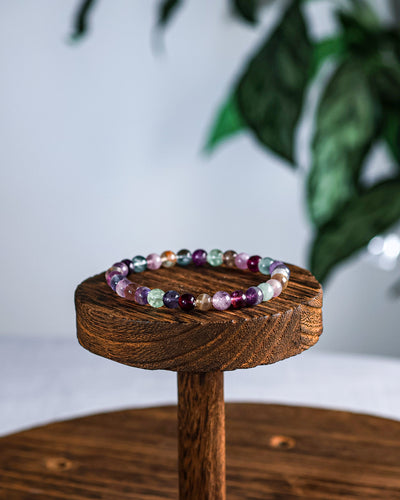
Mexican Purple Opal surfaced from the Jalisco hills only recently, and it looks like nothing else on the table: soft lavender and deep violet suspended in a milky silica body, the color borrowed from microscopic fluorite locked inside the stone as it formed. It works the way dusk works, dimming the noise until the quieter signal underneath becomes audible. People reach for it when the thinking mind will not stop circling and they want calm and stress relief that settles them without dulling them, or when intuition and clarity have gone quiet under too much input. Pick up a polished piece and the first thing you notice is how cool and still it feels in the palm.
Key Traits
- Quiets mental noise without flattening focus
- Purple color created by natural fluorite inclusions, not dye
- A common opal, so no flashing play of color, just soft banded violet
- Long associated with dreamwork, night practice, and inner listening
- Found only in central Mexico and traded only since about 2011
Intentions
Brief Overview
Mexican Purple Opal, sold most often as Morado Opal, is a common opal from central Mexico. Common opal means it has the chemistry of opal, hydrated silica, without the internal structure that makes precious opal flash with color. What it has instead is body color, and unusually good body color at that: lavender, grape, and violet zones marbled with white and gray silica, sometimes with a druzy quartz pocket at the center of a nodule. Cutters like it because it takes a smooth polish and every slab is different. Practitioners like it because the color sits squarely in the register most people already associate with quiet, dreaming, and clear seeing.
Properties
This is a settling stone rather than an activating one. Mexican Purple Opal is worked with to slow an overrun mind to a workable speed, to hold steady emotion in place while something is being felt through rather than fought, and to support the kind of attention that notices small signals. In crystal tradition, opal of any color is treated as a mirror that returns your own state to you amplified, which is why the purple material is usually paired with practices that ask for honesty: journaling, dream recording, evening meditation, quiet decision-making. It is also carried as a soft protective stone, the kind that helps you keep a boundary without hardening against people.
Metaphysical Properties
- Supports third eye work, inner listening, and the trust it takes to act on a quiet hunch
- Traditionally worked with to calm an overactive mind before sleep and to improve dream recall
- Long associated with emotional honesty, holding difficult feeling steady enough to be understood
- Carried as a gentle protective stone for people who take on the moods of a room
- Used in crystal healing tradition to encourage self-worth and a settled sense of your own judgment
Physical Properties
- Type: Common opal, a hydrated amorphous silica
- Color: Lavender to deep violet, often zoned with white, cream, and gray, occasionally with druzy quartz pockets
- Luster: Vitreous to waxy, pearly on a fine polish
- Structure: Amorphous, no crystal system, formed as masses, seams, and nodules
Meaning & Energy
The meaning of Mexican Purple Opal sits at the meeting point of two things: opal, which crystal tradition regards as an amplifier and a mirror, and violet, the color long tied to inner sight and quiet mind. Put together, the stone reads as a listening tool. It does not push. It lowers the volume on everything competing for your attention until the thing you have been avoiding, or the answer you already carry, is the loudest thing left in the room. There is a specific pleasure to that experience, and it is why this stone tends to be kept close, on a nightstand or in a pocket, rather than displayed on a shelf.
Emotions
If your feelings arrive all at once and leave you unsure which one is actually yours, this is a stone worth sitting with. Mexican Purple Opal is worked with to slow that rush down so you can look at one thing at a time, and to give you a little distance from other people's moods without shutting you off from them. When you are stretched thin at the end of a long week, it supports the small recovery of a quiet hour: less circling, less bracing, more of the calm that lets you hear your own thinking again. Keep it near where you sleep or where you write, and use it when you need to be honest with yourself rather than convincing.
Crystal Pairings
- Amethyst – deepens the same calm and third eye register with a stone that has centuries of practice behind it
- Fluorite – the mineral that colors this opal, brought in whole for mental order and clean decisions
- Clear Quartz – amplifies and focuses the softer signal of the opal during meditation or dream practice
- Labradorite – adds a protective outer layer for intuitive work, keeping the boundary firm while you stay open
Science & Origin
Mexican Purple Opal is hydrated silica that formed in volcanic host rock, filling seams and cavities as silica-rich water moved through the fractures and slowly set. Its purple is not a stain and not a dye. It comes from fluorite inclusions too small to see individually, spread through the silica in enough quantity to color the whole stone, and some material fluoresces green or blue under ultraviolet light, an effect reported as trace uranium in the fluorite. Because opal holds water in its structure, this material is softer and more temperamental than the quartz stones it grows beside.
- Also Known As: Morado Opal, Violet Flame Opal, Purple Opal, Opal Royale. Morado is simply the Spanish word for purple, and none of these names indicate a different mineral.
- Formation: Silica-rich water moving through volcanic rock deposited hydrated silica in seams, masses, and nodules, with microscopic fluorite carried in alongside it to give the stone its violet body color.
- First Discovery: Reported from central Mexico around 2011, chiefly Jalisco with further reports from Queretaro, and introduced to the wider gem trade in quantity at the 2012 Tucson Gem and Mineral Show.
- Safety Note: Soft and porous, and some material crazes or develops fine surface cracks as it dries after cutting. Keep it away from ultrasonic cleaners, steamers, prolonged soaking, sudden heat, and household chemicals, and do not prepare elixirs by direct immersion.
Ancient Myths
- Pliny the Elder described opal as paederos, a gem the Romans ranked above nearly all others because it appeared to hold the color of every other stone at once. The story belongs to the opal family as a whole rather than to this recent Mexican material.
- Greek tradition credited opal with foresight, and it was carried by people who wanted some warning of what was approaching before it arrived.
- Bedouin storytellers said opals fell to earth in lightning strikes with the storm caught inside them. Mexican Purple Opal inherits this older opal lore, since a stone first traded in 2011 has no myths of its own yet.
Chakras Table
| Chakra | Connection | Healing Focus | Energy Type |
|---|---|---|---|
| Third Eye | Its clearest placement, sitting where the mind sorts signal from noise | Quiet perception and trust in your own read of a situation | Receptive and inward |
| Crown | A softer secondary connection, opening the space above ordinary thinking | Stillness, perspective, and release of mental gripping | Expansive and calming |
Planets Table
| Planet | Influence | Energy |
|---|---|---|
| Neptune | Dreams, imagination, and the porous edge between waking and sleeping | Dissolving and intuitive |
| Uranus | Sudden insight and the answer that arrives sideways | Quick and clarifying |
Zodiacs Table
| Zodiac | Attribute | Benefit |
|---|---|---|
| Cancer | Emotional depth and strong instinct | Helps you hold feeling steady instead of being carried by it |
| Virgo | Analysis, discernment, and a busy mind | Slows the mental sorting enough for intuition to get a word in |
| Pisces | Dreaming, sensitivity, and imagination | Supports the dream practice while keeping a boundary against everyone else's mood |
Elements Table
| Element | Power | Aspect |
|---|---|---|
| Water | Emotional flow and the willingness to feel something through | Reflective and cleansing |
| Air | Mental clarity and the space between thoughts | Light and perceptive |
Sacred Numbers Table
| Number | Vibration | Meaning |
|---|---|---|
| 7 | Inward attention and quiet study | The number of the seeker, matched to a stone worked with for listening rather than broadcasting |
| 8 | Cycles, structure, and return | Traditionally given to opal, marking a stone that reflects back what you bring to it |
Color Variations
- Pale lavender: the softest and most common grade, often cloudy, with white silica drifting through it like weather
- Deep grape violet: the most sought after color, dense and saturated, usually found in the interior of a nodule
- Violet with white banding: sharp bands of white and cream silica cutting across the purple, prized for cabochons
- Purple with druzy pockets: nodules that opened around a cavity lined with tiny sparkling quartz crystals
Mohs Scale Hardness
Mexican Purple Opal sits at roughly 5.5 on the Mohs scale, with published figures for this material ranging from about 4.5 to 6.5 depending on how much water a given piece holds. In practice that means it is softer than quartz and softer than window glass, so it scratches if it is stored loose with harder stones or dropped in a bag with keys. Treat it the way you would treat a piece of soft jewelry: cabochons and beads are fine for everyday wear if you take them off before rough work, and any piece is happier in a lined box than in a pile.
Chemical Formula
The chemical formula for Mexican Purple Opal is SiO2 with variable water content, usually written SiO2 with nH2O, which marks it as hydrated silica rather than a true crystalline mineral. The purple comes from fluorite, CaF2, present as microscopic inclusions rather than as part of the opal formula itself.
- Silicon and oxygen: the silica framework that makes up the body of the stone
- Water: held within the amorphous structure, typically between three and ten percent by weight in common opal, and the reason the material is soft and sensitive to drying
- Calcium fluoride: the fluorite inclusions responsible for the violet body color and for the fluorescence some pieces show under ultraviolet light
Summary of Composition
- Mineral Class: Mineraloid, silica group, classified as common opal
- Crystal System: Amorphous, no crystal system
- Transparency: Translucent to opaque
- Luster: Vitreous to waxy, pearly when finely polished
Care Instructions
- Clean with a soft dry cloth or a barely damp one, then dry it right away rather than letting it sit wet
- Skip ultrasonic cleaners, steam, salt water, and household chemicals, all of which can damage a porous stone
- Keep it out of direct sun and away from heaters, since heat draws water out of opal and encourages crazing
- Store it separately in a soft pouch or lined box so harder stones cannot scratch the polish
Final Summary
Mexican Purple Opal is a young stone with an old temperament: quiet, reflective, and more interested in what you already know than in telling you something new. Keep it where the day slows down, near the bed or the notebook, and it does its best work in the hour when everything else finally goes still. It asks very little and gives back exactly what you bring to it.