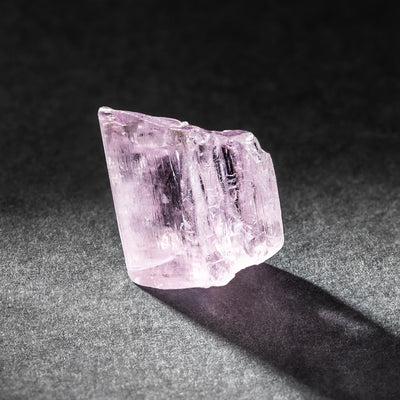
Lithium Quartz looks like clear quartz that someone breathed on from the inside. Those pink and lilac veils are lithium bearing micas, sealed in place while the crystal grew inside a granite pegmatite, and they are why this stone has become a fixture in work with calm and stress relief. It does not force anything quiet. It works more like a steady hand at your back, patient enough that whatever you have been holding down can come up, be looked at, and start to loosen, which is where the healing in it actually lives.
Key Traits
- Clear to milky quartz veiled inside with soft pink, lilac and lavender lithium bearing mica
- Gentle in the way it works, which is unusual for a quartz
- Long associated with easing everyday tension and settling a heavy mood
- Traditionally used as a cleanser for the whole chakra column rather than a single centre
- Grows in lithium rich granite pegmatites, almost all of the market material from Brazil
Intentions
Brief Overview
Lithium Quartz is not a separate mineral species. It is ordinary quartz that grew in extraordinary company, in pegmatite pockets rich enough in lithium that fine mica settled onto the crystal faces and was then sealed inside by the next stage of growth. Almost all of the material on the market comes out of Brazil, chiefly Minas Gerais, with smaller finds in Madagascar, Colombia and the United States. What you are looking at when you hold one is a record of an interruption, a moment when the quartz stopped growing long enough for something softer to arrive.
Properties
This is the quartz you reach for when the problem is not urgency but accumulation. Judy Hall describes it as bringing the underlying causes of a low, heavy mood gently to the surface and neutralising stored grief and long held anger, and that gentleness is the whole point: it works at a pace that does not overwhelm the person doing the work. In crystal healing tradition it is also treated as an all purpose cleanser for the chakras, settling the whole column rather than driving one centre hard, and it is one of the few stones traditionally kept beside houseplants and animals for the same reason. It amplifies an intention the way any quartz does, only slower, and slower is often what is wanted.
Metaphysical Properties
- Softens everyday stress without dulling you or flattening how you feel
- In crystal healing tradition, brings stored grief and old anger gently to the surface where they can be met
- Long worked with for past life recall, on the understanding that the root of a present feeling may be older than this life
- Traditionally used to clear and settle every chakra in turn, which is why it is often chosen as a first stone in a layout
- Amplifies and holds an intention the way quartz does, but at a slower and quieter pace
Physical Properties
- Type: Quartz with inclusions of lithium bearing minerals, chiefly lepidolite and cookeite
- Color: Colourless to milky quartz veiled with pink, lilac, lavender and occasional grey or smoky tones
- Luster: Vitreous, glassy on fresh crystal faces and slightly waxy where inclusions reach the surface
- Structure: Trigonal, most often terminated points, clusters and phantom banded crystals
Meaning & Energy
The meaning of this stone sits in how it was made. Quartz is hard, ordered and relentless, and lithium mica is soft enough to mark with a fingernail. Lithium Quartz is what happens when the soft thing is not crushed by the hard one but carried inside it, protected, still visible after millions of years. That is a useful thing to hold when you have been told, or have told yourself, that softness is a liability. In practice this stone reads as permission to stop bracing. It is worked with for release rather than for power, and for the kind of understanding that arrives only once you have stopped defending against it.
Emotions
If you have been running slightly tense for months without quite noticing, this is a stone that notices for you. What you tend to feel first is not a lift but a loosening, the sense that you can put something down for a minute. Old grief and old anger have a way of coming up in that space, and Lithium Quartz is chosen precisely because it lets them arrive at a manageable size rather than all at once. Keep it where your hands go when you are thinking, a desk, a pocket, the side of the bed, and it will do more for you than it would in a display case.
Crystal Pairings
- Lepidolite – The same lithium in mica form, for the days when tension settles in your shoulders before it reaches your thoughts
- Kunzite – Another lithium mineral, opening the heart outward where Lithium Quartz mostly softens it inward
- Smoky Quartz – Keeps you anchored while older feeling surfaces, so release has somewhere to land
- Amethyst – Steadies a mind that keeps turning the same thing over long after you have gone to bed
Science & Origin
Chemically the host is silicon dioxide, the same as every other quartz. What makes it Lithium Quartz is what got trapped inside: fine platy lepidolite, a lithium mica, and cookeite, a lithium chlorite, deposited during the late fluid rich stage of pegmatite crystallisation. The pink and lilac belong entirely to those inclusions, not to the quartz lattice, which is why the colour appears as veils, clouds and phantom planes rather than an even body tone. Governador Valadares and the surrounding Minas Gerais pegmatite fields supply most of what reaches the market.
- Also Known As: Lithium Included Quartz, Lithian Quartz, Pink Lithium Quartz, Lavender Lithium Quartz
- Formation: Crystallises in lithium rich granite pegmatites, where late stage fluids deposit fine lepidolite and cookeite onto and inside growing quartz
- First Discovery: Lithium was identified in 1817 by Johan August Arfwedson in petalite from Uto, Sweden; the quartz variety was named later in the modern Brazilian gem trade
- Safety Note: Not for elixirs or internal use. Avoid soaking, salt water, ultrasonic and steam cleaning, since the mica and cookeite inclusions are far softer than the quartz around them. Keep out of prolonged direct sunlight, which can fade the pink and lilac tones.
Ancient Myths
- The Greeks called quartz krystallos, ice, and believed it was water frozen so hard by the mountain cold that it could never thaw again. Pliny the Elder repeated the idea in the first century. It belongs to quartz as a whole, not to this variety.
- Lithium itself was found in 1817, when Johan August Arfwedson analysed petalite from the island of Uto in Sweden. It was named from the Greek lithos, stone, because unlike sodium and potassium it had first been drawn out of a mineral rather than plant ash.
- Through the nineteenth century, naturally lithium bearing mineral springs from Georgia to central Europe were bottled and sold as restorative waters, with the lithium content printed on the label as the draw. The trade name Lithium Quartz is modern and carries none of that history, but the older fascination with lithium bearing stone and water is real.
Chakras Table
| Chakra | Connection | Healing Focus | Energy Type |
|---|---|---|---|
| Heart | Where the stone is most often placed, and where stored grief and old resentment tend to sit | Softening what has hardened around loss | Warm and quiet |
| Third Eye | Supports the inward looking work of tracing a feeling back to where it started | Seeing the root rather than the symptom | Still and reflective |
| Crown | Carries the quartz family connection to stillness and settled attention | Calming an overactive mind in meditation | Cool and spacious |
Planets Table
| Planet | Influence | Energy |
|---|---|---|
| Moon | Governs the tides of feeling this stone is worked with | Receptive and cyclical |
| Neptune | Rules dissolution, memory and what surfaces from below the waterline | Soft and dissolving |
Zodiacs Table
| Zodiac | Attribute | Benefit |
|---|---|---|
| Cancer | Feels everything and keeps most of it | A way to set some of it down without losing the tenderness |
| Libra | Keeps the peace outwardly while the imbalance stays inside | Support for restoring an honest inner balance |
| Pisces | Absorbs the moods of everyone in the room | Gentle separation of your own feeling from everyone else's |
Elements Table
| Element | Power | Aspect |
|---|---|---|
| Water | Emotional flow and the willingness to let something move | Release |
| Earth | The pegmatite that made it, and the steadiness underneath the softness | Containment |
Sacred Numbers Table
| Number | Vibration | Meaning |
|---|---|---|
| 2 | Gentleness, patience and pairing | The work of this stone is done two at a time, you and the feeling, rather than all at once |
| 7 | Contemplation and inward attention | The quartz family number, here pointed at looking honestly at your own interior |
Color Variations
- Pink lithium quartz, the most common form, with rose to salmon mica veiling the interior in soft clouds
- Lavender and lilac material, where the included mica leans purple and the whole crystal reads violet in daylight
- Grey lithium quartz, often with a smoky or silvered host and inclusions that read more like mist than colour
- Phantom banded pieces, where growth paused and a whole plane of mica was laid down, leaving a visible ghost crystal inside the clear one
Mohs Scale Hardness
The quartz itself sits at 7 on the Mohs scale, hard enough to carry daily without much thought and hard enough to scratch glass. The number is misleading for this stone, though, because the interesting part is not the quartz. Lepidolite and cookeite fall between roughly 2.5 and 4, so wherever the inclusions reach the surface you have soft mineral sitting in a hard frame, and that is where a Lithium Quartz point actually wears. Handle it as a 7 for knocks and as a 3 for abrasion, polishing and cleaning.
Chemical Formula
The host mineral is quartz, SiO2, silicon dioxide. The lithium arrives in the inclusions rather than the quartz structure, chiefly as lepidolite, K(Li,Al)3(Si,Al)4O10(F,OH)2, and cookeite, LiAl4(Si3Al)O10(OH)8.
- Silicon and oxygen: the quartz framework itself, a continuous lattice of linked tetrahedra
- Lithium: the defining element, carried in the included micas and chlorite, never in the quartz lattice
- Potassium, aluminium and fluorine: structural components of the lepidolite inclusions
- Hydroxyl groups: bound water in both the lepidolite and the cookeite, part of why the inclusions are soft
Summary of Composition
- Mineral Class: Silicate, quartz group, with included phyllosilicates
- Crystal System: Trigonal
- Transparency: Transparent to translucent, opaque where the inclusions are dense
- Luster: Vitreous
Care Instructions
- Wipe with a dry or barely damp soft cloth; do not soak, and keep it out of salt water entirely
- Skip ultrasonic and steam cleaners, which work loose the soft mica where it meets the surface
- Charge it dry beside selenite or on a windowsill after dark rather than in full sun, which fades the pink over time
- Store points wrapped or separated, since quartz will happily scratch the inclusion faces of the next piece along
Final Summary
Lithium Quartz is the quartz that stopped long enough to let something soft settle inside it, and it has been carried ever since by people who need the same permission. It asks nothing dramatic of you. Keep it close through a heavy stretch and what you notice, eventually, is that you have been holding your breath and have quietly started to let it out.