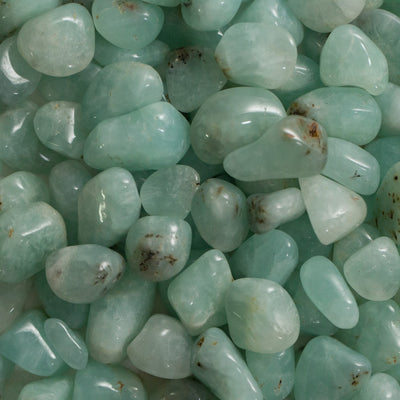
Vesuvianite takes its name from the volcano that first revealed it — greenish crystals thrown up from Mount Vesuvius's slopes and mistaken, for a while, for something more ordinary. It has since become a stone people turn to for Intuition & Clarity and Healing, valued for a very specific kind of work: loosening the grip of old restriction so the mind can move freely again. Most often green, sometimes brown, yellow, or a rare pale blue, it carries a resinous, faintly glassy look that sets it apart from stones it is regularly confused with, jade included.
Key Traits
- Named directly after Mount Vesuvius, where the first specimens were identified in 1795
- Also called idocrase, and known in massive green form as californite
- Long associated with releasing feelings of restriction and old confinement
- Supports mental clarity by clearing repetitive, negative thought patterns
- Stimulates creative problem-solving and the drive to discover something new
Intentions
Brief Overview
Vesuvianite is a complex calcium aluminum silicate that forms where limestone meets the heat of a nearby igneous intrusion, a process called contact metamorphism. First identified in 1795 on the slopes of Mount Vesuvius, it also occurs in California (where the massive green form is called californite), Canada, Russia, Kenya, and Pakistan. Its color ranges from green and brown to yellow and pale blue, and its resinous luster gives even rough specimens a faint glow. Metaphysically, it is worked with for its capacity to release old restriction and sharpen the mind.
Properties
Vesuvianite's reputation centers on release and clarity. It is said to loosen the emotional grip of situations that once felt inescapable, gently dissolving anger and unease in favor of a steadier inner security. Its mental effects are just as pronounced in tradition: a clearing of repetitive, negative thought loops in favor of sharper, more penetrating thinking, paired with a creative pull toward discovery. Where many stones lean either emotional or mental, Vesuvianite is worked with for both at once.
Metaphysical Properties
- Eases the felt sense of being confined or trapped, whether by circumstance or old patterns
- Gently dissolves stored anger and unease, creating a steadier inner security
- Clears repetitive, negative thought patterns in favor of sharper thinking
- Stimulates inventiveness and the drive to discover, connecting directly to creativity
- Long associated with reflecting on old experiences of restriction to release their hold
Physical Properties
- Type: Calcium aluminum silicate
- Color: Most often green; also brown, yellow, pale blue, and red
- Luster: Vitreous to resinous
- Structure: Tetragonal; typically prismatic or massive
Meaning & Energy
Vesuvianite's meaning is tied to its geology: born under pressure and heat, it became something more resilient in the process. Worked with metaphysically, it carries that same signature — a stone for the specific moment when a restriction has run its course and needs to be released rather than endured any longer. It does not rush the release. It simply keeps clearing space until the old pattern has somewhere to go.
Emotions
If you find yourself circling the same worry or holding onto anger that no longer serves a purpose, Vesuvianite is worth spending time with. Many people describe a slow loosening — not a sudden shift, but a gradual sense that whatever felt inescapable has more room around it than they realized. It pairs particularly well with reflection on old patterns, since its traditional use leans toward examining where a restriction actually came from rather than only managing its symptoms.
Crystal Pairings
- Prehnite – adds gentle intuitive support to vesuvianite's clearing work
- Green Aventurine – reinforces the heart-centered ease and steady optimism vesuvianite builds toward
- Smoky Quartz – grounds the release process so old patterns clear without leaving you unmoored
- Citrine – amplifies the creative, inventive spark vesuvianite stimulates
Science & Origin
Vesuvianite forms through contact metamorphism, where heat from an igneous intrusion transforms nearby limestone or dolomite into new minerals. It crystallizes in the tetragonal system and typically appears as prismatic crystals or massive material. First identified in 1795 on Mount Vesuvius, it has since been found in skarn deposits across the United States, Canada, Russia, Kenya, and Pakistan.
- Also Known As: Idocrase, Californite (massive green form)
- Formation: Contact metamorphism of limestone near igneous intrusions
- First Discovery: 1795, Mount Vesuvius, Italy
- Safety Note: Safe to handle, no special precautions needed.
Ancient Myths
- Named in 1795 by German mineralogist Abraham Gottlob Werner after Mount Vesuvius, where the first specimens were found in limestone blocks ejected from the volcano's slopes.
- The massive green variety found in California's Sierra Nevada foothills, called 'californite,' was mistaken for jade by miners well into the twentieth century, and the two are still confused by casual buyers today.
- Vesuvianite carries no deep ancient mythology of its own — unlike stones traded for millennia, it entered the gem trade only after its 1795 naming, so its lore is geological rather than legendary.
Chakras Table
| Chakra | Connection | Healing Focus | Energy Type |
|---|---|---|---|
| Heart | Supporting | Easing stored anger, building inner security | Steadying, releasing |
| Third Eye | Primary | Mental clarity, clearing negative thought patterns | Penetrating, clarifying |
| Crown | Secondary | Connection to higher self and its guidance | Expansive, illuminating |
Planets Table
| Planet | Influence | Energy |
|---|---|---|
| Mercury | Communication, mental agility, quick thinking | Sharp, clarifying |
| Pluto | Transformation, release, deep change | Intense, releasing |
Zodiacs Table
| Zodiac | Attribute | Benefit |
|---|---|---|
| Virgo | Analytical, detail-oriented, practical | Supports clear thinking and productive creativity |
| Scorpio | Transformative, intense, deeply reflective | Aids release of old emotional restriction |
Elements Table
| Element | Power | Aspect |
|---|---|---|
| Earth | Grounding, structure, endurance | Reflects the stone's origin under geological pressure |
| Fire | Transformation, creativity, drive | Echoes its volcanic naming and creative spark |
Sacred Numbers Table
| Number | Vibration | Meaning |
|---|---|---|
| 3 | Creativity, expression, growth | Aligned with vesuvianite's inventive, discovery-driven energy |
| 9 | Completion, release, letting go | Reflects the stone's focus on releasing old restriction |
Color Variations
- Green: the most common form, sometimes massive and called californite
- Brown: common in skarn-hosted material
- Yellow: associated with manganese content
- Pale blue to violet: rare, colored by trace copper or vanadium
Mohs Scale Hardness
Vesuvianite registers 6 to 7 on the Mohs scale, making it durable enough for regular handling and most jewelry use. It resists everyday scratching reasonably well, though it should still be kept away from harder gemstones during storage. Its vitreous to resinous luster holds up well to normal wear.
Chemical Formula
Vesuvianite's approximate formula is Ca19(Al,Mg,Fe)13(Si2O7)4(SiO4)10(OH,F,O)10 — a complex calcium aluminum silicate.
- Ca (Calcium): the dominant structural element, giving the mineral its density
- Al (Aluminum): forms much of the crystal lattice alongside magnesium and iron
- Si (Silicon): present in both single and paired silicate groups within the structure
- O (Oxygen): abundant throughout the silicate and hydroxide framework
- Fe/Mg (Iron/Magnesium): substitute for aluminum and influence color
Summary of Composition
- Mineral Class: Sorosilicate
- Crystal System: Tetragonal
- Transparency: Transparent to opaque
- Luster: Vitreous to resinous
Care Instructions
- Clean with a soft, dry or slightly damp cloth; avoid harsh chemicals
- Store separately from harder stones to prevent surface scratching
- Avoid prolonged sun exposure, which can fade certain color variations over time
- Cleanse energetically with sound, moonlight, or a short smoke cleanse
Final Summary
Vesuvianite carries its origin story right in its name — a stone born from volcanic heat and geological pressure, later worked with for exactly that kind of transformation. It clears what has run its course, steadies what remains, and leaves more room for creative thinking than restriction ever allowed.