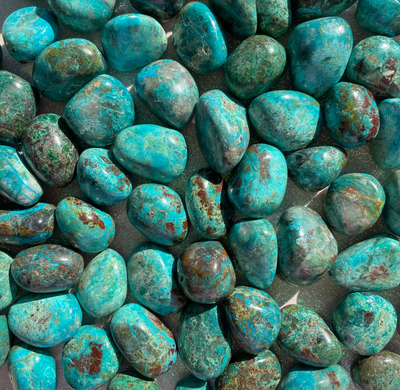
Turquoise has been placed in tombs, set into armor, and worn by healers for more than six thousand years — a blue-green stone that cultures separated by oceans and centuries all reached for as protection. It is one of the oldest and most trusted stones for Protection and Healing, carried by people who needed both a shield and a steady hand. Its color comes from copper weathering slowly into desert rock, but its reputation comes from something less explainable: an unbroken record of being reached for exactly when it was needed most.
Key Traits
- One of the most widely recognized protective stones across human history and culture
- Long associated with honest, courageous communication — saying what needs to be said
- Carries a grounding quality despite its sky-blue color, bridging earth and sky
- Supports emotional and physical steadiness, particularly through long-standing strain
- Strengthens a sense of self in those who have felt unseen or silenced
Intentions
Brief Overview
Turquoise is a hydrated copper aluminum phosphate that forms in copper-rich desert environments, where groundwater slowly weathers aluminum-bearing rock. Its blue comes from copper; iron shifts it toward green. It has been mined in Egypt's Sinai Peninsula since at least 4000 BCE, and later in Iran, China, the American Southwest, Mexico, and Tibet, with each region producing material of distinct character — the clear robin's-egg blue of Sleeping Beauty turquoise, the veined matrices of the American Southwest, the warmer tones of Persian material. Metaphysically, it is unusually complete: protective, healing, clarifying, and grounding within a single stone.
Properties
Turquoise works on more than one level at once. It filters negativity from the aura while supporting honesty with yourself — an unusual pairing that makes it useful both in difficult environments and in difficult conversations you are having with yourself. Its copper content ties it to Venus-ruled qualities of warmth and harmony, while its desert origin keeps it grounded rather than abstract. It tends to be reached for by people navigating identity questions, long recoveries, or situations that call for speaking up when staying quiet would be easier.
Metaphysical Properties
- Builds a protective field around the body and aura, filtering out negativity
- Opens and supports the Throat chakra for honest, grounded communication
- Long regarded in crystal healing tradition as a stone of healing, supporting emotional recovery and a sense of physical steadiness
- Eases nervousness before public speaking and difficult conversations
- Bridges earth and sky energy, balancing practical instinct with intuition
Physical Properties
- Type: Hydrated copper aluminum phosphate
- Color: Sky blue to blue-green; iron content shifts it toward green
- Luster: Waxy to dull, polishing to a smooth finish
- Structure: Triclinic; typically massive, nodular, or vein-filling
Meaning & Energy
Turquoise has never belonged to one culture or one meaning — it has been shaped by everyone who ever held it. What they share is the instinct that this stone is fundamentally about surviving with dignity: surviving conflict, surviving illness, surviving the pressure to be smaller or quieter than you actually are. Its energy is confident without being aggressive, protective without closing you off, and steadying in a way that does not ask you to relive every wound to earn it.
Emotions
If you struggle to say what you mean, or mean what you say, turquoise sits in the gap between what you know internally and what you let yourself express. Working with it over time, many people notice the anxiety around speaking up softens, replaced by a quieter kind of confidence. It is also useful when you are carrying something heavy you have not named yet — grief, chronic stress, or the specific fatigue of constantly adjusting yourself for other people's comfort. Turquoise asks you to take up exactly the space you need, no apology required.
Crystal Pairings
- Lapis Lazuli – deepens throat chakra work with a layer of truth-seeking clarity
- Black Tourmaline – adds a grounding, shielding force to turquoise's protective field
- Chrysocolla – a copper sister stone that amplifies turquoise's calming, communicative qualities
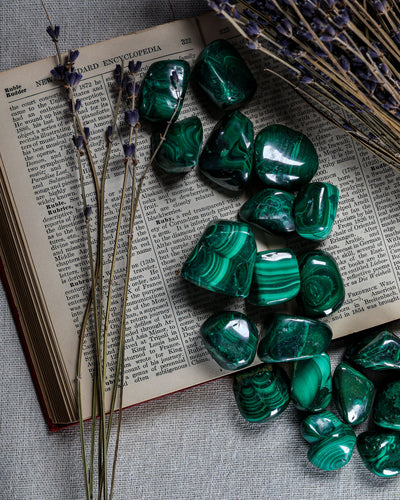
- Malachite – supports emotional healing and heart-centered courage after long illness or heartbreak
Science & Origin
Turquoise's formula is CuAl6(PO4)4(OH)8·4H2O. It is a secondary mineral, forming through the chemical alteration of aluminum-rich rock in the presence of copper-bearing groundwater — a process that requires the specific dryness of desert climates. The oldest documented mines are in Egypt's Sinai Peninsula, worked as early as 6000 BCE; important modern sources include the American Southwest, Iran, China, and Tibet.
- Also Known As: Persian Turquoise, Sleeping Beauty Turquoise, Kingman Turquoise, Tibetan Turquoise
- Formation: Secondary mineral formed by weathering of copper-bearing rock in arid environments
- First Discovery: Used as early as 6000 BCE in the Sinai Peninsula, Egypt
- Safety Note: Safe to handle. Porous — avoid prolonged water exposure, perfume, oils, and cleaning chemicals, which can permanently alter color.
Ancient Myths
- Ancient Egyptians called turquoise 'mefkat,' a word tied to joy and delight, and set it into protective amulets buried with pharaohs — including the turquoise inlays found in Tutankhamun's burial mask.
- Many Native American traditions regard turquoise as a sacred stone connecting sky and earth, carried by warriors for protection in battle and used by healers to reach for healing spirits.
- Persian warriors inscribed turquoise with prayers and set it into armor and horse bridles, trusting the stone to guard both rider and mount from injury in combat.
Chakras Table
| Chakra | Connection | Healing Focus | Energy Type |
|---|---|---|---|
| Heart | Supporting | Emotional healing, self-compassion, opening to care | Receptive, healing |
| Throat | Primary | Honest expression, truth-speaking, communicative courage | Clarifying, liberating |
| Third Eye | Secondary | Intuitive sight, seeing clearly through emotional noise | Perceptive, discerning |
Planets Table
| Planet | Influence | Energy |
|---|---|---|
| Venus | Heart, beauty, harmony, healing relationships | Warm, receptive, heart-centered |
| Neptune | Intuition, healing, spiritual sight | Fluid, compassionate, dissolving |
Zodiacs Table
| Zodiac | Attribute | Benefit |
|---|---|---|
| Sagittarius | Expansive, truth-seeking, direct | Supports courageous honesty and protection during travel |
| Scorpio | Intense, transformative, emotionally deep | Channels emotional depth into clear expression and healing |
| Pisces | Sensitive, intuitive, emotionally fluid | Provides grounding protection and strengthens self-expression |
Elements Table
| Element | Power | Aspect |
|---|---|---|
| Water | Emotional healing, flow, adaptability | Supports emotional healing and communicative fluidity |
| Earth | Grounding, stability, physical steadiness | Anchors turquoise's protective and healing energy |
| Air | Thought, speech, truth | Activates the Throat chakra and supports honest communication |
Sacred Numbers Table
| Number | Vibration | Meaning |
|---|---|---|
| 1 | Independence, leadership, original force | Strengthens individual voice and self-determination |
| 11 | Illumination, spiritual clarity, master perception | Sharpens intuition and bridges the earthly and the knowing |
Color Variations
- Robin's-egg blue: the clearest, most valued tone, associated with fine Sleeping Beauty and Persian material
- Sky blue with brown matrix: common in Southwestern American turquoise, veining from the natural host rock
- Blue-green: moderate iron content, common in Nevada and Chinese material
- Green: higher iron content, sometimes called 'faustite,' earthier in character
Mohs Scale Hardness
Turquoise sits between 5 and 6 on the Mohs scale — moderately hard but notably porous. That porosity is exactly why it absorbs liquids, oils, and pigments so readily, and why so much commercial turquoise is stabilized with resin for durability. Natural, untreated material deserves particular care: store it dry, away from chemicals and cosmetics, and handle it with clean hands. Its relative softness also means it can be scratched by harder stones stored alongside it.
Chemical Formula
Turquoise's formula is CuAl6(PO4)4(OH)8·4H2O — a hydrated copper aluminum phosphate.
- Cu (Copper): responsible for the signature blue; more copper deepens the tone
- Al (Aluminum): structural component of the mineral lattice
- P (Phosphorus): central to the phosphate groups defining the mineral
- O (Oxygen): abundant throughout the phosphate and hydroxide bonds
- H (Hydrogen): present in hydroxide and crystallization water, contributing to porosity
- Fe (Iron): in trace amounts, shifts color from blue toward green
Summary of Composition
- Mineral Class: Phosphate
- Crystal System: Triclinic
- Transparency: Opaque
- Luster: Waxy to dull, polishing smoothly
Care Instructions
- Wipe with a soft, dry cloth; avoid water, soap, and chemical cleaners, which turquoise absorbs readily
- Keep away from perfume, body oils, sunscreen, and household chemicals that can permanently alter its color
- Store separately in a soft pouch or lined box — turquoise scratches easily against harder stones
- Cleanse energetically with sound or moonlight rather than salt water, which is too harsh for its porous surface
Final Summary
Turquoise does not need to be explained so much as worn. Six thousand years of hands reaching for this stone is its own kind of evidence. It protects, it heals, and it steadies the voice of anyone who carries it with intention — and if any stone has earned the word essential, turquoise earned it across every culture that ever held it up to the light.