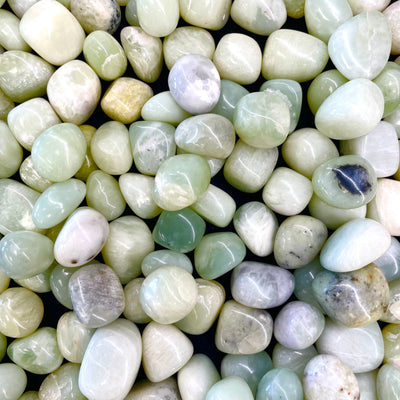
Tree Agate carries its own small forest inside a milky-white stone, branching green inclusions that look like something still growing. It is a natural fit for Grounding & Stability, keeping you anchored to who you are even while your circumstances change around you. It is also carried for Prosperity & Opportunity, in the patient, root-first sense of abundance that builds over seasons rather than overnight, and traditionally for Healing understood as steady, restorative growth.
Key Traits
- A moss-patterned chalcedony with tree-like green inclusions
- Traditionally used to keep you rooted while you grow and change
- Long associated with balancing and aligning the chakras
- Believed to support plant and garden health when placed in soil
- Traditionally used to ease geopathic stress in a space
Intentions
Brief Overview
Tree Agate is a variety of chalcedony distinguished by its pale, milky background and the branching, moss-like green inclusions that give it its name, rather than the ringed banding most people associate with agate. It forms slowly inside volcanic rock cavities as silica-rich groundwater deposits itself around included minerals, and it has been used and gathered for centuries as part of the wider agate family.
Properties
Tree Agate works the way a root system works: quietly, underground, and in service of something larger growing above it. It is traditionally carried to stay grounded during periods of change, to support steady, patient growth rather than sudden leaps, and to bring a settled, garden-variety kind of abundance into daily life. It suits anyone who wants to grow without losing their footing.
Metaphysical Properties
- Traditionally used to help you stay connected to your roots as you grow and change
- Long associated with opening and aligning the chakras
- Believed to support the health of plants and gardens when placed in soil
- Said to stabilize a space and ease geopathic or restless earth energy
- Traditionally carried as a stone of steady, patient abundance
Physical Properties
- Type: Chalcedony (cryptocrystalline quartz)
- Color: Milky white to cream with green, moss-like inclusions
- Luster: Waxy to vitreous
- Structure: Trigonal (microcrystalline)
Meaning & Energy
Tree Agate's branching inclusions read almost like a diagram of how growth actually happens: underground first, unglamorously, long before anything visible appears above the soil. In tradition, it is described as a stone that resonates with anything that branches, roots, blood vessels, river deltas, and is used to bring that same patient, structural logic to whatever in your life is trying to take root.
Emotions
If you feel pressure to grow faster than feels natural, Tree Agate gives you permission to slow down without stalling out. It supports you in trusting a process that is not yet visible, and in finding steadiness even when your circumstances are still shifting. It is a quiet companion for anyone rebuilding something from the ground up.
Crystal Pairings
- Moss Agate – its closest relative, doubling the sense of grounded, plant-like growth
- Green Aventurine – layers in a lighter, more overtly prosperity-minded energy
- Jade – deepens the theme of patient, long-term abundance
- Rose Quartz – softens Tree Agate's grounded steadiness with gentle, heart-centered warmth
Science & Origin
Tree Agate's tree-like pattern is a real mineralogical feature, not a decorative effect, and it is what separates the stone from its banded agate relatives.
- Also Known As: Dendritic Agate
- Formation: Forms as chalcedony in volcanic rock cavities, with branching chlorite or manganese oxide inclusions growing as silica deposits accumulate
- First Discovery: Documented as part of the broader agate family for centuries, distinguished by its light background and internal tree-like inclusions
- Safety Note: Durable and generally safe to cleanse with water; no special precautions beyond standard stone care
Ancient Myths
- The name "agate" traces back to the Achates River in Sicily, where the Greek philosopher Theophrastus is credited with first describing the stone around 300 BCE.
- Because its branching inclusions resemble roots and budding trees, Tree Agate has long been associated in folk tradition with agricultural fertility, carried or buried near crops and gardens in the hope of encouraging abundant growth.
- Agate amulets have been worn since antiquity for protection, and Tree Agate's clear link to earth and root made it a natural choice for those wanting a steady connection to home and land.
Chakras Table
| Chakra | Connection | Healing Focus | Energy Type |
|---|---|---|---|
| Root | Anchors you to the earth as you grow | Grounded stability | Steady, rooted |
| Heart | Nurtures growth and connection to nature | Patient, growing love | Gentle, expansive |
Planets Table
| Planet | Influence | Energy |
|---|---|---|
| Saturn | Structure, patience, long-term growth | Steady |
Zodiacs Table
| Zodiac | Attribute | Benefit |
|---|---|---|
| Virgo | Practical, detail-oriented, earth-connected | Supports patient, methodical growth |
| Capricorn | Disciplined, growth-minded | Supports building lasting stability |
Elements Table
| Element | Power | Aspect |
|---|---|---|
| Earth | Grounding and growth | Fertility and stability |
Sacred Numbers Table
| Number | Vibration | Meaning |
|---|---|---|
| 4 | Foundation and structure | Steady, patient building toward growth |
Color Variations
- Cream-white with soft green dendrites – the most common tone
- Gray-green base with darker moss-like inclusions
- Pale pink-tinted background – a rarer material
- Nearly white with faint, delicate branching patterns
Mohs Scale Hardness
Tree Agate measures 6.5 to 7 on the Mohs scale, quite durable and well suited to daily handling, jewelry, or even time spent in garden soil, resistant to scratching from most surfaces it might encounter.
Chemical Formula
Tree Agate's base formula is SiO2, silicon dioxide, with included chlorite or manganese oxide responsible for its green, branching pattern.
- Si – Silicon
- O – Oxygen
- Trace Mg, Fe, Mn – found in the chlorite or manganese oxide inclusions responsible for the green dendritic pattern
Summary of Composition
- Mineral Class: Chalcedony (Quartz family)
- Crystal System: Trigonal (microcrystalline)
- Transparency: Translucent to opaque
- Luster: Waxy to vitreous
Care Instructions
- Cleanse under lukewarm running water
- Safe for regular handling given its durability
- Avoid harsh chemicals if used in garden soil for extended periods
- Store away from harder stones to prevent scratching
Final Summary
Tree Agate does its work below the surface, the way real roots do, long before anything visible shows for it. Keep it close while you are building something that needs time, and let it remind you that steady, unhurried growth is still growth, even on the days it does not look like much is happening at all.