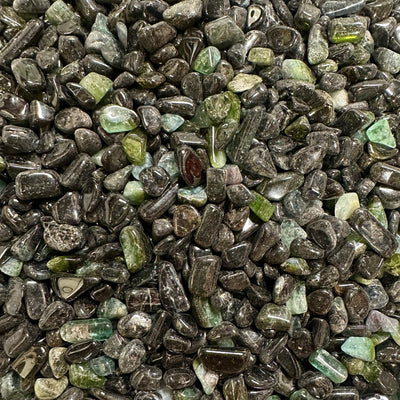
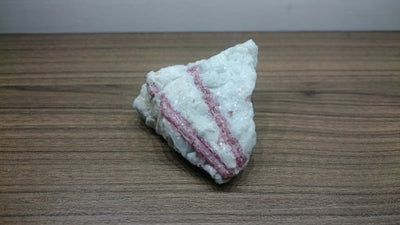
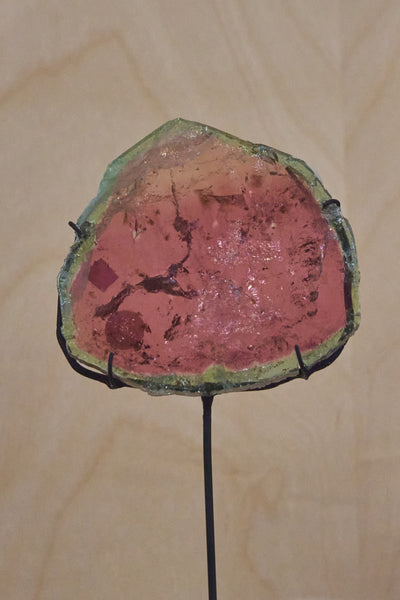
Tourmaline is less a single stone than an entire family of them, sharing one crystal structure across nearly every color found in nature. It is one of the most reliable stones for Protection, traditionally used to build a shield of energy around the body, and for Confidence & Strength, quietly dissolving the sense of being a victim of circumstance. Many colors are also carried for Prosperity & Opportunity, drawing in the kind of steady abundance that follows a person who no longer feels powerless.
Key Traits
- A mineral family with more natural colors than almost any other gem
- Traditionally used as a shamanic protection stone
- Long associated with cleansing and balancing every chakra
- Naturally piezoelectric and pyroelectric, generating a real electrical charge
- Believed to dissolve victim-mindset thinking and attract inspiration
Intentions
Brief Overview
Tourmaline is a group of closely related borosilicate minerals, all sharing a trigonal crystal structure but varying enormously in color depending on which trace elements are present during formation. Black, green, pink, and watermelon tourmaline are common and beloved enough to have their own dedicated profiles; this entry focuses on the wider family and its rarer members, from deep blue indicolite to copper-colored paraiba.
Properties
Tourmaline works as both shield and mirror. Across nearly every color, it is traditionally carried to cleanse dense or heavy energy, to form a protective boundary around the body, and to help you see your own patterns clearly enough to change them. It is a family of stones for people who want to feel steady and clear at the same time.
Metaphysical Properties
- Traditionally used to cleanse dense energy and lighten the body's overall vibration
- Long carried as a shamanic protection stone during ritual and difficult transitions
- Said to cleanse and balance every chakra, from root to crown
- Believed to dissolve a victim mindset and encourage grounded self-confidence
- Traditionally associated with attracting inspiration, compassion, and prosperity
Physical Properties
- Type: Borosilicate mineral group (many species and colors)
- Color: Nearly every color, sometimes several in a single crystal
- Luster: Vitreous
- Structure: Trigonal
Meaning & Energy
Because tourmaline is genuinely piezoelectric and pyroelectric, meaning it produces a real electrical charge under pressure or heat, it has long been treated as a stone that does something rather than one that simply sits and looks beautiful. In tradition, its striated crystal wands are considered natural healing tools, said to comb through the aura, loosen blockages, and point toward practical solutions rather than vague comfort.
Emotions
If you tend to slip into feeling like things are happening to you rather than with you, tourmaline gives you something to push back against that pattern with. It supports you in noticing old victim narratives as they arise, and in choosing a steadier, more self-possessed response instead. Over time, it helps compassion for others coexist with real boundaries for yourself.
Crystal Pairings
- Black Tourmaline – the family's best-known grounding and protection color, worth exploring on its own for deep-earth stability
- Green Tourmaline – channels the same family properties into abundance and heart-centered growth
- Pink Tourmaline – softens the family's protective strength into gentle, self-compassionate love
- Watermelon Tourmaline – combines pink and green in one stone, balancing the heart's giving and receiving
Science & Origin
Tourmaline's color range comes down to chemistry: swap out one trace element for another during formation, and the same crystal structure produces an entirely different gem.
- Also Known As: Schorl (black), Rubellite (pink-red), Verdelite (green), Indicolite (blue), Dravite (brown), Achroite (colorless)
- Formation: Forms as a complex borosilicate in pegmatites and metamorphic rock, with trace elements determining its wide color range
- First Discovery: Traded for its color range since antiquity; introduced to Europe from Sri Lanka by Dutch traders in the early 1700s
- Safety Note: Generally safe to cleanse with water; protect from sudden temperature change and prolonged direct sunlight, which can fade some colors
Ancient Myths
- Egyptian legend holds that tourmaline traveled up from the center of the Earth along a rainbow, picking up every color it passed through, which is why it comes in more colors than almost any other gem.
- Dutch traders introduced tourmaline to Europe from Sri Lanka in the early 1700s under the name "aschentrekker," or ash-puller, after discovering its electrical charge could attract ash from a pipe.
- Traditionally used by shamans as a protective stone during ritual work, and in some traditions carried to help identify who was responsible for wrongdoing during times of conflict.
Chakras Table
| Chakra | Connection | Healing Focus | Energy Type |
|---|---|---|---|
| Root | Grounds spiritual energy into the body | Stability | Anchoring |
| Sacral | Balances creative and emotional flow | Emotional balance | Fluid |
| Solar Plexus | Personal power and confidence | Self-assurance | Activating |
| Heart | Opens compassion and connection | Emotional openness | Warm |
| Throat | Supports honest expression | Clear communication | Resonant |
| Third Eye | Supports psychic insight | Intuitive clarity | Perceptive |
| Crown | Completes the chakra alignment | Spiritual connection | Unifying |
Planets Table
| Planet | Influence | Energy |
|---|---|---|
| Mercury | Mental balance and communication | Harmonizing |
Zodiacs Table
| Zodiac | Attribute | Benefit |
|---|---|---|
| Libra | Seeks balance and fairness | Supports emotional equilibrium |
| Sagittarius | Adventurous, truth-seeking | Supports confident exploration |
Elements Table
| Element | Power | Aspect |
|---|---|---|
| Earth | Grounding and protection | Stability |
| Fire | Transformation of dense energy | Activation |
Sacred Numbers Table
| Number | Vibration | Meaning |
|---|---|---|
| 8 | Balance and polarity | Reflects the stone's own positively and negatively charged poles |
Color Variations
- Indicolite (blue) – a rare, cool-toned variety prized by collectors
- Paraiba (vivid blue-green) – colored by trace copper, among the rarest and most valuable tourmalines
- Dravite (brown) – an earthy, grounding tone common in Africa and Australia
- Achroite (colorless) – the rarest tourmaline color, formed with almost no trace elements
Mohs Scale Hardness
Tourmaline measures 7 to 7.5 on the Mohs scale, durable enough for daily jewelry and resistant to most scratching. Heavily included stones can still be more brittle than the number alone suggests, so a careful setting matters as much as the hardness.
Chemical Formula
Tourmaline's general group formula is XY3Z6(BO3)3Si6O18(OH)4, where the X, Y, and Z positions can each be filled by different elements, which is why the family shows such range.
- B – Boron
- Si – Silicon
- O – Oxygen
- Al – Aluminum (common in the Z site)
- Na, Ca – Sodium or calcium (X site)
- Fe, Mg, Mn, Li – Iron, magnesium, manganese, or lithium (Y site, determines color)
Summary of Composition
- Mineral Class: Borosilicate (Tourmaline group)
- Crystal System: Trigonal
- Transparency: Transparent to opaque, depending on color and clarity
- Luster: Vitreous
Care Instructions
- Cleanse under lukewarm running water
- Avoid ultrasonic and steam cleaners for heavily included stones
- Keep away from prolonged direct sunlight, which can fade some colors
- Store separately to prevent scratching
Final Summary
Tourmaline does not offer one meaning so much as a whole spectrum of them, one for nearly every color it grows in. Whichever variety finds its way to you, it tends to arrive with the same underlying message: build the shield first, then stand inside it with confidence, because the abundance you are looking for meets people who have already stopped feeling like a target.