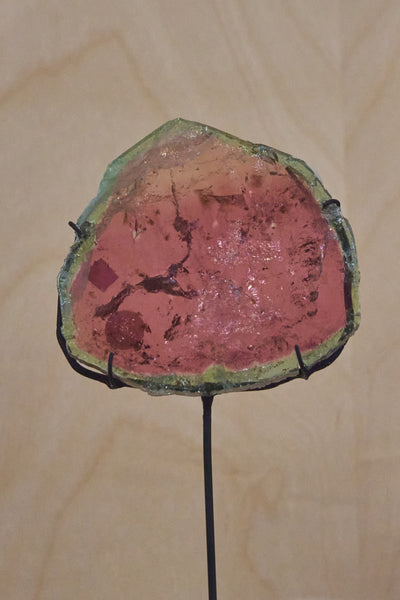
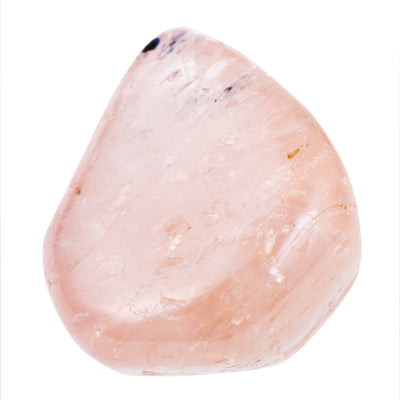
Pink Tourmaline carries the quiet certainty that love is safe to receive. Formed inside slow-cooling pegmatite and colored rose by trace manganese, it has long been reached for in support of love and relationships built on trust rather than performance. It tends to work inward first, easing the guardedness that keeps real closeness at arm's length, before it ever turns its attention outward toward others.
Key Traits
- Rose to raspberry-pink elbaite tourmaline, colored by trace manganese
- Long, striated, hexagonal crystals with a glassy, vitreous shine
- Rated 7 to 7.5 on the Mohs scale, durable enough for daily wear
- Piezoelectric and pyroelectric — generates a small charge under heat or pressure
- Sourced from pegmatite deposits in Brazil, Afghanistan, Nigeria, and the United States
Intentions
Brief Overview
Pink Tourmaline is the rose-colored variety of elbaite, part of the larger tourmaline group prized for its long, glassy prisms and unusually wide color range. Where black tourmaline is reached for as a shield, pink tourmaline is reached for as an opening — a stone associated less with keeping things out and more with letting the right things in. It has been worn as a talisman for love since at least the nineteenth century, when California's pink tourmaline mines shipped rough directly to the Chinese imperial court.
Properties
At its core, pink tourmaline is a heart-centered stone. It is worked with to soften old emotional armor, to encourage self-worth as the foundation for any healthy connection, and to bring a steadier, more receptive quality to relationships already in progress. Its long internal striations are traditionally said to channel and direct energy the way they direct light, giving the stone a sense of forward motion rather than static comfort.
Metaphysical Properties
- Opens and softens the heart chakra, easing long-held emotional guardedness
- Encourages self-love as the ground a healthy partnership is built on
- Traditionally used to disperse old grief and worn-out emotional patterns
- Invites compassion, tact, and patience into close relationships
- Promotes a sense of peace and relaxation that supports openness to change
Physical Properties
- Type: Elbaite (tourmaline group), borosilicate mineral
- Color: Pale blush to deep raspberry pink
- Luster: Vitreous (glassy)
- Structure: Trigonal, long striated prismatic crystals
Meaning & Energy
Pink Tourmaline's meaning is inseparable from its color: manganese turns the crystal rose the way it colors rhodochrosite and rhodonite, and across all three stones that hue has come to represent the same territory — the heart, held gently. What sets pink tourmaline apart is its structure. Tourmaline's long striations are thought to move energy along a directional line rather than simply holding it, which is why the stone is more often described as active than soothing. It doesn't ask you to sit still with your feelings so much as it asks you to let them move through and out.
Emotions
If you tend to keep people at a careful distance, even the ones you love, pink tourmaline meets you there rather than pushing past it. It supports you in naming what old hurt is still doing the guarding, and in loosening its grip a little at a time. Worn or held over the heart, it can make it easier to receive affection without flinching, to extend patience to someone difficult, and to remember that tenderness toward yourself isn't indulgent — it's the thing that makes tenderness toward anyone else sustainable.
Crystal Pairings
- Watermelon Tourmaline – its own pink-and-green banding widens heart-opening work into fuller emotional balance
- Rose Quartz – deepens gentle, unconditional self-love alongside pink tourmaline's more active heart work
- Rhodochrosite – supports moving through old emotional wounds that pink tourmaline has helped surface
- Morganite – brings a quieter, more contemplative register to sustained heart-centered practice
Science & Origin
Pink tourmaline is elbaite, a lithium-bearing tourmaline colored by manganese, formed in the mineral-rich final stage of a cooling pegmatite. Because that chemistry can shift as a crystal grows, a single prism sometimes zones from pink at one end toward green or colorless at the other.
- Also Known As: Rubellite, Pink Elbaite
- Formation: Granite pegmatites; color from trace manganese
- First Discovery: European gem trade by the early 1700s; major California and Maine deposits identified in the 1890s
- Safety Note: Safe for everyday skin contact; avoid soaking, steaming, or ultrasonic cleaning
Ancient Myths
- Dutch traders encountered tourmaline in Sri Lankan gem gravels in the early 1700s and named it from the Sinhalese "turmali," a catch-all term for mixed colored gems.
- Ancient Egyptian legend held that tourmaline traveled up from the earth's core along a rainbow, gathering a different color from each band it crossed.
- Empress Dowager Cixi of China became the largest buyer of rough pink tourmaline from California's mines in the late 1800s, commissioning carved pieces for court and burial use until her death in 1908.
Chakras Table
| Chakra | Connection | Healing Focus | Energy Type |
|---|---|---|---|
| Heart | Manganese-rose color long linked to affairs of the heart | Softening guardedness, opening to love and self-worth | Receptive |
Planets Table
| Planet | Influence | Energy |
|---|---|---|
| Venus | Rules love, beauty, and relationship | Warm, magnetic |
Zodiacs Table
| Zodiac | Attribute | Benefit |
|---|---|---|
| Libra | Seeks balance and harmony in partnership | Supports fairness and ease in relationships |
| Taurus | Values steadiness and sensory comfort | Encourages patient, grounded affection |
| Scorpio | Feels deeply and guards the heart closely | Supports safe emotional opening |
Elements Table
| Element | Power | Aspect |
|---|---|---|
| Water | Governs emotion and connection | Receptive |
| Earth | Roots feeling in steady, lived reality | Stabilizing |
Sacred Numbers Table
| Number | Vibration | Meaning |
|---|---|---|
| 2 | Partnership | Balance, connection, and gentle receptivity |
Color Variations
- Pale blush pink — soft, delicate coloring often seen in lightly included stones
- Medium rose pink — the most common commercial grade, balanced saturation
- Deep raspberry to magenta (often sold as rubellite) — the most saturated, richly colored material
- Watermelon zoning — pink core wrapped in a green rind within a single crystal
Mohs Scale Hardness
Pink tourmaline rates 7 to 7.5 on the Mohs scale, on par with quartz and slightly harder in places. That makes it a practical everyday stone: resistant to scratching from dust, sand, and most surfaces it might brush against, though it still deserves the same care as any fine gem when it comes to hard knocks or contact with harder minerals like sapphire or diamond.
Chemical Formula
Pink tourmaline's formula is Na(Li,Al)3Al6(BO3)3Si6O18(OH)4, identifying it as elbaite, the lithium-rich member of the tourmaline group.
- Na — sodium, occupies the crystal's central structural site
- Li, Al — lithium and aluminum, define the elbaite species
- B (as BO3) — boron, the defining element of all tourmalines
- Si — silicon, forms the mineral's silicate framework
- Mn (trace) — manganese, responsible for the pink to red coloring
Summary of Composition
- Mineral Class: Borosilicate (tourmaline group)
- Crystal System: Trigonal
- Transparency: Transparent to translucent
- Luster: Vitreous
Care Instructions
- Cleanse with dry sound, sage smoke, or a soft brush rather than water when possible
- If rinsing, keep it brief and dry the stone immediately afterward
- Avoid ultrasonic cleaners, steam, and prolonged sun exposure, which can fade or fracture the stone
- Store separately from harder gems like quartz points or diamond-set jewelry to prevent scratching
Final Summary
Pink Tourmaline doesn't ask you to become someone softer than you are — it asks you to let the softness you already carry find its way to the surface. Slow-grown in stone and colored by the same trace mineral that tints a rose garnet, it has spent centuries being reached for at the exact moment someone needed to believe love was worth the risk again. Keep it close to the heart, and let it do what it has always done.