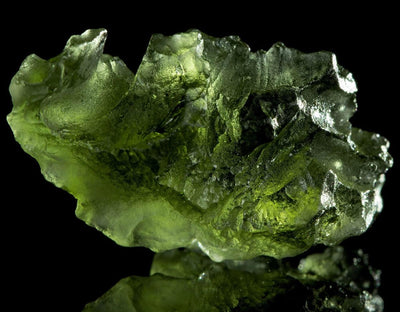
Indonesian Tektite fell to Earth before it ever became a keepsake, forged in the heat of a meteorite impact and cooled into dark glass on its way back down. It is worked with for Intuition & Clarity, sharpening perception past the ordinary and into something closer to clairvoyant. It is also carried for Protection, traditionally believed to reinforce the energy field around the body, and for Healing, in the sense of releasing an experience while keeping what it taught you.
Key Traits
- Extraterrestrial glass formed by an ancient meteorite impact
- Traditionally used to balance and correct chakra flow
- Long associated with telepathy and clairvoyant work
- Believed to strengthen the body's protective energy field
- Said to help release outdated experiences while keeping their lessons
Intentions
Brief Overview
Tektites are not minerals in the traditional sense but natural glass, thrown into being when a large meteorite strikes Earth with enough force to melt surrounding rock. Indonesian material, known in the trade as billitonite or javanite, belongs to the Australasian strewn field, the largest tektite strewn field on the planet, scattered across Southeast Asia by an impact roughly 790,000 years ago.
Properties
Tektite works like a compressed piece of a much larger event. It is traditionally used to correct chakras that feel out of alignment, to support telepathic and clairvoyant practice, and to hold a boundary around your energy when the outside world feels like too much. More than most stones, it is associated with taking you straight to the core of a problem rather than circling it.
Metaphysical Properties
- In crystal healing tradition, said to balance chakra flow and correct chakras that feel out of alignment
- Long used to support telepathic and clairvoyant work
- Placed at the third eye, traditionally believed to open communication beyond ordinary awareness
- Said to strengthen the protective energy field believed to surround the body
- Traditionally carried as a talisman of fertility at every level
Physical Properties
- Type: Natural glass (tektite, not a true mineral)
- Color: Black to dark brown, translucent at thin edges
- Luster: Vitreous to glassy
- Structure: Amorphous (no crystal system)
Meaning & Energy
Because of its extraterrestrial origin, Tektite has long been described as a bridge between creative energy and physical matter, something that has already crossed one impossible distance and so is well suited to helping you cross your own. In tradition, it is said to reduce the spin of chakras that are turning the wrong way and to steady the ones running erratically, bringing the whole energetic system back into working order.
Emotions
Tektite does not linger on old stories. It supports you in taking the lesson from a hard experience and setting the rest of it down, rather than replaying it on a loop. When you feel scattered or overexposed, it helps you gather your attention back into a single, steady point.
Crystal Pairings
- Moldavite – another tektite-family glass, amplifying Tektite's fast-moving, transformative energy
- Clear Quartz – clarifies and directs Tektite's intensity toward focused, deliberate work
- Smoky Quartz – grounds Tektite's high-velocity energy back down into the body
- Labradorite – adds a layer of protective shimmer to Tektite's boundary-strengthening reputation
Science & Origin
Tektites are one of the few materials sold as crystals that are not, strictly speaking, minerals at all, which makes their origin story genuinely extraordinary rather than embellished.
- Also Known As: Billitonite, Javanite
- Formation: Forms when a large meteorite impact melts surrounding rock, which cools into glass while airborne and falls back to Earth
- First Discovery: Documented as part of the Australasian strewn field, the largest tektite strewn field on Earth, from an impact roughly 790,000 years ago
- Safety Note: A natural glass with potentially sharp edges on raw specimens; cleanse with water and avoid harsh chemicals
Ancient Myths
- In parts of Java and Sumatra, tektites have long been gathered as "thunderstones," believed to fall from the sky during storms and kept as protective household charms.
- Because of their extraterrestrial origin, tektites have been described in crystal lore as tools for communicating with other worlds, said to hold and release higher knowledge to whoever carries them.
- Tektites have traditionally been carried as fertility talismans, valued at every level from the physical to the symbolic.
Chakras Table
| Chakra | Connection | Healing Focus | Energy Type |
|---|---|---|---|
| Third Eye | Traditionally opens perception beyond ordinary awareness | Clairvoyant and telepathic work | Penetrating, otherworldly |
| Crown | Gateway associated with higher, far-reaching knowledge | Spiritual reception | Elevated, expansive |
Planets Table
| Planet | Influence | Energy |
|---|---|---|
| Uranus | Sudden change, the unconventional | Electric, disruptive |
Zodiacs Table
| Zodiac | Attribute | Benefit |
|---|---|---|
| Aquarius | Drawn to the unconventional and futuristic | Supports embracing sudden change |
| Scorpio | Seeks transformation and hidden truth | Supports deep psychic work |
Elements Table
| Element | Power | Aspect |
|---|---|---|
| Fire | Born of impact and heat | Transformation |
| Air | Communication across distance | Mental reach |
Sacred Numbers Table
| Number | Vibration | Meaning |
|---|---|---|
| 9 | Completion and release | Letting go of what has run its course |
Color Variations
- Black, opaque – the most common Indonesian tone
- Dark brown, translucent at thin edges – visible when held to light
- Olive-black – a rarer, subtly greenish tone
- Pitted, sculpted surface texture – formed by atmospheric ablation during its fall
Mohs Scale Hardness
Indonesian Tektite measures roughly 5.5 to 6.5 on the Mohs scale, sturdy enough to handle and carry daily, but as a glass rather than a crystal, it can chip on hard impact. Treat it more like fine glass than a hard gemstone.
Chemical Formula
Tektite has no single fixed formula since it is a natural glass rather than a mineral, but it is overwhelmingly silica (SiO2) with smaller amounts of aluminum, iron, calcium, magnesium, and alkali oxides.
- SiO2 – Silica (majority component)
- Al2O3 – Aluminum oxide
- FeO – Iron oxide
- CaO – Calcium oxide
- MgO – Magnesium oxide
- K2O and Na2O – Combined alkali oxides
Summary of Composition
- Mineral Class: Natural glass (not a true mineral)
- Crystal System: None (amorphous)
- Transparency: Translucent at thin edges to opaque
- Luster: Vitreous
Care Instructions
- Handle raw specimens carefully, as edges can be sharp
- Cleanse with lukewarm water only, no salt or harsh chemicals
- Store separately to avoid scratching softer stones
- Avoid dropping onto hard surfaces, since it is glass rather than crystal
Final Summary
Indonesian Tektite has already survived one impossible fall, and it carries that history into whatever work you bring to it. Hold it when you need to cut through noise and reach the actual center of a question, and let it remind you that what looks like an ending can just as easily be the beginning of something with more clarity than before.