


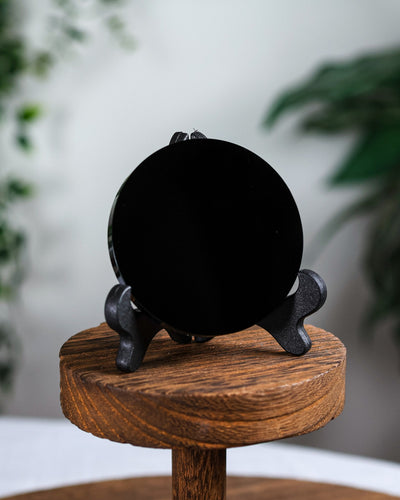
You can carry a lot of other people's weather without noticing, until the end of the day when everything feels louder than it should. Obsidian is volcanic glass, lava that cooled so fast it never had time to crystallize, and it is carried for Protection when you need a firm edge between you and the room, and for Grounding & Stability when you need your feet back under you. It is also honest in a way few stones are: it shows you what is there and does not soften it. Hold it when you are ready to look straight at something.
Key Traits
- Draws a clear line between your energy and everyone else's
- Anchors you to the ground when the day has scattered you
- Reflects patterns and blind spots without softening them
- Works quickly, so it rewards a steady, unhurried hand
- Steadies focus for scrying, meditation, and quiet inner work
Intentions
Brief Overview
Obsidian is natural volcanic glass, not a crystal in the strict mineral sense. It forms when silica-rich lava cools so fast that its atoms cannot organize into a lattice, leaving a smooth, dark glass that breaks in curved, razor-edged surfaces. Most pieces sold simply as Obsidian are plain and unpatterned, black to deep brown, while its patterned and sheen varieties, such as Snowflake Obsidian, are covered in entries of their own.
Properties
In crystal healing tradition, Obsidian is a stone of boundaries and honesty. It is carried to hold a protective edge around your personal energy, to ground you through a cord that runs from the base chakra toward the center of the earth, and to bring what you have been avoiding into plain view. It works fast and without much cushioning, which is why many people handle it in short, deliberate sessions.
Metaphysical Properties
- Forms a protective shield against negativity and draining surroundings
- Draws a grounding cord from the base chakra toward the center of the earth
- Reflects flaws, weaknesses, and blocks so they can finally be addressed
- Long used for scrying, mirror-gazing, and meditation
- Supports shadow work by bringing the darker side of the self into view to be integrated
Physical Properties
- Type: Volcanic glass (mineraloid)
- Color: Black, brown, or grey, occasionally banded
- Luster: Vitreous, glassy
- Structure: Amorphous, with conchoidal fracture
Meaning & Energy
Obsidian's meaning is written into how it forms: molten rock meets air and freezes before it can settle into any pattern. You feel that in the stone, something unresolved made suddenly and undeniably solid. Held with intention, it brings the same quality to you. It names what is going on and then gives you weight to stand on while you deal with it, and because it works so quickly, many people begin with a smaller piece or the gentler Snowflake variety.
Emotions
If you are worn down from absorbing everyone else's moods, Obsidian helps you notice where your own edges are. If you have been circling a hard truth, it can feel like a window opening in a stuffy room: bracing at first, then clearer. Go slowly, give it a few minutes at a time, and set it down when you have had enough. Many people find that simply naming what is actually bothering them is the part that lets them settle.
Crystal Pairings
- Black Obsidian – concentrates the protective work in the deepest black, most focused variety
- Snowflake Obsidian – offers the same honesty at a gentler, more gradual pace
- Clear Quartz – helps you anchor and put words to what Obsidian shows you
- Selenite – clears and recharges the stone between uses
Science & Origin
Obsidian forms at the edges of lava flows and domes where silica-rich (felsic) lava cools so rapidly that atoms cannot build an ordered crystal lattice, producing an amorphous glass instead of a true mineral. It occurs wherever fast-cooling volcanic activity has taken place, from Mexico and the western United States to Iceland, Italy, and Armenia. Brightly colored blue or green pieces sold as obsidian are typically manufactured glass rather than natural volcanic glass.
- Also Known As: Volcanic Glass
- Formation: Forms when silica-rich lava cools too quickly for crystals to develop, producing a natural amorphous glass rather than a crystalline mineral.
- First Discovery: Obsidian tools date back to the Stone Age; the name itself was recorded by Pliny the Elder in the 1st century CE, who attributed the discovery to a Roman explorer named Obsius.
- Safety Note: Rough, unpolished obsidian can break into razor-sharp edges, so handle raw specimens with care. Polished and tumbled pieces are safe for everyday handling. Obsidian is brittle glass and can chip if dropped.
Ancient Myths
- At Catalhoyuk, a Neolithic settlement in modern-day Turkey, people polished obsidian into some of the oldest known mirrors, roughly 8,000 years old, and several were buried with their owners.
- The Aztec and other Mesoamerican peoples linked obsidian with Tezcatlipoca, the Smoking Mirror, and used polished obsidian for divination mirrors as well as for blades and ceremonial tools.
- The Roman naturalist Pliny the Elder wrote that obsidian was named for a Roman explorer called Obsius, said to have first found the glassy black stone in Ethiopia, an account recorded in his Naturalis Historia nearly two thousand years ago.
Chakras Table
| Chakra | Connection | Healing Focus | Energy Type |
|---|---|---|---|
| Root | Primary | Anchors you through a grounding cord running from the base chakra toward the center of the earth | Grounding |
| Third Eye | Secondary | Supports scrying and mirror-gazing, and loosens stuck mental patterns | Reflective |
Planets Table
| Planet | Influence | Energy |
|---|---|---|
| Saturn | Boundaries, structure, and hard-earned clarity | Grounded, structured |
| Pluto | Deep transformation and shadow work | Intense, revealing |
Zodiacs Table
| Zodiac | Attribute | Benefit |
|---|---|---|
| Scorpio | Depth, intensity, and honest self-examination | Supports facing what has been avoided |
| Sagittarius | Directness and the drive toward deeper truth | Encourages clear-eyed exploration of new ground |
Elements Table
| Element | Power | Aspect |
|---|---|---|
| Earth | Density, weight, and grounded presence | Keeps intense inner work anchored and steady |
| Fire | Born in molten volcanic heat | Reflects the stone's sudden, transformative intensity |
Sacred Numbers Table
| Number | Vibration | Meaning |
|---|---|---|
| 1 | Singularity and unflinching focus | One thing looked at fully, rather than everything at once |
Color Variations
- Deep, glossy black, the most familiar form
- Brown to reddish-brown, colored by iron oxides
- Grey and black banding
- Patterned and sheen varieties, such as Snowflake, Silver, and Velvet, which have entries of their own
Mohs Scale Hardness
Obsidian sits at roughly 5 to 5.5 on the Mohs scale. That is moderate hardness, but as a glass it is also brittle, so it chips and fractures more readily than it scratches. Handle rough specimens carefully and store polished pieces away from harder stones.
Chemical Formula
Obsidian is composed primarily of silicon dioxide (SiO2), roughly 70 to 75 percent, along with smaller amounts of aluminum, iron, sodium, potassium, calcium, and magnesium oxides carried over from its parent lava.
- SiO2 – silicon dioxide, the dominant glass-forming component
- Al2O3 – aluminum oxide, contributing to the glass structure
- Fe2O3 / FeO – iron oxides, responsible for darker coloring
- Na2O, K2O, CaO, MgO – minor oxides inherited from the parent lava
Summary of Composition
- Mineral Class: Mineraloid (volcanic glass, not a true mineral)
- Crystal System: None (amorphous)
- Transparency: Opaque, translucent at thin edges
- Luster: Vitreous
Care Instructions
- Rinse polished pieces briefly under cool running water after use, then pat dry
- Handle rough or unpolished pieces carefully, as their edges can be razor sharp
- Store apart from harder stones so the glass does not chip, and avoid drops
- Recharge on a Selenite plate or in moonlight
Final Summary
Obsidian does not ease you into anything. It formed in an instant and it works the same way, showing you what is really there and giving you the ground to stand on while you decide what to do about it. Keep it close for the days you are ready to stop circling and start seeing.

