Key Traits
- Grounds scattered energy into the present moment
- Encourages openness to new experiences
- Balances practical decisions with intuitive insight
- Builds quiet confidence for trying something unfamiliar
- Connects the wearer to a sense of deep-time perspective
Intentions
Brief Overview
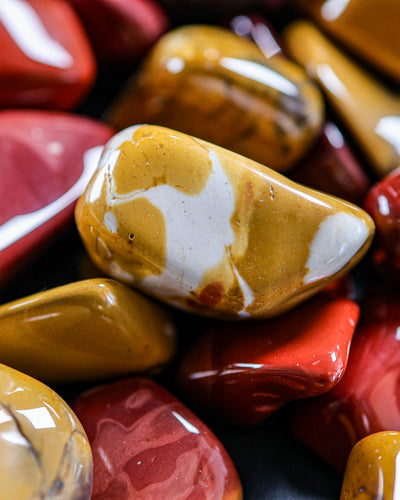
Mookaite is a fossiliferous jasper found only in the Kennedy Range of Western Australia, formed from the silica remains of ancient marine radiolaria. Its mottled red, yellow, and cream coloring comes from iron and manganese oxides absorbed into the rock over millions of years, making every piece a genuinely one-of-a-kind pattern.
Properties
Mookaite works as a bridge between staying grounded and staying open. It steadies the body the way most jaspers do, but its patchwork coloring reflects a stone comfortable holding many possibilities at once rather than narrowing down too quickly. It is well suited to decision-making, new beginnings, and any moment that calls for calm curiosity instead of rigid certainty.
Metaphysical Properties
- Grounds restless or scattered energy
- Encourages a sense of calm curiosity about new experiences
- Supports clear-headed decision-making
- Builds quiet, steady confidence
- In crystal healing tradition, called on to support physical resilience and steady recovery
Physical Properties
- Type: Chalcedony (fossiliferous jasper)
- Color: Mottled red, yellow, cream, mauve, and purple
- Luster: Waxy, polishes to a soft sheen
- Structure: Cryptocrystalline, nodular
Meaning & Energy
Mookaite's meaning is written into its own geology: countless small lives, settled and compressed over millions of years into a single patterned stone. Its energy reflects that patience and range, holding space for many outcomes rather than insisting on one. It is a stone for people standing at a genuine fork in the road.
Emotions
If you tend to freeze up when a decision has more than one good option, Mookaite can loosen that grip. It steadies an anxious mind without shutting down your options, so weighing a choice feels less like a threat and more like an open field. You may notice more willingness to try something unfamiliar and less need to have every outcome mapped out in advance.
Crystal Pairings
- Red Jasper – adds a sharper, more grounding jasper energy for decisive action
- Ocean Jasper – brings a gentler, heart-centered jasper pairing for emotional balance
- Carnelian – layers in warmth and courage for stepping into something new
- Agate – supports the same grounded, patient decision-making Mookaite encourages
Science & Origin
Mookaite formed on the floor of a Cretaceous-era sea roughly 145 million years ago, as the silica skeletons of radiolaria (microscopic marine organisms) accumulated into thick layers of chert. Iron- and manganese-rich groundwater later moved through the rock, depositing the oxide minerals responsible for its color.
- Also Known As: Mookaite Jasper, Australian Jasper
- Formation: Forms from fossilized radiolarian chert, compacted and colored over millions of years by iron oxide, manganese oxide, and other trace minerals moving through the rock.
- First Discovery: Mookaite was introduced to the gem and lapidary trade in the 1960s, discovered along Mooka Creek in the Kennedy Range of Western Australia, its only known source.
- Safety Note: Mookaite is a naturally colored stone with no known treatment concerns. Avoid harsh chemicals and prolonged acid exposure, which can dull its polish.
Ancient Myths
- Mookaite is a modern discovery, first brought to the gem trade in the 1960s from Australia's Kennedy Range, so it carries none of its own ancient legend. What it does carry is the broader jasper family's long reputation: Egyptian priests carved jasper amulets believed to protect the dead on their journey through the afterlife.
- Several Native American traditions treated jasper as a grounding, protective stone, sometimes called on in rain ceremonies -- lore belonging to jasper as a whole rather than to Mookaite specifically.
- The stone's own true origin story is geological rather than mythic: its reds and yellows are the fossilized remains of radiolaria, microscopic sea creatures that lived and died in an ancient ocean roughly 145 million years ago.
Chakras Table
| Chakra | Connection | Healing Focus | Energy Type |
|---|---|---|---|
| Root | Primary | Grounds the body and steadies restless energy | Grounding |
| Sacral | Secondary | Encourages openness to new experience and creative flow | Renewal |
| Solar Plexus | Tertiary | Builds quiet confidence for decision-making | Confidence |
Planets Table
| Planet | Influence | Energy |
|---|---|---|
| Earth | Grounded stability and physical presence | Steady, patient |
| Mars | Drive and courage to try something new | Active, bold |
Zodiacs Table
| Zodiac | Attribute | Benefit |
|---|---|---|
| Libra | Balance and fair-minded decision-making | Helps weigh choices without getting stuck |
| Scorpio | Depth and resilience through transformation | Supports steady recovery through big changes |
Elements Table
| Element | Power | Aspect |
|---|---|---|
| Earth | Density, structure, and physical grounding | Keeps the body steady through change |
| Fire | Warmth, drive, and creative spark | Encourages confident, curious action |
Sacred Numbers Table
| Number | Vibration | Meaning |
|---|---|---|
| 4 | Structure and steady groundwork | Reflects Mookaite's grounding, patient, decision-supporting character |
Color Variations
- Deep brick red mottled with cream
- Golden yellow patches shifting into soft mauve
- Purple-grey banding with red accents
- Pastel pink and cream chalk Mookaite from lighter deposits
Mohs Scale Hardness
Mookaite sits at roughly 6.5 to 7 on the Mohs scale, in line with other chalcedony-family jaspers. It takes a good polish and stands up well to everyday wear in jewelry, though it should still be kept away from harsh chemicals and abrasive contact.
Chemical Formula
Mookaite is composed of SiO2 (silicon dioxide) with iron oxide, manganese oxide, and hematite inclusions producing its characteristic mottled color.
- Si -- silicon, forming the quartz framework
- O -- oxygen, completing the silica structure
- Fe -- iron oxide, source of red and yellow tones
- Mn -- manganese oxide, contributing mauve and purple hues
Summary of Composition
- Mineral Class: Chalcedony (silica mineral)
- Crystal System: Trigonal (cryptocrystalline quartz)
- Transparency: Opaque
- Luster: Waxy to dull
Care Instructions
- Wipe with a soft, dry or slightly damp cloth
- Avoid prolonged soaking, which can dull the natural sheen
- Keep away from harsh chemicals and extreme heat
- Store separately from harder stones to prevent surface scratches
Final Summary
Mookaite is proof that patience and change are not opposites. Formed from millions of years of ocean sediment and colored by minerals that moved through it long after, it is a stone built for anyone standing at a genuine crossroads. Keep it close when you need to stay grounded while reaching for something new.