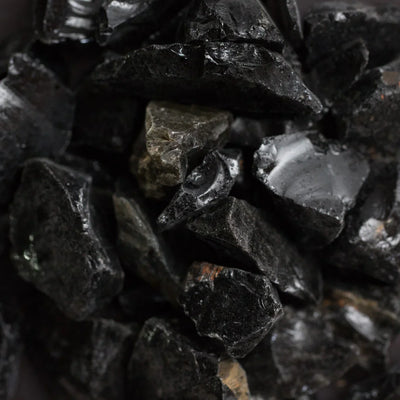
Lava Rock is the most literal of all grounding stones: it is the earth's interior, brought to the surface. Formed when magma erupts and cools rapidly in contact with air or water, every piece of lava rock carries the physical record of that transformation — the pores are actual gas vesicles, bubbles frozen in place at the moment of solidification. It works with Grounding & Stability and Confidence & Strength as its core actions, but its energy is less about calm steadiness and more about the specific quality of strength that comes from having already been through fire. It is a stone of beginning, not ending — of what is built after something has burned away.
Key Traits
- Formed by rapid cooling of volcanic magma — the pores are actual gas vesicles from the eruption process, not surface treatments
- Naturally absorbent and porous — widely used as an essential oil diffuser in bracelet and jewelry formats
- Matte black, lightweight, and distinctively textured — visually and texturally unlike any other stone
- One of the most abundant rock types on Earth — forms the ocean floors globally and erupts from active volcanoes on every continent
- Associated with both Fire and Earth elements simultaneously — a stone of the boundary between them
Intentions
Brief Overview
Lava Rock — volcanic basalt — is among the oldest and most widespread materials on the planet. It erupts from active volcanoes, forms the ocean floor, and has been used by human cultures across every volcanic region since prehistoric times. In crystal practice, it is valued for a quality of grounding that carries a different character than most earth stones: it is not the grounding of stillness but of foundation after disruption — the stability that forms when something that was once in motion becomes solid. Its porosity makes it uniquely practical as an essential oil diffuser stone, allowing it to carry scent throughout the day in a way that extends and complements its grounding and calming properties.
Properties
Lava Rock works at the root — connecting the wearer to the earth's core energy with an directness that few other materials match. Its grounding is active rather than passive: it does not simply calm, but builds — encouraging the kind of confidence that comes from feeling genuinely anchored. Its fire element association gives it a quality of courage and initiation that is rare in grounding stones, making it particularly useful in moments of new beginning, especially those that follow a difficult ending. As a diffuser stone, it extends its properties through scent — the chosen oil amplifies its action, whether that is calming, energizing, or clarifying.
Metaphysical Properties
- Provides deep, active grounding — connects to the earth's core energy directly and without mediation
- Encourages courage and the willingness to begin, especially after a difficult ending or period of change
- Supports the release of emotional patterns that have burned out their usefulness — the metaphysical quality of lava's clearing fire
- Stabilizes the root chakra and provides a foundation from which the sacral and solar plexus can function with confidence
- Functions as a natural essential oil diffuser — holds and releases scent throughout the day, extending aromatherapy benefits
Physical Properties
- Type: Volcanic basalt — mafic igneous rock
- Color: Matte black to dark grey
- Luster: Dull to matte (vesicular surface)
- Structure: Fine-grained to glassy, highly porous/vesicular
Meaning & Energy
Every piece of lava rock was, at some point, liquid — moving, undifferentiated, impossibly hot. The stone you hold now is what happened when that movement stopped: it became solid, gained form, became the foundation for something. That is the specific quality lava rock carries — not just the energy of the earth, but the energy of earth that has been through transformation and come out the other side as something that holds. It is a stone for people who are in transition, who have survived something, who are building from scratch. Its fire element association is not about warmth or inspiration so much as about the capacity to endure extreme conditions and still arrive at solidity.
Emotions
If you are in a moment that feels unstable — after a change you did not choose, or standing at the beginning of something new and feeling the vertigo of it — lava rock offers the most direct version of what grounding actually means. It does not soften the edges of difficult things. It makes sure you are standing on firm ground while you face them. For those who need to access courage — not bravado, but the quiet kind of strength that shows up for difficult things — lava rock is the right companion. Apply an essential oil that matches your need for the day, wear it close, and let the combination do its work through the hours.
Crystal Pairings
- Black Tourmaline — Amplifies lava rock's protective and grounding action with a strong shielding energy for the root chakra
- Red Jasper — Shares the fire-and-earth connection; adds sustained endurance and vitality to lava rock's courage-building quality
- Obsidian — Another volcanic material that deepens the fire-earth connection and adds sharp clarity and truth-revealing properties
- Tigers Eye — Adds confidence and solar plexus strength, complementing lava rock's root anchoring with upward-moving empowerment
Science & Origin
Lava Rock is volcanic basalt — the most abundant igneous rock on Earth. Basalt is classified as a mafic igneous rock, meaning it is rich in magnesium and iron and relatively low in silica. It erupts from both shield volcanoes (like those in Hawaii and Iceland) and fissure eruptions, and forms the entirety of the oceanic crust globally. The vesicular texture that makes lava rock distinctive in crystal practice results from gases dissolved in magma coming out of solution as pressure drops during eruption — the bubbles are frozen in place by rapid cooling. Sources used in crystal practice include Hawaii, Iceland, Indonesia, Mexico, and Italy, among others.
- Also Known As: Volcanic Basalt, Volcanic Rock, Basalt Lava Stone, Vesicular Basalt
- Formation: Rapid cooling of erupted mafic magma; vesicles formed by trapped gas bubbles during solidification
- First Discovery: Used by human cultures globally since prehistory; as a crystal practice material, commercially popularized in the early 2000s
- Safety Note: Porous surface can absorb and harbor residue over time — clean regularly. No mineral toxicity. When using with essential oils, apply topically to the stone; do not ingest.
Ancient Myths
- In Hawaiian tradition, lava rock is sacred to Pele, the goddess of volcanoes and creation — considered to embody her living presence. Removing lava rock from the Hawaiian islands is regarded as spiritually inadvisable and disrespectful to the land.
- Ancient Romans paved the Via Appia and other major roads with volcanic basalt, recognizing its exceptional durability. Civilization's paths were literally grounded in volcanic stone — a fitting metaphor for what the material carries.
- Mesoamerican cultures carved volcanic stone into ritual objects, altars, and boundary markers — recognizing it as material that held the transformative power of the earth's interior made accessible at the surface.
Chakras Table
| Chakra | Connection | Healing Focus | Energy Type |
|---|---|---|---|
| Root | Primary — deepest grounding and safety activation | Establishing physical and energetic foundation, clearing survival anxiety, anchoring presence | Anchoring, stabilizing, primal |
| Sacral | Secondary — fire element and passion activation | Supporting creative fire, courage to begin, emotional authenticity | Energizing, initiating |
| Solar Plexus | Supporting — personal power and confidence | Building self-trust and the willingness to act from a grounded centre | Strengthening, activating |
Planets Table
| Planet | Influence | Energy |
|---|---|---|
| Mars | Courage, action, and the energy to begin | Initiating, strengthening, igniting forward motion from solid ground |
| Earth | Physical stability and rooted presence | The most literal planetary grounding — connection to the planet itself |
Zodiacs Table
| Zodiac | Attribute | Benefit |
|---|---|---|
| Aries | Courage, initiation, and pioneering energy | Grounds Aries's forward-moving fire energy so it builds rather than burns through |
| Scorpio | Transformation and depth | Supports Scorpio through cycles of intense change — stability in the aftermath of deep transformation |
| Taurus | Earth connection and physical presence | Deepens Taurus's natural grounding and reinforces the capacity for endurance |
Elements Table
| Element | Power | Aspect |
|---|---|---|
| Fire | Transformation, courage, and the energy of new beginning | Holds the initiating quality of fire — what starts, what clears, what makes space for the new |
| Earth | Stability, foundation, and physical reality | The element lava rock becomes — the solidified form that grounds and endures |
Sacred Numbers Table
| Number | Vibration | Meaning |
|---|---|---|
| 1 | Beginning, initiation, and original force | The number of the first movement — new starts, original energy, the courage to begin |
| 9 | Completion and the wisdom of what has passed | Reflects lava rock's association with transformation — the end of one cycle and the foundation it becomes for the next |
Color Variations
- Matte Black: The most common and classic form — deep, uniform matte black with a porous, vesicular surface
- Dark Grey: Slightly lighter specimens with visible mineral texture — found in some basalt flows with higher plagioclase content
- Reddish-Brown Basalt: Found in some oxidized lava flows where iron has weathered to produce reddish tones — less common in jewelry use but found in natural specimens
- Dyed Variants: Commercially, lava rock is sometimes dyed in various colors for jewelry — these are not natural colorations; natural lava rock is black to dark grey only
Mohs Scale Hardness
Lava Rock measures approximately 3.5 on the Mohs hardness scale as a porous vesicular basalt — notably softer than solid basalt (which measures 5.5–6.0) because the vesicles reduce the structural density of the rock. This means lava rock beads and tumbled pieces can chip or crack at the edges if knocked hard against other stones, and the porous surface will scratch more readily than denser materials. Handle with moderate care; avoid tumbling in the same bag with harder stones.
Chemical Formula
Lava Rock (basalt) is a rock rather than a single mineral, composed primarily of plagioclase feldspar (CaAl2Si2O8 to NaAlSi3O8 series), pyroxene — typically augite (Ca,Na)(Mg,Fe,Al)(Si,Al)2O6 — and olivine (Mg,Fe)2SiO4, with accessory ilmenite, magnetite, and apatite.
- Ca / Na / Al / Si / O: Calcium, sodium, aluminium, silicon, oxygen — plagioclase feldspar framework
- Mg / Fe: Magnesium and iron — abundant in pyroxene and olivine, responsible for dark color and mafic classification
- Ti / Fe (oxides): Titanium and iron oxides — in ilmenite and magnetite, contributing to density and darkness
Summary of Composition
- Mineral Class: Igneous rock — mafic basalt (tectosilicate and inosilicate framework)
- Crystal System: Fine-grained to glassy aggregate; individual minerals monoclinic and orthorhombic
- Transparency: Opaque
- Luster: Dull to matte (vesicular texture)
Care Instructions
- Rinse periodically with warm water to flush the pores — the vesicular surface can accumulate residue from oils, skin, and environment over time
- When using with essential oils, apply 1–2 drops directly to the stone and allow to absorb before wearing — reapply as needed, typically every few days
- Cleanse energetically with sound or moonlight — avoid burying in salt as it can settle into the pores; smudging is also effective
- Store separately from harder stones — the porous surface scratches more readily than dense minerals, and edges can chip against harder materials
Final Summary
Lava Rock is for those who are in the process of becoming something solid after a period of heat and movement. It is not a gentle stone, but it is a truthful one — it offers grounding that has earned its authority, the kind that knows what fire is because it came from it. Carry it when you need the stability of something that has already survived everything it needed to.