Key Traits
- Deep, velvety black fossilized wood, not a mineral
- Carried as a talisman since the Stone Age
- One of the oldest continuously used gem materials
- Traditionally worn for protection during travel
- Associated with root chakra grounding and release
Intentions
Brief Overview
Jet is not a mineral but a fossilized wood, compressed and transformed over roughly 180 million years into a dense, glassy black material. Carried as a talisman since the Stone Age and worn widely during Victorian mourning, it has one of the longest continuous histories of any gem material still in use today.
Properties
Jet works by absorption — drawing in the static of negative energy the way it once drew carbon into its own structure. It is traditionally kept close during periods of grief or upheaval, valued as a steady, grounding presence that does not ask you to feel better quickly, only to feel supported while you do.
Metaphysical Properties
- Traditionally believed to absorb negative energy from its surroundings
- Worn as protection during travel and difficult transitions
- Associated with root chakra grounding and energetic release
- Said to stabilize finances when kept in a home's wealth corner
- Used historically to ease unreasonable fears
Physical Properties
- Type: Organic mineraloid (fossilized wood)
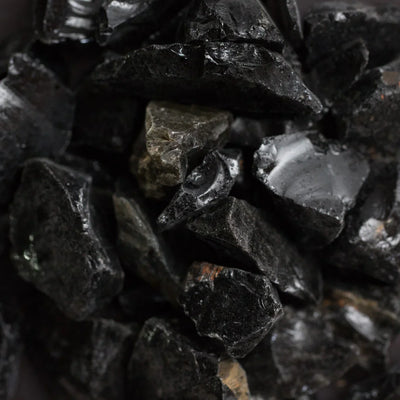
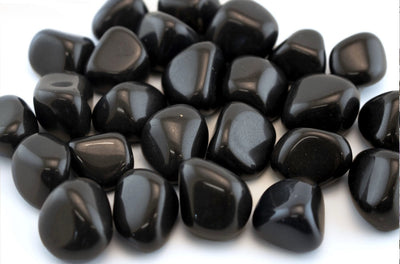
- Color: Deep black, occasionally brown-black
- Luster: Vitreous to waxy when polished
- Structure: Amorphous, no crystal lattice
Meaning & Energy
Jet means endurance through transformation. What began as living wood became, over unimaginable spans of time, something entirely different — dense, dark, and durable. That transformation is the heart of its meaning: proof that pressure and time can turn even the softest beginnings into something that lasts.
Emotions
You may find Jet useful during a hard season — a loss, a big transition, a stretch where your mood keeps shifting without warning. It offers a steadying hand rather than a quick fix, absorbing some of the emotional noise so you have room to move through it at your own pace.
Crystal Pairings
- Black Tourmaline – reinforces Jet's protective shield against outside negativity
- Obsidian – adds sharp emotional clarity to Jet's steady grounding
- Onyx – lends extra resolve and endurance to Jet's calm strength
- Smoky Quartz – softens Jet's intensity with gentle, grounded release
Science & Origin
Jet forms from ancient Araucaria-family wood buried in oxygen-poor marine mud, where it was slowly compressed and carbonized over roughly 180 million years into a dense, workable, coal-related material.
- Also Known As: Black Amber, Azabache, Gagate
- Formation: Forms when Araucaria-family driftwood sinks into anoxic marine sediment and is compressed over millions of years, its structure slowly replaced by carbon until it becomes a dense, fossilized, coal-related material.
- First Discovery: Worked as a talisman since the Stone Age; formally documented by Pliny the Elder in the 1st century CE
- Safety Note: Jet is soft (Mohs 2.5–4) and can scratch or crack if dropped or knocked against harder stones — store it separately, away from jewelry with harder gems, and avoid ultrasonic cleaners.
Ancient Myths
- Jet has been carried as a protective talisman since the Stone Age, among the oldest gem materials worked by human hands.
- Victorian England turned to Whitby jet in vast quantities for mourning jewelry after Queen Victoria wore it through her long period of grief for Prince Albert.
- Ancient Britons and Romans burned jet for its acrid, coal-like scent, believing the smoke could drive away harmful spirits — a practice reflected in its old name, “gagates,” after the Gagas river in Asia Minor where Pliny the Elder recorded it being found.
Chakras Table
| Chakra | Connection | Healing Focus | Energy Type |
|---|---|---|---|
| Root | Absorbs negative energy at the base of the body | Grounding and stabilizing | Cleansing |
| Crown | Directs rising energy toward higher awareness | Supporting spiritual reflection | Elevating |
Planets Table
| Planet | Influence | Energy |
|---|---|---|
| Saturn | Structure, endurance, discipline | Steady, enduring |
| Pluto | Transformation, release, renewal | Deep, intense |
Zodiacs Table
| Zodiac | Attribute | Benefit |
|---|---|---|
| Capricorn | Disciplined, enduring, and practical | Reinforces steady, long-term resilience |
| Scorpio | Deep, transformative intensity | Supports emotional depth through difficult change |
Elements Table
| Element | Power | Aspect |
|---|---|---|
| Earth | Grounding and material stability | Steadying |
| Water | Emotional depth and release | Flowing |
Sacred Numbers Table
| Number | Vibration | Meaning |
|---|---|---|
| 8 | Structure, karma, and material stability | A number of endurance and hard-earned strength |
| 4 | Grounded foundations | The number of steady, dependable ground underfoot |
Color Variations
- Deep, velvety black — the most common and prized shade
- Brownish-black in less dense specimens
- A subtle sheen that can appear almost blue-black under strong light
Mohs Scale Hardness
At roughly 2.5 to 4 on the Mohs scale, Jet is soft for a gem material, closer in hardness to a fingernail-scratchable stone than to true quartz. That softness is part of why it takes such a fine, glassy polish, but it also means Jet needs gentler handling than harder crystals in your collection.
Chemical Formula
Because Jet is fossilized organic material rather than a true mineral, it has no single fixed chemical formula — its composition is predominantly carbon, with smaller amounts of hydrogen, oxygen, and sulfur retained from the original wood.
- Carbon (C) — the dominant element, from compressed ancient wood
- Hydrogen (H) — a minor component remaining from organic tissue
- Oxygen (O) — present in trace organic compounds
- Sulfur (S) — occurs in small amounts, sometimes giving a faint odor when worked
Summary of Composition
- Mineral Class: Organic mineraloid (coal-family)
- Crystal System: None (amorphous)
- Transparency: Opaque
- Luster: Vitreous to waxy
Care Instructions
- Clean with a soft, dry cloth only — avoid water and household cleaners.
- Store away from harder gemstones that could scratch its surface.
- Avoid extreme heat or sudden temperature changes, which can crack it.
- Keep out of direct sunlight for extended periods to preserve its deep black color.
Final Summary
Jet has been carried, worn, and trusted for longer than almost any other stone in this collection — proof that some things earn their staying power the slow way. It asks for patience and gives back a quiet, steady kind of protection in return.