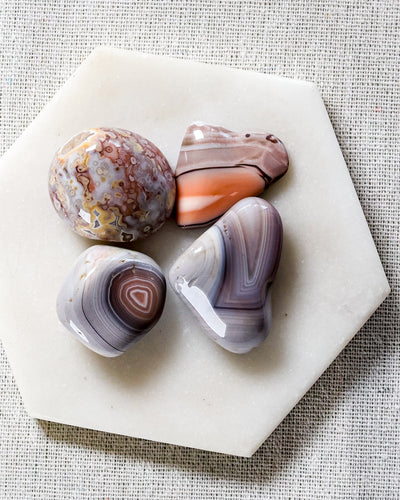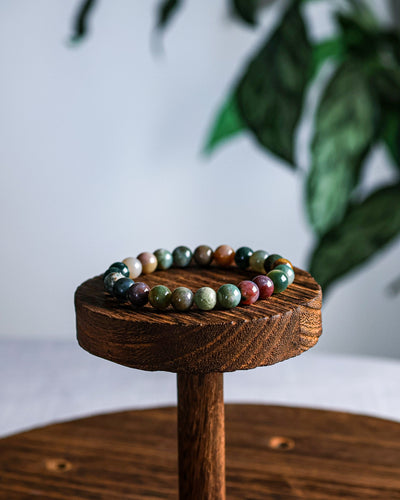
India Agate carries one of the oldest agate-working traditions on earth into a modern piece built for Grounding & Stability and Confidence & Strength. Its bold, wavy bands come from a region of India that has mined and shaped agate for thousands of years, longer than almost anywhere else on the planet. Like all agate, it works slowly rather than dramatically, layering steadiness the same way the stone itself layers color. For anyone who wants stability built patiently rather than promised instantly, this is that stone.
Key Traits
- Banded agate mined chiefly from Gujarat, India, one of the world's oldest agate-working regions
- Naturally gray, white, or softly banded; vivid colors are usually achieved through dyeing
- Forms inside ancient volcanic basalt cavities as silica-rich fluids cooled in layers
- Traditionally valued as a grounding, emotionally balancing stone
- Long associated with quiet confidence and steady self-acceptance
Intentions
Brief Overview
Agate as a family is known as one of crystal work's steadiest anchors, and India Agate carries that reputation with an unusually deep history behind it. Traditionally described as bringing emotional, physical, and intellectual balance, it centers and stabilizes energy the way its own banding builds up in patient layers. It is a slow worker rather than a dramatic one, valued for quietly reinforcing whatever stability is already present rather than manufacturing something new.
Properties
India Agate is traditionally treated as a harmonizing stone, one that balances opposing forces and smooths the friction between them. It gently favors self-acceptance, which in turn builds genuine self-confidence rather than a performed version of it. It is also associated with sharper concentration and clearer analysis, making it a favorite for anyone who wants a level head alongside a steady heart.
Metaphysical Properties
- Traditionally used to bring emotional, physical, and intellectual balance
- Believed to center and stabilize scattered physical energy
- Long associated with harmonizing opposing forces and easing friction
- Thought to build genuine self-confidence through self-acceptance
- Valued for sharpening concentration, perception, and analysis
Physical Properties
- Type: Agate (banded chalcedony, a microcrystalline form of quartz)
- Color: Naturally gray, white, or pale banded; commercial pieces are frequently dyed in vivid reds, blues, greens, and yellows
- Luster: Waxy to vitreous when polished
- Structure: Cryptocrystalline, with concentric or wavy banding
Meaning & Energy
Agate has always worked on a slower timeline than flashier crystals, and India Agate is no exception, its identity built quite literally in layers laid down over long stretches of time. That patience is the whole point: a stone that brings hidden information to light gradually, rather than all at once, and that confers real strength precisely because it takes its time getting there. It suits anyone working on something that won't be rushed, whether that's confidence, calm, or simple day-to-day balance.
Emotions
If your footing feels a little shaky, this stone is traditionally kept close to help settle you back into your own layers rather than someone else's expectations. It won't hand you instant confidence, but it supports the slower, more durable kind that comes from actually accepting where you are. Hold it during a stressful stretch, or simply keep it nearby as a steady, grounding presence through an ordinary day.
Crystal Pairings
- Botswana Agate – reinforces grounded, solutions-focused calm
- Moss Agate – deepens connection to steady, everyday growth
- Carnelian – adds warmth, motivation, and vitality
- Tigers Eye – supports confident, clear-headed action
Science & Origin
India, particularly the Gujarat region around Cambay (Khambhat) and Ratanpur, has mined and worked agate for thousands of years, with archaeological evidence of bead-making stretching back to the Indus Valley Civilization. The agate itself formed inside gas cavities in ancient Deccan Trap basalt flows, where silica-rich groundwater deposited chalcedony in successive bands over long periods of geological time. Much of the material sold commercially today is dye-enhanced to achieve vivid, consistent color, since the natural stone tends toward softer grays and whites.
- Also Known As: Indian Agate, Cambay Agate, Gujarat Agate
- Formation: Silica-rich groundwater depositing banded chalcedony inside volcanic basalt cavities
- First Discovery: Not tied to a single documented find; agate working in this region dates back to the Indus Valley Civilization
- Safety Note: Commercial material is frequently dyed; avoid prolonged soaking or harsh cleaners that could affect color
Ancient Myths
- Agate beads found at Indus Valley Civilization sites, dating back roughly 4,000 years, make Gujarat one of the oldest continuously worked agate sources in the world
- Persian magi were said to carry agate amulets to turn aside oncoming storms, a belief that traveled along trade routes connecting Persia and the Indian subcontinent
- Ancient traders prized banded agate as a protective travel stone, carrying pieces mined in India across land and sea trade routes as both jewelry and amulets
Chakras Table
| Chakra | Connection | Healing Focus | Energy Type |
|---|---|---|---|
| Root | Anchors the body's sense of safety and presence | Steadying scattered or anxious energy | Grounding |
| Sacral | Supports emotional balance and warmth | Softening tension held in the body | Balancing |
| Solar Plexus | Builds quiet, self-accepting confidence | Turning self-acceptance into steady resolve | Strengthening |
Planets Table
| Planet | Influence | Energy |
|---|---|---|
| Mercury | Sharper analysis and clear thinking | Quick, discerning |
| Venus | Harmony and balanced connection | Warm, steady |
Zodiacs Table
| Zodiac | Attribute | Benefit |
|---|---|---|
| Gemini | Agate's traditional zodiac sign; quick, adaptable thinking | Balances mental energy with steadiness |
| Virgo | Careful, grounded attention to detail | Builds confidence through preparation |
| Capricorn | Discipline and long-view patience | Reinforces steady, layered progress |
Elements Table
| Element | Power | Aspect |
|---|---|---|
| Earth | Stability, structure, and grounded presence | Grounding |
| Fire | Transformation and volcanic origin | Formative |
Sacred Numbers Table
| Number | Vibration | Meaning |
|---|---|---|
| 4 | Foundation, order, and steady structure | Building stability one layer at a time |
Color Variations
- Natural gray and white banding — the stone's undyed base tone
- Vivid dyed reds and oranges — among the most common commercial colors
- Dyed blues and greens — popular for slices, bookends, and coasters
- Multicolor banded slices — combining several dyed tones in one piece
Mohs Scale Hardness
India Agate measures about 7 on the Mohs scale, durable enough for daily handling and everyday wear. Dyed pieces are chemically stable under normal use, but repeated harsh cleaning or prolonged soaking can gradually affect the color, so gentle care keeps the banding looking its best.
Chemical Formula
India Agate is silicon dioxide, SiO2, in its microcrystalline chalcedony form. Natural banding colors come from trace iron oxide and other included minerals, while most commercial color is added through dyeing.
- Silicon (Si) and Oxygen (O) — form the silica that makes up agate's structure
- Iron oxide and trace minerals — responsible for natural banding colors
- Dye compounds — used commercially to intensify or add color in most India Agate on the market
Summary of Composition
- Mineral Class: Chalcedony (a cryptocrystalline form of quartz)
- Crystal System: Trigonal (microcrystalline; no visible individual crystals)
- Transparency: Translucent to opaque
- Luster: Waxy to vitreous
Care Instructions
- If dyed, avoid prolonged soaking or harsh cleaners, which can affect color over time
- Keep out of direct, prolonged sunlight to reduce fading
- Clean with a soft, dry or barely damp cloth
- Store away from harder stones that could scratch the surface
Final Summary
India Agate carries thousands of years of craft into a stone built for the long game: steady, layered, and unhurried. Keep it close while you build something that needs to actually last, and let it remind you that real stability is rarely instant.