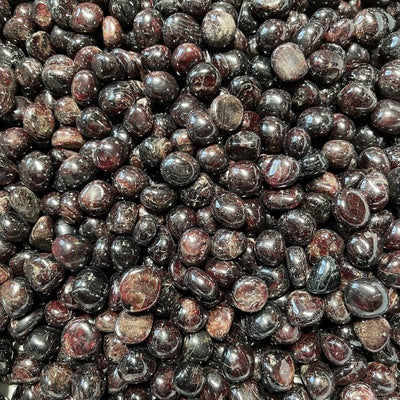
Garnet in Limestone brings two very different materials together in one stone: fiery red garnet crystals held fast inside a pale, load-bearing bed of limestone. Where cut garnet moves fast and burns hot, this matrix form works at the pace of rock itself, offering Grounding & Stability alongside garnet's familiar Confidence & Strength. It is a stone that shows its formation story on its surface, the crystal quite literally rooted in the ground that made it. For anyone who wants garnet's nerve without losing their footing, this is the steadier version of that same fire.
Key Traits
- Deep red garnet crystals fused directly into their natural limestone bed
- A true matrix specimen — nothing cut away, nothing added
- Combines garnet's fire-toned confidence with limestone's grounded calm
- Naturally two-toned: crystal red against pale stone
- Formed at the exact boundary where garnet crystallized inside carbonate rock
Intentions
Brief Overview
Garnet in Limestone is exactly what it sounds like: garnet crystals still embedded in the limestone they grew inside, rather than cut free and polished on their own. The result is a stone that reads as landscape as much as gem — dark red crystal faces breaking through a pale, sedimentary field. It carries garnet's traditional reputation as a stone of courage and steady confidence, but grounded by a host rock that has spent millions of years simply holding its shape under pressure.
Properties
Left in its matrix, garnet keeps its traditional associations with confidence, protection, and emotional resilience, but the limestone host changes how those qualities show up. Rather than garnet's usual quick spark, this pairing works more slowly and steadily, supporting the kind of confidence that holds up under real pressure rather than the kind that flares and fades. It is often kept as a grounding piece for moments that call for endurance — a crisis to get through, a long project, a season that asks more patience than excitement.
Metaphysical Properties
- Traditionally carried as a stone of courage in difficult or uncertain periods
- Believed to support steady self-confidence rather than sudden bursts of energy
- Long associated with protection, historically worn as a protective talisman
- Thought to help release old, unhelpful patterns of thought and behavior
- Valued as a grounding piece that keeps ambition tethered to the practical
Physical Properties
- Type: Garnet crystals (commonly andradite or spessartine) embedded in a limestone host
- Color: Deep red to reddish-brown crystals against pale gray, cream, or white stone
- Luster: Vitreous to resinous on the garnet faces; dull and earthy on the limestone
- Structure: Isometric garnet crystals (often dodecahedral) set in fine-grained carbonate rock
Meaning & Energy
Garnet has long carried a reputation as a survival stone, the kind of crystal people reached for in genuinely hard moments rather than easy ones. Set into limestone, that reputation gets a second layer: the rock itself is a record of pressure and time, the kind of material that only becomes what it is after enormous, sustained weight. Together they read as an argument for staying rooted through difficulty rather than trying to outrun it, letting confidence build the way stone does — slowly, and without much drama.
Emotions
If you're working through something that keeps asking for more patience than you feel you have, this stone is built for that kind of stretch. It doesn't rush you toward resolution or promise a quick turnaround; it asks you to keep showing up, the way limestone keeps holding its shape long after the pressure that made it has passed. Held during a hard week or kept on a desk through a demanding season, it's a reminder that steadiness and courage aren't opposites — that you can be scared and still stay put.
Crystal Pairings
- Garnet – doubles down on courage and confidence in cut, unmatrixed form
- Hematite – adds a second layer of grounding and mental focus
- Smoky Quartz – steadies emotional intensity during stressful stretches
- Black Tourmaline – reinforces the protective, boundary-setting side of this pairing
Science & Origin
Garnet-in-limestone specimens form where garnet-bearing rock developed directly against or within a limestone bed, most often at a skarn contact where heat and mineral-rich fluids reorganized both rock types at once. The garnet crystallizes in place inside the carbonate host rather than growing in an open cavity, which is why the crystals sit flush with the surrounding stone instead of pointing freely into open space. Material sold under this name is typically trimmed and tumbled just enough to reveal the garnet faces without separating them from their matrix.
- Also Known As: Garnet in Matrix, Garnet in Calcite
- Formation: Garnet crystallizing in place within a limestone host at a metamorphic contact zone
- First Discovery: Not tied to a single documented find; sourced from the same skarn-contact deposits worked for garnet more broadly
- Safety Note: The limestone matrix is soft and reacts to acids — keep away from vinegar, lemon juice, and acidic cleaners
Ancient Myths
- A Jewish legend holds that Noah lit the interior of the Ark with a glowing garnet, giving the stone a long association with guidance through danger
- Medieval European soldiers carried garnet amulets into battle, believing the stone offered protection and helped slow the bleeding of wounds
- Ancient Egyptian burial jewelry frequently included garnet, placed with the dead as a protective stone for the passage into the afterlife
Chakras Table
| Chakra | Connection | Healing Focus | Energy Type |
|---|---|---|---|
| Root | Anchors the body's sense of safety and physical presence | Steadying fear and survival-level stress | Grounding |
| Sacral | Supports emotional resilience and creative drive | Rebuilding confidence after setback | Restorative |
| Heart | Opens space for self-worth and devotion | Softening self-protection into genuine connection | Warming |
Planets Table
| Planet | Influence | Energy |
|---|---|---|
| Mars | Drive, courage, and assertive action | Active, warming |
| Saturn | Structure, patience, and long-term endurance | Steady, disciplined |
Zodiacs Table
| Zodiac | Attribute | Benefit |
|---|---|---|
| Aries | Bold initiative and quick courage | Tempers impulsiveness with staying power |
| Virgo | Careful, grounded attention to detail | Builds confidence through preparation |
| Capricorn | Discipline and long-view ambition | Reinforces patience under pressure |
Elements Table
| Element | Power | Aspect |
|---|---|---|
| Earth | Stability, structure, and the physical body | Grounding |
| Fire | Passion, courage, and transformation | Motivating |
Sacred Numbers Table
| Number | Vibration | Meaning |
|---|---|---|
| 1 | New beginnings and self-reliant action | Starting again after a hard stretch |
| 4 | Foundation, order, and steady structure | Building something that lasts |
Color Variations
- Deep blood red — the most common garnet tone found in limestone hosts
- Reddish-brown to orange-red — typical of spessartine garnet crystals
- Pale cream to gray limestone — the most frequent matrix color
- White, calcite-rich matrix — occasional, giving the strongest color contrast
Mohs Scale Hardness
The garnet crystals in this stone measure about 7 on the Mohs scale, hard enough to resist everyday scratching on their own. The limestone matrix is far softer, typically around 3, which means the stone as a whole should be handled with the limestone's softness in mind rather than the garnet's hardness. Treat it like a piece with a hard, protected core and a comparatively delicate frame.
Chemical Formula
Garnet is a silicate mineral with the general formula X3Y2(SiO4)3, where X is typically calcium, magnesium, iron, or manganese and Y is aluminum, iron, or chromium; the specific ratio determines whether a given crystal is classified as andradite, spessartine, or another garnet species. The limestone host is chemically distinct, made up primarily of calcium carbonate (CaCO3) in the form of calcite.
- Silicon (Si) and Oxygen (O) — form the silicate framework of the garnet crystal
- Calcium (Ca) — present in both the garnet structure and the limestone matrix
- Iron (Fe) or Manganese (Mn) — common substituting elements that shift garnet's exact variety and color
- Carbon (C) — found in the carbonate (CO3) that makes up the limestone host
Summary of Composition
- Mineral Class: Silicate (garnet) intergrown with a carbonate (limestone) host
- Crystal System: Isometric for the garnet crystals; the limestone host is typically fine-grained and non-crystalline in appearance
- Transparency: Garnet crystals translucent to opaque; limestone matrix opaque
- Luster: Vitreous to resinous on garnet faces; dull, earthy luster on the limestone
Care Instructions
- Avoid vinegar, lemon juice, and other acidic cleaners, which will etch the limestone matrix
- Skip ultrasonic and steam cleaners; clean with a soft, dry cloth only
- Store away from harder gemstones that could scratch the limestone surface
- Keep out of direct, prolonged sun exposure to avoid fading the limestone's natural tone
Final Summary
Garnet in Limestone keeps garnet's old reputation for courage intact, but slows it down to the pace of stone. It is a piece for the long stretch rather than the quick fix — proof, in mineral form, that steadiness and fire can share the same ground.