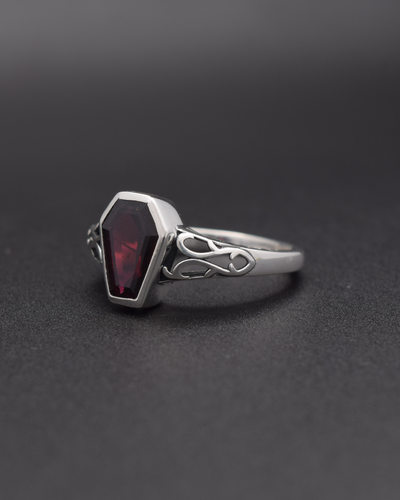
When life splinters, the instinct is to scatter with it. Garnet does the opposite. This deep red stone of grounding and stability has been kept close through crisis since the time of the pharaohs, carried by travelers and warriors as a talisman of protection when there seemed to be no way through. It does not offer an escape: it turns the crisis into a challenge you can meet, and gives you the nerve to stay and meet it.
Key Traits
- Deep wine red silicate with a glassy, ember-like glow
- Long carried as a protective talisman by travelers and warriors
- Turns a crisis into a challenge you can meet
- Steadies scattered energy and brings you back into your body
- Kindles devotion, commitment and warmth in close relationships
Intentions
Brief Overview
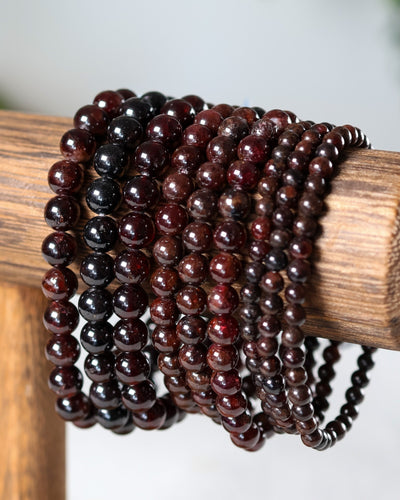
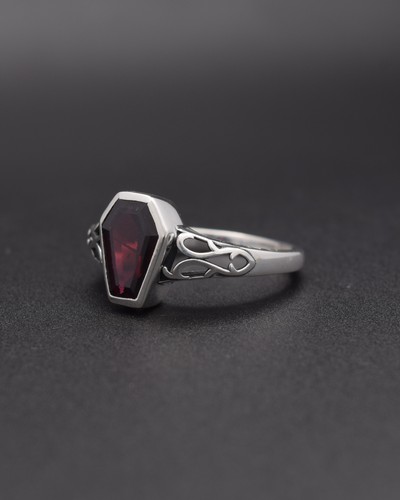
Garnet is not one mineral but a family of them, sharing a single crystal structure while trading places in color and chemistry across almandine, pyrope, spessartine, grossular, andradite and more. The deep red garnet most people picture is almandine, pyrope or rhodolite, a blend of the two. Egyptian pharaohs wore red garnet necklaces and were buried with them, Romans carved garnet signet rings to seal their documents, and Anglo-Saxon goldsmiths set thin slices of it over gold foil in the treasures of Sutton Hoo. It is the modern birthstone for January, and across all of that history its reputation has held remarkably steady: a stone of endurance, protection and loyal love.
Properties
Garnet energizes and regenerates. In Judy Hall's reading it cleanses and re-energizes the chakras, revitalizing and balancing energy so that it brings serenity or passion as each moment asks. It is the stone to have close when a situation seems to have no way out, strengthening the survival instinct and bringing courage and hope where both have run thin. Worked with over time, it sharpens how you see yourself and others, loosens deep-rooted habits and unconscious self-sabotage, and is said to activate the other crystals around it, amplifying their effect.
Metaphysical Properties
- Cleanses and re-energizes the chakras, bringing serenity or passion as needed
- Brings courage and hope to situations that seem to have no way out
- Traditionally said to warn of approaching danger and shield the wearer
- Loosens old behavior patterns and unconscious self-sabotage
- Activates the crystals placed alongside it, amplifying their effect
Physical Properties
- Type: Garnet group silicate (nesosilicate), most often almandine or pyrope in red trade material
- Color: Deep wine red to brownish red; the wider group also runs orange, pink, green, yellow, brown and black
- Luster: Vitreous to resinous
- Structure: Isometric (cubic), commonly as rhombic dodecahedra or trapezohedra
Meaning & Energy
Judy Hall calls garnet a stone of commitment, and its meaning is built on staying. Where showier stones promise reinvention, garnet promises endurance: the capacity to hold a shape, a promise or a position under real pressure. Under its influence, as Hall puts it, a crisis becomes a challenge to overcome, and it encourages people to help one another through troubled times rather than retreat. That is why it has been handed so consistently to travelers heading into the unknown and to couples marking a lasting bond: it does not manufacture courage or devotion from nothing, it reinforces what is already being asked of you.
Emotions
When a hard stretch leaves you scattered, depleted or shaken, garnet gives your energy somewhere to land. It helps you stay steady instead of reactive, and find a confidence that does not depend on the moment going well. Red garnet is traditionally used to cool anger, especially the anger you turn on yourself, and it opens your heart without asking you to drop your guard entirely. In relationships it supports you in staying warm and devoted when things are strained, and in releasing the inhibitions that keep you at a distance from the people you love.
Crystal Pairings
- Rose Quartz – softens garnet's heat into tender, unconditional love
- Black Tourmaline – adds a second layer of protection and keeps you anchored
- Carnelian – matches garnet's fire with motivation and creative drive
- Clear Quartz – carries and focuses the energy garnet brings up
Science & Origin
Most garnet crystallizes during regional metamorphism, when aluminum-rich sedimentary rock such as shale is buried, heated and squeezed into schist and gneiss, and red crystals grow within it; pyrope forms deeper, in mantle rocks such as peridotite and kimberlite. The name comes from the medieval Latin granatum, pomegranate, because small rounded garnets scattered through their host rock look like the fruit's seeds. Red garnet became far more available after the Bohemian deposits of central Europe were found around 1500, feeding a regional jewelry industry that peaked in the late 1800s.
- Also Known As: Almandine, Pyrope, Rhodolite, Red Garnet
- Formation: Regional metamorphism of aluminum-rich sedimentary rock into schist and gneiss; pyrope also forms in mantle-derived peridotite and kimberlite
- First Discovery: Worn in Egypt since the time of the pharaohs, whose red garnet necklaces were buried with them; the name comes from the Latin granatum, pomegranate.
- Safety Note: Safe to handle and wear every day. Avoid ultrasonic and steam cleaning on fracture-filled or foil-backed stones, and protect it from sharp knocks, which can chip an edge despite its hardness.
Ancient Myths
- A tradition drawn from the Talmud holds that the only light aboard Noah's ark came from a single great garnet, glowing through the dark nights of the flood.
- During the Crusades, garnet was carried as a warrior's talisman by Christian and Muslim fighters alike, each side trusting the red stone to see them safely through battle.
- Old European lore held that garnet could warn its wearer of approaching danger, and travelers carried it through the night believing it would guard them and light their way.
Chakras Table
| Chakra | Connection | Healing Focus | Energy Type |
|---|---|---|---|
| Root | Primary: anchors scattered energy back into the body | Security, survival instinct, staying power | Grounding |
| Heart | Secondary: opens the heart to devotion and commitment | Love, loyalty, self-confidence | Warming |
| Third Eye | Tertiary: sharpens how you see yourself and others | Perception, insight, honest self-assessment | Clarifying |
Planets Table
| Planet | Influence | Energy |
|---|---|---|
| Mars | Courage, drive and the will to act under pressure | Active |
| Pluto | Transformation forged through crisis and regeneration | Intense |
Zodiacs Table
| Zodiac | Attribute | Benefit |
|---|---|---|
| Aries | Boldness and forward drive | Steadies impulsive fire into grounded courage |
| Leo | Warmth and a generous heart | Deepens devotion and confident self-expression |
| Virgo | Precision and service | Softens self-criticism and loosens outdated habits |
| Scorpio | Intensity and depth | Turns a crisis into a challenge to meet |
| Sagittarius | Adventure and faith | Guards the traveler and keeps hope alive |
| Capricorn | Discipline and endurance | Reinforces stamina through long, hard stretches |
Elements Table
| Element | Power | Aspect |
|---|---|---|
| Earth | Stability | Grounding, endurance, physical presence |
| Fire | Passion | Courage, devotion, renewed drive |
Sacred Numbers Table
| Number | Vibration | Meaning |
|---|---|---|
| 2 | Union | Partnership, loyalty and committed love |
| 9 | Completion | Endurance carried through to the other side of hardship |
Color Variations
- Deep wine red to brownish red (almandine), the classic garnet most people picture
- Fiery red to orange red (pyrope), the stone of the famous Bohemian deposits
- Raspberry pink to purplish red (rhodolite), a lighter blend of pyrope and almandine
- Orange, green and black in other species, from spessartine to tsavorite and melanite
Mohs Scale Hardness
Garnet ranges from about 6.5 to 7.5 on the Mohs scale depending on species, and the red almandine and pyrope sold as garnet sit around 7, as hard as quartz or slightly harder. That makes it durable enough for rings, bracelets and bead strands worn every day. It has no cleavage, so it does not split along planes, but a sharp knock can still chip an edge or a facet corner.
Chemical Formula
Garnet's general formula is X3Y2(SiO4)3. The red stones sold as garnet are mainly almandine, Fe3Al2(SiO4)3, and pyrope, Mg3Al2(SiO4)3, often blended together.
- Iron (Fe): the X-site metal in almandine and the source of its deep wine red
- Magnesium (Mg): the X-site metal in pyrope, whose fiery red comes from trace iron and chromium
- Aluminum (Al): fills the Y site in both almandine and pyrope
- Silicon and Oxygen (SiO4): isolated tetrahedra that classify garnet as a nesosilicate
Summary of Composition
- Mineral Class: Silicate (nesosilicate, garnet group)
- Crystal System: Isometric (cubic)
- Transparency: Transparent to opaque
- Luster: Vitreous to resinous
Care Instructions
- Rinse your garnet in lukewarm water with a drop of mild soap, then dry it with a soft cloth
- Skip ultrasonic and steam cleaners, especially on fracture-filled or foil-backed stones
- Store it apart from harder gems and away from surfaces that could chip an edge
- Recharge it in moonlight, with smoke or on a Clear Quartz cluster
Final Summary
Garnet does not ask you to become someone new. It asks you to stay: rooted in your body, steady in your nerve, and loyal to what you love when letting go would be easier. Keep it close when the ground shifts, and let it burn the way it always has, low and long.