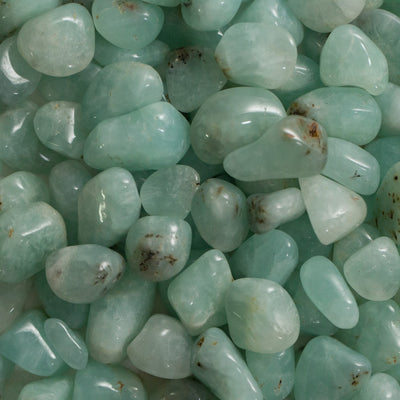
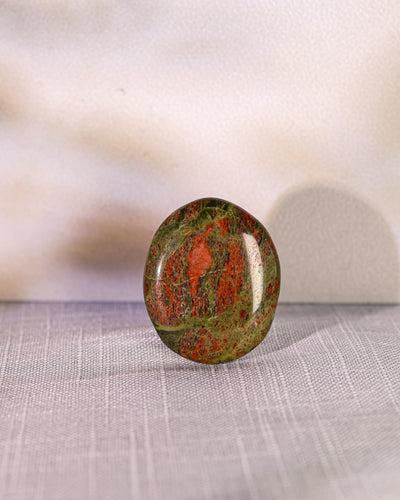
Epidote takes what is already growing in your life and gives it more weight. This pistachio-to-forest-green crystal has built its reputation as a stone of prosperity and opportunity, sharpening confidence and steady growth rather than manufacturing them from nothing. Where other stones ask you to start over, epidote works with what is already in motion and gives it more force. It rewards patience, and it favors people willing to build rather than those hoping for a shortcut.
Key Traits
- Known as an amplifier — magnifies whatever intention or energy you bring to it
- Ranges from pistachio-green to deep forest green, often with golden-brown flashes
- Long associated with prosperity, personal growth, and manifestation work
- Supports steady confidence and forward motion rather than sudden change
- Forms the vivid green flecks running through Unakite, one of its best-known composite stones
Intentions
Brief Overview
Epidote is a calcium aluminum iron silicate best recognized by its yellow-green to deep green color and its role as the green component in Unakite. In crystal healing tradition, it is considered an amplifier — a stone that intensifies whatever energy, intention, or companion crystal it is paired with, rather than generating an effect of its own. That amplifying quality has made it a favorite for prosperity and manifestation work, personal growth, and steadying self-confidence as it builds over time.
Properties
Epidote works less like a spark and more like a magnifying glass, taking the intention or energy you bring to it and making it more pronounced. In practice, that means it is often used to support manifestation and prosperity work, to reinforce a growing sense of personal confidence, and to help release patterns, attachments, or beliefs that have stopped serving their purpose. It is also associated with heart-centered healing and with sharpening intuition, making it a companion stone for anyone doing steady, cumulative inner work rather than looking for an overnight shift.
Metaphysical Properties
- Amplifies intentions, energy work, and the properties of companion crystals
- Supports prosperity, opportunity, and long-term manifestation work
- Encourages the release of outgrown patterns, attachments, and beliefs
- Builds quiet, steady self-confidence and personal power
- Sharpens intuition and supports heart-centered emotional healing
Physical Properties
- Type: Calcium aluminum iron sorosilicate
- Color: Yellowish-green to deep forest green, occasionally grey, brown, or near-black
- Luster: Vitreous to resinous
- Structure: Monoclinic crystal system, typically elongated and deeply striated prisms
Meaning & Energy
Epidote's meaning is tied directly to its function: Hauy named it for the Greek word for addition, describing the uneven sides of its crystal faces, and the name has proven fitting in another sense — this is a stone that adds to what is already present. It does not introduce a new direction so much as strengthen the one you are already on, which is why it has become closely associated with prosperity, growth, and manifestation. Worked with consistently, it favors people who are willing to build rather than those looking for a quick reversal of fortune.
Emotions
If you have been putting in the work but feel like progress is slow or invisible, epidote is a steadying companion. It supports you in recognizing what is already changing rather than dismissing gradual gains, and it can make it easier to release relationships, habits, or self-images you have outgrown but kept holding onto out of familiarity. Many people describe a quiet lift in confidence when working with it consistently — not a dramatic shift, but a growing willingness to trust your own pace.
Crystal Pairings
- Prehnite – Softens epidote's amplifying force into gentle, heart-led healing
- Clear Quartz – Sharpens and focuses epidote's amplifying effect for intention work
- Citrine – Pairs naturally for prosperity and opportunity-focused manifestation
- Unakite – Epidote's own composite stone, extending its growth-and-balance energy
Science & Origin
Epidote crystallizes when calcium-rich rocks are transformed by heat, pressure, and mineral-rich fluids deep within metamorphic and hydrothermal systems, often growing alongside quartz, feldspar, and garnet. Its type locality sits in the French Alps near Le Bourg-d'Oisans, and the Knappenwand deposit in Austria's Salzburg region later produced the long, lustrous crystals that made epidote a serious collector's stone rather than just a common green mineral.
- Also Known As: Pistacite, Thallite, Arendalite
- Formation: Secondary mineral formed through metamorphism and hydrothermal alteration of feldspar, garnet, and amphibole
- First Discovery: Named and described in 1801 by French mineralogist Rene-Just Hauy
- Safety Note: Generally safe to handle; avoid harsh chemicals and prolonged soaking, especially with composite stones like Unakite
Ancient Myths
- Epidote's name is a nineteenth-century scientific coinage rather than an ancient one: Rene-Just Hauy described and named the mineral in 1801, drawing on the Greek epidosis, meaning addition, for the unequal sides of its crystal prism
- In the 1800s, the Alpine cavities of Knappenwand in Austria produced epidote crystals so long and lustrous that they turned a common green mineral into a prized museum specimen across Europe
- Collectors once called the pistachio-green form pistacite, a name that still surfaces informally alongside older regional terms like thallite and arendalite
Chakras Table
| Chakra | Connection | Healing Focus | Energy Type |
|---|---|---|---|
| Root | Grounds prosperity work in physical reality | Stability, foundation | Anchoring |
| Sacral | Supports creative and material growth | Flow, adaptability | Generative |
| Solar Plexus | Builds quiet personal confidence | Willpower, self-trust | Empowering |
| Heart | Primary connection — supports emotional healing and release | Compassion, letting go | Nurturing |
| Throat | Clarifies intention before it is spoken or acted on | Honest expression | Clarifying |
| Third Eye | Sharpens intuition and inner perspective | Insight, discernment | Illuminating |
| Crown | Aligns personal growth with a larger sense of purpose | Perspective, integration | Expansive |
Planets Table
| Planet | Influence | Energy |
|---|---|---|
| Jupiter | Growth, abundance, and expansion | Expansive |
Zodiacs Table
| Zodiac | Attribute | Benefit |
|---|---|---|
| Gemini | Curiosity and adaptability | Sharpens focus and follow-through |
| Virgo | Practical, detail-oriented growth | Supports steady, grounded progress |
| Libra | Balance and fair judgment | Encourages confident, considered decisions |
Elements Table
| Element | Power | Aspect |
|---|---|---|
| Earth | Stability and material growth | Prosperity, groundedness |
| Water | Emotional depth and flow | Release, intuition |
Sacred Numbers Table
| Number | Vibration | Meaning |
|---|---|---|
| 2 | Partnership, balance | Steady growth built through patience and cooperation |
| 11 | Intuition, mastery | Heightened insight and alignment between vision and action |
Color Variations
- Pistachio-green — the classic yellow-green shade most associated with epidote
- Deep forest to blackish-green — richer coloration from higher iron content
- Grey-green to brown — less common, occurring in some hydrothermal deposits
- Green-flecked composite — the vivid green striping seen in Unakite, where epidote grows alongside pink feldspar and quartz
Mohs Scale Hardness
Epidote measures 6 to 6.5 on the Mohs scale, putting it in a similar durability range as quartz and feldspar. That makes it sturdy enough for regular handling and most jewelry settings, though its distinct cleavage means it should still be protected from sharp knocks and drops onto hard surfaces.
Chemical Formula
Epidote's chemical formula is Ca₂Al₂(Fe³⁺,Al)(SiO₄)(Si₂O₇)O(OH), a calcium aluminum iron sorosilicate.
- Calcium (Ca) — anchors the crystal lattice and supports its stability
- Aluminum (Al) — forms part of the silicate framework
- Iron (Fe³⁺) — the element most responsible for epidote's green color, with darker shades reflecting higher iron content
- Silicon and Oxygen (SiO₄, Si₂O₇, O) — build the sorosilicate structure of paired and single tetrahedra
- Hydroxide (OH) — completes the mineral's chemical structure
Summary of Composition
- Mineral Class: Sorosilicate
- Crystal System: Monoclinic
- Transparency: Translucent to transparent
- Luster: Vitreous to resinous
Care Instructions
- Clean with lukewarm water, mild soap, and a soft cloth
- Avoid ultrasonic cleaners and prolonged soaking, especially with composite stones like Unakite
- Keep away from harsh chemicals and extended direct sunlight, which can dull its color over time
- Store separately from harder stones like quartz or topaz to prevent surface scratches
Final Summary
Epidote does not rush. It takes the intention you already carry, the confidence already forming, the prosperity already in motion, and gives it more weight and more force. Keep it close while you build, and let it remind you that steady growth is still growth.