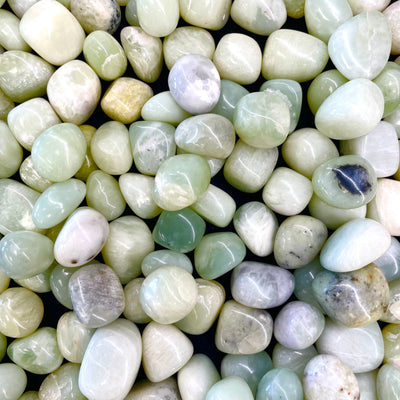
Aventurine carries its confidence quietly, the way a shimmer catches light without ever needing to shout. This softly sparkling green quartz has long been worked with for Confidence & Strength and Prosperity & Opportunity, steadying a wavering resolve while keeping the heart guarded enough to stay open. It is a stone for decisions made calmly, not from panic.
Key Traits
- Granular green quartz with a signature metallic sparkle, called aventurescence
- Also occurs in blue, peach, red, and other colors depending on its mineral inclusions
- Long associated with luck, opportunity, and steady self-assurance
- Traditionally worked with to protect and stabilize the heart chakra
- Durable, everyday stone well suited to frequent handling
Intentions
Brief Overview
Aventurine is a quartz variety prized for its gentle sparkle and its long-standing reputation as a stone of luck, opportunity, and quiet confidence. Formed with tiny reflective mineral inclusions, it has been carved and carried across cultures for centuries as a marker of good fortune and steady nerve.
Properties
Aventurine is traditionally worked with to settle a restless, unsettled state into something steadier, supporting decisive action without the edge of impatience. It is carried as a heart-protective stone, believed to filter out draining or negative influences while keeping the wearer receptive to new opportunity, and is often reached for before a decision that calls for calm nerve.
Metaphysical Properties
- Traditionally associated with leadership, decisiveness, and steady follow-through
- Long carried as a stone of good fortune and new opportunity
- Believed to calm flashes of anger or irritation into more even feeling
- Used in crystal-working tradition to protect the heart chakra's energy
- Associated with perceiving alternatives and possibilities others may miss
Physical Properties
- Type: Quartz (aventurine, chalcedony-family)
- Color: Most commonly green; also blue, peach, red, orange, and brown
- Luster: Vitreous with a glittering, metallic sheen (aventurescence)
- Structure: Granular, translucent to opaque massive quartz
Meaning & Energy
Aventurine's sparkle is easy to mistake for lightness, but its real character is steadiness. Traditionally worked with to reinforce decisiveness and a level head, it is treated less as a stone that hands you good fortune outright and more as one that clears the static so you can recognize the opportunity already in front of you. Its protective heart association gives that confidence a guarded, considered edge rather than a reckless one.
Emotions
When irritation flares up fast or your nerve wavers right when you need it most, Aventurine is traditionally reached for to bring you back to an even keel. It is a companion for the in-between moments — after a setback, before a decision — helping you meet what comes next with steadier feeling instead of a scattered one. Kept close, it supports staying open-hearted without leaving yourself unguarded.
Crystal Pairings
- Rose Quartz – softens Aventurine's confidence with gentle self-compassion and emotional warmth
- Citrine – reinforces Aventurine's opportunity-focused energy with bright, forward-moving optimism
- Jade – deepens Aventurine's association with fortune and steady, grounded prosperity
- Clear Quartz – amplifies Aventurine's clarity and sharpens focus during decision-making
Science & Origin
Aventurine forms as a granular variety of quartz in metamorphic and igneous rock, where silica-rich fluids crystallize around included flakes of fuchsite mica, hematite, or goethite. These reflective inclusions catch and scatter light, producing the glittering effect known as aventurescence that gives the stone its name.
- Also Known As: Aventurine Quartz
- Formation: Forms in metamorphic and igneous rock as quartz crystallizes around fine, flat inclusions of mica or iron oxide minerals, which produce its characteristic sparkle.
- First Discovery: Large Indian deposits, which have supplied most of the world's green aventurine for generations
- Safety Note: Aventurine is durable and generally safe to cleanse in water, though prolonged sun exposure can dull the color of some material over time.
Ancient Myths
- Aventurine takes its name from the Italian a ventura, "by chance," after 18th-century Venetian glassmakers accidentally created a sparkling copper-flecked glass and later named the mineral for its resemblance to it.
- In Chinese carving tradition, green aventurine has long been shaped into jewelry, seals, and ornamental figures as a stone of good fortune, sometimes called the Stone of Opportunity.
- Tibetan artisans historically used aventurine in place of the costlier jade for eye inlays and decorative work in religious statuary, prizing its rich green tone and gentle sparkle.
Chakras Table
| Chakra | Connection | Healing Focus | Energy Type |
|---|---|---|---|
| Heart | Primary seat of Aventurine's protective, steadying influence | Guarding emotional openness while staying receptive to others | Nurturing |
| Solar Plexus | Center of personal will and decisiveness | Supporting confident, level-headed action | Activating |
Planets Table
| Planet | Influence | Energy |
|---|---|---|
| Mercury | Sharpens perception and clear-headed thinking | Quick, communicative |
Zodiacs Table
| Zodiac | Attribute | Benefit |
|---|---|---|
| Aries | A natural drive toward bold, decisive action | Tempers impulsiveness with steadier follow-through |
| Leo | A warm, confident presence that draws opportunity | Supports generous leadership without losing composure |
Elements Table
| Element | Power | Aspect |
|---|---|---|
| Earth | Governs steadiness, fortune, and material growth | Anchors Aventurine's association with luck and stability |
| Water | Governs emotion and adaptability | Softens sharp feeling into calmer, more even responses |
Sacred Numbers Table
| Number | Vibration | Meaning |
|---|---|---|
| 3 | The number of creativity and forward motion | Reflects Aventurine's pairing of optimism with practical follow-through |
Color Variations
- Green — the most recognized form, colored by fuchsite mica inclusions
- Blue — a cooler-toned variety associated with clear thinking
- Peach to red — colored by hematite or goethite inclusions
- Occasional bi-color or multi-hued material combining several inclusion types
Mohs Scale Hardness
At 7 on the Mohs scale, Aventurine shares quartz's everyday durability, standing up well to regular handling, tumbling, and carving without special precautions beyond the usual care given to any polished stone.
Chemical Formula
Aventurine is a variety of quartz, with the base chemical formula SiO2, colored and given its sparkle by included mineral flakes rather than by trace elements within the quartz itself.
- Si — Silicon
- O2 — Oxygen (two atoms)
- Included flakes of fuchsite mica or iron oxide (hematite/goethite) produce color and sparkle
Summary of Composition
- Mineral Class: Silicate (quartz variety)
- Crystal System: Trigonal
- Transparency: Translucent to opaque
- Luster: Vitreous with a glittering, metallic sheen (aventurescence)
Care Instructions
- Clean with lukewarm water and a soft cloth as needed
- Safe for occasional sun exposure, though prolonged direct light may gradually dull vivid coloring
- Store away from harder gemstones to prevent surface scratching
- Recharge by resting on a bed of uncut quartz or in moonlight
Final Summary
Aventurine does its work in the background — a quiet sparkle steadying the nerve behind a decision, a guarded but open heart moving toward whatever comes next. It is a stone for people who want their confidence to feel earned rather than performed, and their luck to meet them halfway.