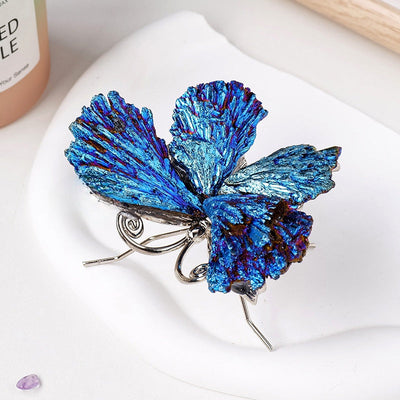
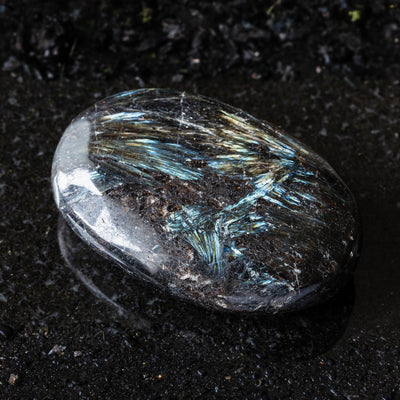
Arfvedsonite arrives looking like nothing at all: a flat black stone, unremarkable in the palm. Turn it toward the light and a band of electric blue runs across the surface like a signal, and the whole character of the piece changes. That is close to how the stone works with intuition and clarity, holding a thing dark and still until the angle is right and you finally see it. It is a stone for people who suspect they already know the answer and want the nerve to look straight at it.
Key Traits
- Deep black amphibole that throws a blue to blue violet flash only at certain angles
- Named in 1823 for the Swedish chemist who isolated lithium
- Long called a stone of truth and self knowledge by crystal workers
- Carries an iron heavy weight in the hand rather than a light or airy feel
- Uncommon in good polished quality, with most material from a handful of alkaline intrusions
Intentions
Brief Overview
Arfvedsonite is a sodium and iron rich amphibole that crystallises in alkaline igneous rock, most famously in the nepheline syenites and agpaitic pegmatites of southern Greenland, at Mont Saint-Hilaire in Quebec, and across the Kola Peninsula in Russia. For most of its recorded history it was a specimen mineral rather than a lapidary one. What changed that is the flash: cut and polished at the right angle, the black surface throws a band of electric blue produced by the mineral's strong pleochroism. Good material is uncommon, and it is routinely sold under the wrong name, usually as Nuummite or Astrophyllite.
Properties
Arfvedsonite works as a clarifier with weight behind it. It is used to sharpen focus, to settle a mind that has been spinning without arriving anywhere, and to make honest speech easier to reach. Its long standing association with shadow work comes from that combination: it does not soften what you see, it steadies the person doing the seeing. Worn or carried, it reads as a working stone rather than a comforting one, more useful during a decision than after it.
Metaphysical Properties
- Long associated with truth telling and with saying the difficult thing plainly
- Traditionally worked with for shadow work and honest self examination
- Used to sharpen focus in meditation without tipping the mind into overstimulation
- Held as a grounding counterweight for people who live mostly in their thoughts
- Carried for composure when a conversation is likely to be a hard one
Physical Properties
- Type: Sodic amphibole, an inosilicate of the amphibole group
- Color: Greenish black to blue black, with bluish grey and dark brown variants
- Luster: Vitreous, glassy across a fresh polish
- Structure: Monoclinic and prismatic, with lengthwise striations and two directions of cleavage
Meaning & Energy
Crystal workers call Arfvedsonite the stone of truth, and the name fits the way it behaves. Where softer stones cushion a difficult realisation, this one holds it in place and lights it from the side. It is associated with self knowledge, with clear seeing about your own patterns, and with the steadiness needed to act on what you find rather than filing it away for later. The iron in it gives that clarity a floor to stand on, so the insight lands in the body instead of staying in the head.
Emotions
Arfvedsonite is good company when your mind is running fast and you want it to slow without going numb. It is traditionally worked with to steady you through the moment between recognising something and admitting it, when the honest thing is also the uncomfortable one. If you tend to talk around a subject rather than through it, keep the stone where your hands can find it while you speak. It supports composure under everyday pressure and a kind of self honesty that feels less like criticism and more like finally getting a straight answer.
Crystal Pairings
- Labradorite – Holds your energy steady while something in your life is actively changing
- Blue Kyanite – Opens the throat so what you have understood can actually be said
- Black Tourmaline – Grounds you after long stretches of focused inner work
- Astrophyllite – Illuminates the patterns you keep repeating so you can name them
Science & Origin
Arfvedsonite belongs to a family of minerals that only forms where the magma chemistry is unusual, which is why the good localities are few and famous.
- Also Known As: Arfwedsonite, and Blue Flash Arfvedsonite in the trade. Frequently mislabelled as Nuummite or Astrophyllite, which are separate materials.
- Formation: Crystallises from sodium rich, silica poor magma in alkaline igneous settings, principally nepheline syenite intrusions, agpaitic pegmatites and peralkaline granites, alongside aegirine, nepheline, albite and quartz.
- First Discovery: Described in 1823 from Kangerluarsuk Fjord in the Ilimaussaq complex of southern Greenland and named for Johan August Arfwedson, the Swedish chemist who isolated lithium in 1817.
- Safety Note: Arfvedsonite is an amphibole. Polished, tumbled and set pieces are safe to handle and wear. Do not dry cut, grind, sand or drill raw material, and avoid creating or breathing its dust. Keep it out of ultrasonic and steam cleaners and away from household chemicals.
Ancient Myths
- No ancient tradition names this stone. Arfvedsonite was first described in 1823, and everything attached to it as lore has been built by collectors and crystal workers since the late twentieth century, which the trade is generally open about.
- Much of its reputation is borrowed from Nuummite, the Greenlandic stone it is most often confused with, which carries genuine northern standing as a stone of hidden power. Arfvedsonite is a different mineral from a different rock, and the two are worth keeping separate.
- The blue flash has earned it a modern association with the aurora that runs above the Greenland and Kola localities where much of the material is found. That is an appearance driven attribution rather than an inherited story, and it is best held loosely.
Chakras Table
| Chakra | Connection | Healing Focus | Energy Type |
|---|---|---|---|
| Root | Anchors the stone's iron heavy weight down into the body | Steadying scattered attention | Dense and settling |
| Throat | Opens the gap between knowing something and saying it | Honest, unhurried speech | Clear and direct |
| Third Eye | Sharpens inner sight without overstimulating it | Seeing your own patterns plainly | Cool and observant |
Planets Table
| Planet | Influence | Energy |
|---|---|---|
| Mercury | Governs thought, language and the movement between the two | Quick, precise and communicative |
| Saturn | Brings structure, patience and the willingness to face what is real | Slow, disciplined and unsentimental |
Zodiacs Table
| Zodiac | Attribute | Benefit |
|---|---|---|
| Gemini | Curiosity and quick thinking | Gives a restless mind somewhere solid to land |
| Scorpio | Depth and honesty about hidden things | Supports the inner excavation Scorpio is already drawn to |
Elements Table
| Element | Power | Aspect |
|---|---|---|
| Air | Thought, clarity and communication | The mental and spoken side of the stone |
| Earth | Weight, patience and material grounding | The steadying, body based side |
Sacred Numbers Table
| Number | Vibration | Meaning |
|---|---|---|
| 5 | Change, movement and the spoken word | Supports honest communication through a period of change |
| 9 | Completion and self knowledge | Marks the point where a pattern is seen clearly and set down |
Color Variations
- Blue black with a blue to blue violet flash, the form most often cut and polished
- Greenish black, common in specimen material and in massive pieces
- Bluish grey, usually seen where the stone is thinly sliced or lightly polished
- Reddish to dark brown, an oxidised surface tone that shows on weathered material
Mohs Scale Hardness
Arfvedsonite sits at 5.5 to 6 on the Mohs scale, harder than fluorite and calcite but softer than quartz. In practice that means ordinary dust, which is mostly fine quartz, will dull a polish over time, so the stone wants a soft cloth and its own place in a drawer. The bigger consideration is not hardness but structure: like every amphibole it carries two directions of prismatic cleavage, so a sharp knock can part it cleanly along a plane rather than chip it. Set pieces and beads wear well with normal care; raw prisms are best left on a shelf.
Chemical Formula
Arfvedsonite is written Na₃(Fe²⁺)₄Fe³⁺Si₈O₂₂(OH)₂, also given as NaNa₂Fe²⁺₄Fe³⁺Si₈O₂₂(OH)₂, with magnesium substituting freely for iron across the amphibole series. Specific gravity runs near 3.4, which is why a small piece feels heavier than it looks.
- Sodium (Na): three alkali sites, the sodium content that makes this a sodic amphibole rather than a calcic one
- Iron (Fe): both ferrous and ferric iron, responsible for the black body colour and the density in the hand
- Silicon (Si) and Oxygen (O): the Si₈O₂₂ double chain that gives every amphibole its prismatic habit and cleavage
- Hydroxyl (OH): structural water bound into the lattice, which is why heat treatment is never appropriate here
Summary of Composition
- Mineral Class: Silicate, inosilicate, amphibole group
- Crystal System: Monoclinic
- Transparency: Opaque, translucent only in thin slivers under strong light
- Luster: Vitreous
Care Instructions
- Wipe polished pieces with a soft dry cloth; a quick rinse in cool water is fine, but dry it fully since the stone is iron rich
- Keep it away from ultrasonic cleaners, steamers and household chemicals, which work into the prismatic cleavage
- Store it apart from harder stones such as quartz and topaz so the polish does not pick up scratches
- Clear it overnight on a bed of dry salt or in indirect moonlight rather than in long soaks
Final Summary
Arfvedsonite does not perform. It sits black and quiet until you turn it, and then it shows you the single line of blue it was holding the whole time. Keep it near while you work out what you already know, and it will keep handing that flash back until you stop looking away.