A free hand-picked bracelet is going in your box
$124.00
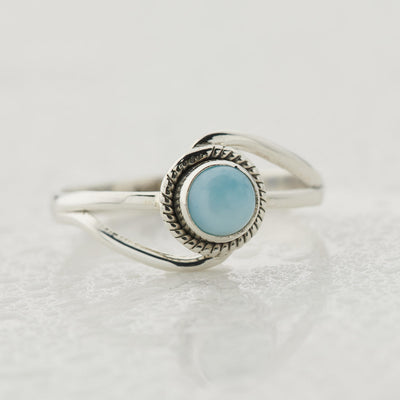
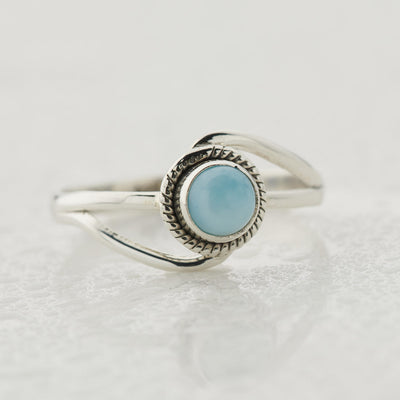
Larimar Sterling Silver Infinity Ring Size 6
$100.00
Couldn't load pickup availability
Larimar is the blue variety of the mineral pectolite, and it comes from a single mountainous area in the Dominican Republic. Its blues run from pale sky to deep sea, laced with white patterns that look like sunlight moving across the floor of a lagoon. Judy Hall describes it as a stone that radiates love and peace and promotes tranquility. It is most often worn as jewelry or held during quiet time, and it works best with long, steady contact.
Item: One (1) Larimar sterling silver infinity ring
Look: Round sky blue larimar with white marbling in a 925 sterling silver infinity band
Size: US ring size 6.
Note: Color and pattern vary from stone to stone. Photos show the typical look.
Soft and light-sensitive. Keep out of long direct sun and heat, which can fade the blue. Avoid salt water, long soaks, harsh chemicals and ultrasonic cleaners. Store apart from harder stones.
Larimar comes from one small mountainous area in Barahona province in the southwest Dominican Republic. A parish priest, Miguel Domingo Fuertes Loren, asked permission to mine a blue rock there in 1916, but nothing came of it. In 1974 Miguel Mendez and Peace Corps volunteer Norman Rilling found blue pebbles on a beach at the mouth of the Bahoruco River and followed them upstream to the source at Los Chupaderos, where it is still mined by hand.
Larimar is the blue variety of pectolite, a sodium calcium silicate hydroxide with the formula NaCa2Si3O8(OH). It crystallizes in the triclinic system as tightly packed, radiating fibers. Copper taking the place of some calcium gives the blue. It ranks 4.5 to 5 on the Mohs scale and its color can fade with long exposure to strong light and heat.
Larimar is traditionally used to cool strong emotions and bring calm during stress and change. It is long associated with easing guilt and fear, comforting a heart after relationship hurts, and encouraging clear, kind self-expression. Many people also use it to settle into meditation.
Yes, briefly. Rinse it in cool water or wipe it with a damp cloth, then dry it right away. Avoid salt water, long soaks and chemicals. Recharge it by moonlight rather than sunlight, since long sun and heat can fade the blue, and store it apart from harder stones.
Larimar comes from one small mountainous area in Barahona province in the Dominican Republic. Pectolite, its parent mineral, is found in many countries, but only there does it form in this blue. It was rediscovered in 1974 and named for Larissa and mar, the sea.
It can. Larimar is light-sensitive, and long exposure to strong sunlight and heat can slowly fade its blue. Keep it off sunny windowsills, take it off at the beach, and store it in a soft pouch so the color stays rich.