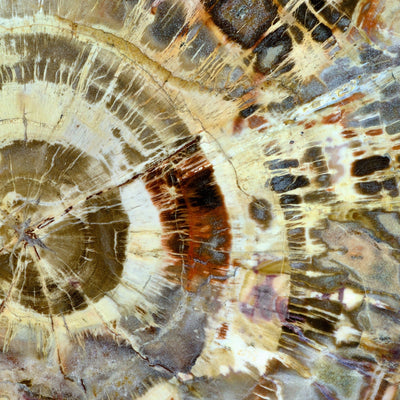
Some seasons leave you feeling exposed, as though every outside mood and opinion walks straight in. Pyritized Wood is what remains when an ancient branch sinks into airless mud and is rebuilt, cell by cell, in brassy iron pyrite. It offers Protection with roots: the bright shield of pyrite carried on the long patience of fossil wood, for Grounding & Stability that does not flinch. Keep it near when you need to hold your shape.
Key Traits
- A rooted shield against draining moods and environments
- Steadies you when plans and people keep shifting
- Strengthens self-worth without loudness
- Helps you move past inertia and begin
- A true fossil: wood replaced by pyrite, not silica
Intentions
Brief Overview
Pyritized Wood is fossil wood whose tissue has been replaced or filled by iron pyrite, the brassy mineral nicknamed fool's gold. It is not the familiar agate-like petrified wood, which is rebuilt in silica; here the grain of the tree is drawn in metal. Judy Hall has no entry for this fossil, so its meaning is read from its two parents: her account of pyrite as an energy shield and confidence stone, and the crystal tradition of fossil wood as a teacher of patience and deep roots.
Properties
Judy Hall calls pyrite an excellent energy shield, a very positive stone that overcomes inertia and feelings of inadequacy and energizes the space around a desk. Fossil wood is traditionally used for grounding, patience and a steady sense of belonging to something older than the present moment. Pyritized Wood holds both at once. It is kept by people who want protection that feels calm rather than armored, and confidence that comes from standing firmly instead of pushing hard.
Metaphysical Properties
- Traditionally kept as a shield against negative or draining energy
- Grounds scattered attention into the body and the task at hand
- Supports self-worth and the courage to take up space
- Associated with overcoming inertia and starting what you have delayed
- A reminder that slow change can leave you stronger than before
Physical Properties
- Type: Fossil wood replaced by iron sulfide (pyrite, often with marcasite)
- Color: Brassy gold to pale bronze, with dark brown and black areas
- Luster: Metallic on pyrite; dull where coalified wood remains
- Structure: Wood grain and growth rings preserved in fine-grained pyrite, surprisingly heavy in the hand
Meaning & Energy
Pyritized Wood is a study in becoming something else without losing your shape. The tree is gone; every line of it is still there, written in a harder, brighter material. Its energy is slow fire: the spark of pyrite banked inside the stillness of old wood. It suits anyone rebuilding after a long, quiet pressure, and anyone who wants their boundaries to be felt as solidity, not as sharpness.
Emotions
When you feel thin-skinned and easily knocked off course, Pyritized Wood gives you something heavy and certain to hold. It supports you in trusting your own worth, so other people's opinions land more lightly. If you have been stuck, waiting to feel ready, it encourages you to begin from where you already stand. And when change has been slow and tiring, it reminds you that you are not being worn away. You are being remade.
Crystal Pairings
- Pyrite – Brightens the shield and adds drive for work, money and bold plans
- Petrified Wood – Deepens the patience and ancestral steadiness of the fossil side
- Smoky Quartz – Draws heavy moods downward so the protection feels calm, not tense
- Hematite – Adds a second layer of iron-rich grounding for overextended days
Science & Origin
Pyritized Wood is a replacement fossil. Its metal is iron pyrite, FeS2, often with some marcasite, and many pieces still hold dark traces of the original wood turned to coal. Researchers studying Jurassic examples from Russia found that the pyrite crystals grew more strictly aligned inside the wood than in ordinary pyrite nodules nearby, as if the vanished tree were still directing them.
- Also Known As: Pyritised Wood, pyrite wood, pyrite-replaced wood. It is sometimes loosely sold as petrified wood, but true petrified wood is silica, and this is iron sulfide.
- Formation: Wood washed into ancient seas and estuaries sank into oxygen-poor mud. As it decayed without air, sulfide combined with dissolved iron and pyrite precipitated on the cell walls and inside the cells, replacing the tissue while keeping its form, sometimes down to cellular detail.
- First Discovery: No single discovery; pyrite has been known since prehistory and takes its name from the Greek pyrites lithos, the stone that strikes fire. Pyritized fossil wood is found wherever wood was buried in oxygen-poor marine mud.
- Safety Note: Keep Pyritized Wood dry. In humid air pyrite and marcasite can slowly oxidize, forming powdery iron sulfate crusts and acid that crack the specimen and mark the surface beneath it. Never soak it, never make an elixir with it, and wash your hands after handling a piece that has begun to powder.
Ancient Myths
- The fire stone: pyrite takes its name from the Greek pyrites lithos, the stone that strikes fire. Struck against flint it throws sparks, and Otzi the Iceman carried pyrite, flint and tinder fungus in his pouch.
- Pliny's brassy stone: the Roman writer Pliny the Elder described a brassy spark-striking stone that was almost certainly pyrite, one reason it has long been treated as a keeper of hidden fire.
- Bones of a giant: in Dine (Navajo) legend the stone logs of Arizona's Petrified Forest, a silica cousin of this fossil, are the bones of the giant Yeitso, slain by the hero twins Monster Slayer and Born for Water.
Chakras Table
| Chakra | Connection | Healing Focus | Energy Type |
|---|---|---|---|
| Root | Primary: the fossil wood side, rooting you in body and place | Safety, steadiness and a sense of belonging | Grounding |
| Solar Plexus | Secondary: the pyrite side, warming will and self-worth | Confidence, boundaries and follow-through | Empowering |
Planets Table
| Planet | Influence | Energy |
|---|---|---|
| Mars | Courage, drive and the will to defend your ground | Active, fiery |
| Saturn | Time, endurance and structure that lasts | Slow, steady |
Zodiacs Table
| Zodiac | Attribute | Benefit |
|---|---|---|
| Leo | Warm, proud and generous | Roots confidence in substance so it does not depend on applause |
Elements Table
| Element | Power | Aspect |
|---|---|---|
| Fire | The spark held in pyrite: will, courage and motivation | Confidence |
| Earth | The weight and patience of fossil wood | Grounding |
Sacred Numbers Table
| Number | Vibration | Meaning |
|---|---|---|
| 9 | Courage and completion, the number of Mars | Finishing what you start |
| 8 | Endurance and structure, the number of Saturn | Strength built slowly over time |
Color Variations
- Brassy gold: fresh, bright pyrite that follows the grain of the wood
- Pale silvery bronze: areas richer in marcasite, lighter and more delicate
- Dark brown to black: remnants of the original wood, turned to coal
- Deep bronze tarnish: older surfaces that have darkened with exposure to air
Mohs Scale Hardness
Pyrite measures 6 to 6.5 on the Mohs scale, hard enough to resist a steel blade. Pyritized Wood is less tough than that number suggests: it is brittle, and areas of marcasite or coalified wood can be crumbly. Treat it as a display fossil for a shelf, desk or altar, not a pocket stone.
Chemical Formula
FeS2: iron disulfide (pyrite, often with its polymorph marcasite).
- Fe (Iron): one atom, the source of its weight and brassy color
- S (Sulfur): two atoms, bonded as a pair
- C (Carbon): not part of the formula, but often present as traces of the original wood
Summary of Composition
- Mineral Class: Sulfides (pyrite, often with marcasite), replacing fossil wood
- Crystal System: Isometric (cubic) for pyrite; orthorhombic for marcasite
- Transparency: Opaque
- Luster: Metallic
Care Instructions
- Keep it dry: no water, salt water or elixirs, and no bathrooms, kitchens or damp windowsills
- Cleanse with smoke, sound or moonlight, and dust with a soft dry brush
- Store it in a closed box with a silica gel packet if your home is humid
- Check it now and then: a white or yellow powder or a sulfur smell means it needs drier storage, away from other specimens
Final Summary
Pyritized Wood is a tree that became metal and kept every line of itself. Keep it where you work or where you gather your courage, and let it remind you that pressure and time can leave you brighter, heavier and harder to move.