Key Traits
- Anchors scattered energy into a steady, grounded state
- Forms a quiet protective boundary around personal space
- Supports patient focus through slow, demanding work
- Clears mental fog so intuition can surface
- Connects a grounded body to a clear, aware mind
Intentions
Brief Overview
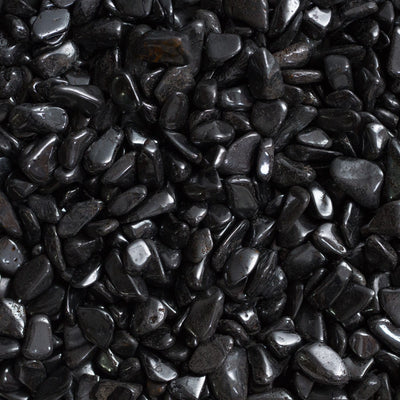
Manganese is the trade name for natural botryoidal manganese oxide stones, typically psilomelane or romanechite, prized for their dense, dark, grape-like clusters. It is not manganese metal or industrial ore; the stones sold under this name are tumbled or polished mineral specimens carried specifically for their grounding, protective character.
Properties
As a stone, Manganese works from the ground up. It settles restless energy, holds a steady line around your personal space, and gives the mind enough quiet to notice what it actually needs. It is not a stone that rushes; it rewards patience, which makes it well suited to long projects, group work, and any stretch of life that calls for staying power over quick fixes.
Metaphysical Properties
- Grounds the body during periods of mental or physical strain
- Forms a protective boundary around personal energy
- Encourages patience and steady, long-term focus
- Supports quiet intuitive awareness once the mind settles
- Helps you stay present instead of scattered under pressure
Physical Properties
- Type: Manganese oxide mineral (psilomelane group)
- Color: Black to silvery-black, occasionally brown
- Luster: Submetallic to dull
- Structure: Botryoidal, cryptocrystalline mass
Meaning & Energy
Manganese carries the weight of something formed slowly and left alone to grow. Its meaning is patience made physical: layer after layer of mineral settling into a dense, protective mass. Held or worn, it asks you to stop reaching for a faster outcome and trust the pace the work actually needs.
Emotions
When your attention is pulled in six directions at once, Manganese gives you somewhere to put it back down. It steadies a racing mind without dulling it, and its grounded weight can make an overstimulated day feel more manageable. You may find it easier to finish long tasks, harder to be rattled by minor setbacks, and more comfortable holding your own space in a crowded room.
Crystal Pairings
- Hematite – reinforces the same grounded, protective floor Manganese builds
- Black Tourmaline – adds a sharper edge of protection for especially draining environments
- Smoky Quartz – clears mental fog while Manganese holds the body steady
- Magnetite – shares Manganese's ancient naming history and doubles down on grounded focus
Science & Origin
Manganese oxide minerals form where manganese-rich groundwater moves through rock over long periods, depositing oxide layers into rounded, botryoidal masses instead of single defined crystals. The trade name covers a family of closely related, often intergrown manganese oxides rather than one single mineral species.
- Also Known As: Psilomelane, Romanechite
- Formation: Forms in botryoidal, grape-like masses as manganese-rich groundwater deposits successive oxide layers, most often in weathered zones above manganese ore bodies.
- First Discovery: Manganese oxide pigments were used in art as early as 17,000 years ago; the element manganese itself was isolated in 1774 by Swedish chemist Johan Gottlieb Gahn.
- Safety Note: Manganese trade stones are natural and untreated. Because the mineral is porous in places, avoid extended water soaking and keep it away from harsh chemicals to preserve its natural sheen.
Ancient Myths
- Ancient Greeks near the region of Magnesia are said to have found two dark stones in the same ground -- one that pulled iron toward it and one that did not. The first became known as magnetite; the second, non-magnetic ore, gave its name to manganese, a naming confusion the two minerals have shared ever since.
- Manganese oxide pigments colored some of the oldest paintings ever found, including the black outlines in the Lascaux cave paintings roughly seventeen thousand years ago, making it one of humanity's earliest art materials.
- Roman and Egyptian glassmakers relied on manganese oxide as a so-called 'glassmaker's soap,' adding small amounts to molten glass to cancel out unwanted green tints -- a practical bit of ancient chemistry still referenced by glassworkers today.
Chakras Table
| Chakra | Connection | Healing Focus | Energy Type |
|---|---|---|---|
| Root | Primary | Steadies the body and settles restless energy into the ground | Grounding |
| Crown | Secondary | Opens quiet awareness above while the Root holds the body steady | Focusing |
Planets Table
| Planet | Influence | Energy |
|---|---|---|
| Pluto | Deep transformation and quiet endurance | Intense, grounding |
| Saturn | Discipline and long-term structure | Steady, patient |
Zodiacs Table
| Zodiac | Attribute | Benefit |
|---|---|---|
| Scorpio | Depth, resilience, and quiet intensity | Supports steady focus through long transformative periods |
Elements Table
| Element | Power | Aspect |
|---|---|---|
| Earth | Density, structure, and quiet endurance | Keeps the body anchored during long or demanding work |
Sacred Numbers Table
| Number | Vibration | Meaning |
|---|---|---|
| 7 | Reflection and inner focus | Encourages patient, deliberate progress rather than rushed results |
Color Variations
- Deep black with a soft silvery sheen across botryoidal surfaces
- Brownish-black banding within a single cluster
- Silvery-grey highlights where light catches the rounded growth surfaces
- Matte charcoal tone on less polished specimens
Mohs Scale Hardness
Manganese trade stones sit at roughly 5 to 5.5 on the Mohs scale, a moderate hardness that takes a gentle polish well but will scratch more easily than quartz-family stones. Keep it away from harder crystals in storage and handle it as you would any mid-hardness mineral specimen.
Chemical Formula
Manganese trade stones are complex manganese oxides, generally in the psilomelane group, with a representative formula close to Ba(Mn2+)(Mn4+)8O16(OH)4.
- Ba -- barium, occupying open channels within the oxide structure
- Mn -- manganese in mixed oxidation states, the dominant structural element
- O -- oxygen, forming the oxide framework
- OH -- hydroxyl groups completing the structure
Summary of Composition
- Mineral Class: Oxide mineral (psilomelane group)
- Crystal System: Amorphous to cryptocrystalline (no single defined crystal system)
- Transparency: Opaque
- Luster: Submetallic to dull
Care Instructions
- Wipe clean with a soft, dry cloth rather than soaking in water
- Store away from harder crystals like quartz to prevent surface scratches
- Keep away from harsh chemicals and prolonged direct sunlight
- Recharge intention with a smoke cleanse or an evening spent near the earth rather than a water rinse
Final Summary
Manganese is not a stone that performs quickly, and that is the point. It is dense, dark, and built in slow layers, offering the same unhurried steadiness to anyone willing to work at its pace. Keep it close when the task ahead needs patience more than speed.